

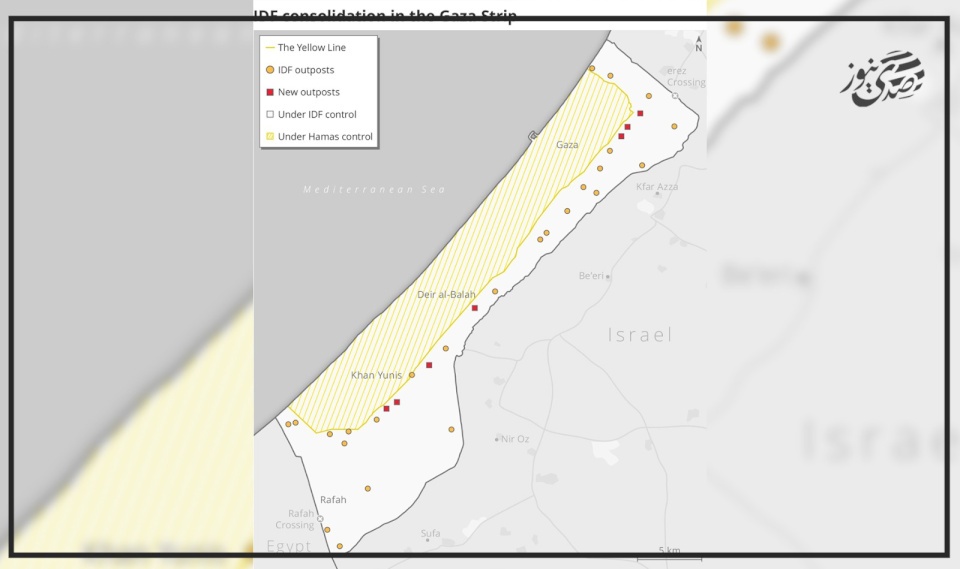
32 Military Points and 10 Miles of Earthen Barriers: The Israeli Army Establishes a New Border Line Inside Gaza.. Here's What It Looks Like
Translation by SadaNews - Five months ago, the "Yellow Line" was presented as a step towards the withdrawal of the Israeli army from Gaza. Since then, the Israeli army has established a series of military sites along its length and has killed more than 200 Gazans in its vicinity.
The demarcation line between the Israeli army and Hamas in the Gaza Strip – known as the "Yellow Line" – is gradually turning into a solid physical border. In recent months, the Israeli army has set up new military sites along the line, according to a report published by the Israeli newspaper Haaretz, and has carried out infrastructure works, transferring equipment and installations, according to analysis of recent satellite images.
Meanwhile, the army is executing a large-scale engineering project to create an earthen barrier extending for dozens of kilometers along the line. The demarcation line leaves more than half of the area of the strip under the control of the Israeli army, and there is currently no detailed mechanism for organizing withdrawal from it.
The army's entrenchment along the line has had a deadly impact on the residents of Gaza. The area surrounding it is considered an active firing zone, witnessing air raids, artillery bombardment, and continuous gunfire. According to the United Nations, more than 200 Palestinians, many of them civilians, have been killed in its vicinity.
The behavior of the Israeli army reflects the statement of its Chief of Staff Eyal Zamir, who said during a visit to the strip three months ago that "the Yellow Line in Gaza is the new border line, a front defensive line [for the border communities with Gaza] and a line of attack for the army," according to what SadaNews translated. Since the ceasefire announcement in October 2025, the army has built seven new military points along the line, as shown by satellite images. At five military sites inside Gaza, the ground has been paved with asphalt, allowing for long-term operational activity.
According to the map of the Yellow Line published by the army after the ceasefire, Israel controls 54% of the strip, while the rest is under Hamas control. Since then, the army has reduced the area under Palestinian control by several additional percentage points by placing yellow concrete blocks outside the official line, demolishing buildings, and displacing residents.
Approximately 2.1 million Palestinians now live in less than half of the area they resided in before the war, under harsh conditions amidst rubble they cannot clear away. Hundreds of thousands are living in tents or in buildings damaged by shelling.
The "Yellow Line" was supposed to be a temporary measure, but over five months have passed since US President Donald Trump announced his plan to end the war and establish phases for the gradual withdrawal of the army. On the ground, the army continues to reinforce its control over the area.
Trump's 20-point plan indicates the army's withdrawal in general without specifying clear phases: "The lines of combat will remain frozen until the conditions for complete gradual withdrawal are met." It also stipulated that any future withdrawal would be linked to the disarmament of Hamas according to specific standards and timelines.
The army has positioned its military points in strategic locations inside the strip. One is located on Mount Al-Montar, providing a wide field of view. Additionally, two elevated points have been established in the Jabalia area, visible from long distances, while a third site is under construction in Beit Hanoun. Several military points have been established around multi-story buildings that survived the war, such as the Qatar-funded hospital in Rafah.
Many of these points are situated amidst the ruins of former agricultural and residential areas. Two were built on sites that housed mosques before the war, while another point was established over a cemetery destroyed during the fighting. Demolition work is also underway in the Shuja’iya area where a cemetery used to be.
Palestinians in Hamas-controlled areas are documenting these sites and posting videos on social media and networks like Al Jazeera. Open-source intelligence researcher Chris Osieka has matched these observations with the locations of some military points accurately.
Manifestations of the entrenchment of the demarcation line also include the earthen barriers that have been established north, east, and south of the areas under Hamas control along the Yellow Line. Their total length exceeds 17 kilometers (10.5 miles), about 40% of the total length of the line (45 kilometers). Work is still ongoing on them in recent weeks.
Satellite images documenting the army's positioning over the past months have been taken by Planet Labs and cross-referenced with the demarcation line map published by the army for the residents of Gaza. After about two and a half years from the events of October 7, the army still does not allow journalists to enter Gaza freely to document the situations on the ground.
In recent months, the UN Human Rights Office has documented the killing of at least 224 Palestinians near or east of the Yellow Line until late February. According to the office, many of them appear to be civilians not participating in combat, including dozens of women and children. The office noted a "continuous pattern of attacks targeting Palestinians seemingly only due to their proximity to the lines of deployment of Israeli forces in Gaza."
According to the office, this may constitute a war crime. It pointed out that some of the dead were shot while trying to return to their homes, and that civilians are at risk of unintentionally crossing the Yellow Line and entering firing zones, due to its lack of clarity on the ground and its frequent changes.
In recent months, the army has issued dozens of nearly identical statements, in which it stated – without details – that its forces "spotted an armed person crossing the Yellow Line and approaching the forces posing an immediate threat, and dealt with him." Only in a few cases was it clarified that the dead belonged to Hamas or Islamic Jihad.
Doctors Without Borders has also linked the Yellow Line to multiple shooting incidents and casualties. Will Edmond, head of the organization's mission in Gaza stated: "In recent months we have treated many patients who were shot or injured by explosions near the Yellow Line while carrying out their daily activities. People do not know its exact location and get injured just for being in the area or while heading home or to fetch water or gather firewood."
He added: "Another problem is that the line is gradually moving west, which leads to swallowing up basic services such as water points and health facilities within its range, thereby reducing access to essential services."
Reports of shootings of civilians near the Yellow Line began immediately following the ceasefire announcement and continue to recur in the media. Since then, about 690 Palestinians have been killed across the strip and more than 1800 injured, according to the Gaza Ministry of Health, while five Israeli soldiers were killed during the same period.
In recent months, Trump has sought to push his plan that includes establishing an international force to ensure stability to take over internal security in Gaza, but this force has yet to materialize. Indonesia, which was expected to contribute troops, recently announced a freeze on its participation due to the war with Iran.
The war with Iran has also diverted attention from efforts to implement the plan. Haaretz reported last week that the US and intermediary countries have presented Hamas with a proposal for a gradual disarmament process that may take months, according to what SadaNews translated. In turn, Hamas has exploited the time to strengthen its control, while the army continues to entrench its presence inside the strip.
The Israeli army spokesperson responded to the report by stating that "the army's forces are deployed in the Yellow Line area in accordance with the ceasefire agreement and directives from the political leadership and operational assessment. The defensive concept in the area includes, among other elements, a security area, a physical barrier, intelligence capabilities, technological means, and operational activity."
He added: "These measures aim to enhance defense in the area and prevent infiltration and hostile activities and to protect the forces and nearby communities."
He continued: "The area adjacent to the Yellow Line is a sensitive and dangerous operational environment, and warning signs have been placed to deter approaching it. The army does not target civilians nor acts against them solely for being near the line. The army has clear procedures and rules of engagement that include warning and graduated use of force, acting only against hostile elements and immediate threats, in accordance with international law, while taking practical steps to minimize harm to civilians as much as possible."
 Follow the latest Sada News via Google News
High-level sources reveal to SadaNews: Washington seeks to hold a Gaza Reconstruction Conf...

Iraqji Reveals Details of the Attack on the Iranian Supreme Leader's Headquarters

صراع على إرث خامنئي وسط غياب مجتبى.. والمتشددون يتهمون قادة إيران بـ«الانقلاب»

The European Union Reiterates Its Call for Israel to Refrain from Expanding Settlements in...

"Mamdani Berlin".. The German Left Bets on a Politician of Turkish Descent to Lead the Cap...

Hebrew Channel: Kushner Pushing to Enhance Communication Between the United States and the...

SadaNews Report: Israeli Elections with a Settlement Flavor!
