

From Politics to the Field.. What are the Limits of Russian-Chinese Support for Iran?
SadaNews - Since the beginning of the U.S.-Israeli war on Iran, many reports have discussed the role of Tehran's allies and friends in the challenges faced by the Islamic Republic. Speculation has particularly focused on China and Russia, given their shared economic, military, and political interests with Iran.
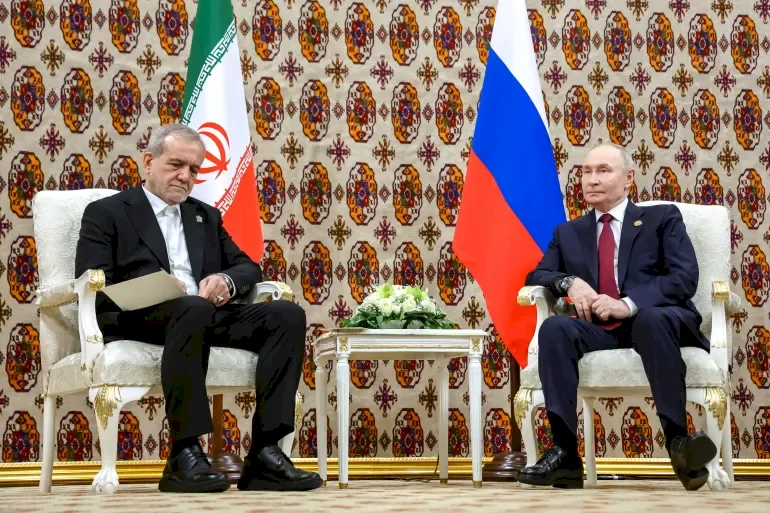
As the U.S.-Israeli war on Iran enters its third week, Tehran has acknowledged a good level of cooperation with Russia and China politically, economically, and even militarily. Iranian Foreign Minister Abbas Araghchi stated two days ago in an interview with the U.S. "MSNOW" network that Russia and China are providing assistance to his country in various ways, including "military cooperation." Araghchi described Russia and China as strategic partners to Tehran in its war with the U.S. and Israel.
In response to those statements, Politico reported that Iran and Russia have strengthened their ties over the past decade, with Tehran supplying Moscow with "Shahed" drones for use in the war in Ukraine, reaching the point of establishing factories to produce those drones inside Russia.
The Iranian official did not disclose the nature of the military assistance that his country is currently receiving from China and Russia, while the Washington Post and CNN reported days ago that Russia may have assisted Iran with advanced targeting data and drone tactics, suggesting that this limited assistance is unlikely to make a meaningful difference.
Trump's Speculation
In this context, former U.S. President Donald Trump speculated in recent newspaper statements that Russian President Vladimir Putin might be providing Iran "slight assistance," suggesting that it may be a response to U.S. support for Ukraine in its war against Russia.
Responding to a question from the Financial Times about whether Russia is supplying Iran with satellite data to target U.S. and Israeli missile defenses, Trump said, "I don't know if that's the case or not. But one could argue that we have also helped Ukraine to some extent. It's hard to say: 'You’re targeting us while we were helping Ukraine.'"
The Role of Russia
Regarding Russia's role in the current war, the American magazine Foreign Affairs stated in an article yesterday that Russia has largely remained passive since the beginning of the U.S.-Israeli attack on Iran, marking the second attack in eight months.
In the article titled "Why is Russia Watching Iran Burn?" the magazine stated that the Kremlin is not in a hurry to save its closest partner in the Middle East.
The magazine recalled the "Comprehensive Strategic Partnership Treaty" signed by the two nations last year, which obligates them to oppose the intervention of third parties in their internal and external affairs.
Regarding the effectiveness of that treaty in the face of Iran's current challenges, Foreign Affairs suggested that Moscow may be adhering to the treaty's strict terms, which do not include a mutual defense clause, and thus has not provided any substantial assistance to support Iran, which has been an important partner in Putin's war against Ukraine.
The magazine believes that what it calls the Kremlin's failure in Iran aligns with a familiar trend in Moscow, whereby whenever their friends find themselves in a predicament, they limit themselves to condemnation and do not do anything significant on the ground, similar to what happened in Syria (the fall of the Assad regime), Armenia's war with Azerbaijan, and the U.S. holding Venezuelan President Nicolás Maduro.
Conversely, the magazine noted that this war serves Russia's interests, as with the continued confrontation, energy prices will continue to rise, helping Moscow generate additional revenues and address its budget deficit resulting from its war in Ukraine.
Hard to Trace Aids
The magazine commented that while Russia may be unable to protect its partners, it remains adept at adapting to strategic failures and gaining significant tactical advantages from such failures.
Nonetheless, the magazine does not rule out that Russia may be providing hard-to-detect assistance, allowing Tehran to develop intelligence and reconnaissance capabilities that could enhance the precision of Iran's targeting in response to U.S. and Israeli strikes.
According to the magazine, some U.S. officials concluded that Moscow is secretly engaging in those activities, which have diminished compared to the American intelligence assistance program to the Ukrainian army, which has continued for years and has enabled it to kill thousands of Russian soldiers since the outbreak of war in 2022.
Economic War
As for the ties between Tehran and Beijing, they are predominantly economic. The two parties signed a 25-year economic cooperation agreement in 2021, centered on selling Iran's rich oil reserves to meet China's energy needs.
With the onset of the war on Iran, many reports indicated that one of its strategic objectives is Washington's aim to undermine China's position by disrupting its access to cheap Iranian oil, given that Beijing was the largest importer of Iranian oil under the international sanctions imposed on Tehran.
A few months earlier, the United States had seized control of the oil resources in Venezuela, which was itself a major energy source for China, which now finds itself in greater need of Russian oil and gas.
The American magazine Atlantic commented on this strategic shift by stating that the current war on Iran has achieved at least one success, represented by undermining the position of America's main competitor, China, which has proven to be an unreliable ally for Iran in the current crisis.
 Follow the latest Sada News via Google News
Earthquake of 5.5 Magnitude Hits Western Iran

To Enhance His Support for "Increasing Children"... Vance Announces the Birth of His Fourt...

Death of a Mosque Imam in Armed Attack in Southeastern Iran

Rubio Reveals Circumstances Surrounding the Death of an American Soldier in Iraq

Reliable Threat.. US Embassy in Jordan: Evacuation of International Airport and Port in Aq...

Italy Raises Alert Level to 'Red' with Deadly Heat Wave

Kuwaiti Army Intercepts Iranian Missile and Drone Attacks
