

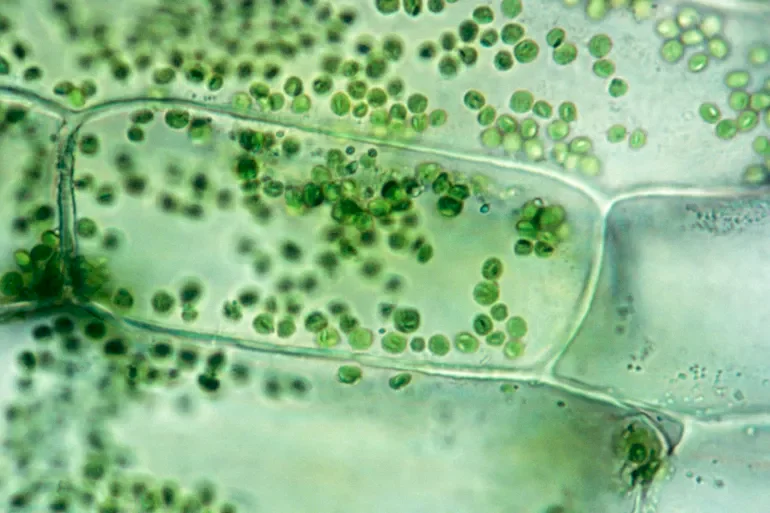
Scientists Discover a Version of "Tug of War" Inside Cells
SadaNews - Inside every plant cell, a complex daily life unfolds that we do not see, as if we are in a meticulously designed miniature city. There are chloroplasts that capture light and produce food through photosynthesis, and there are mitochondria that generate energy through cellular respiration. Scientists have traditionally viewed these two processes as adjacent within the cell.
However, a new study published in the journal "Plant Physiology" suggests that the relationship between them is deeper than we believed. Mitochondria not only consume oxygen but may also compete for it with chloroplasts within the same cell.
This was revealed by researchers from the University of Helsinki, who found that mitochondria in plant cells can, when their respiratory activity increases, draw oxygen from the internal environment surrounding the chloroplasts, reducing the amount of available oxygen there.
In simple terms, according to the study researchers, there is a kind of hidden "tug of war" over oxygen between two essential organelles within the plant cell.
The Important Role of Oxygen
To understand the significance of this, it is important to remember that oxygen in plants is not merely a secondary gas. It is involved in numerous processes related to growth, metabolism, injury response, and adaptation to environmental stress.
Chloroplasts release oxygen as a byproduct of photosynthesis, while mitochondria use it to generate energy. However, what was previously unclear is how this oxygen moves between the two parties within the cell, and whether one organelle can directly affect the other through this exchange.
To reach an answer, researchers studied the Arabidopsis plant, a small, commonly used plant in biological research. They used genetically modified versions that had mitochondrial defects leading to the activation of alternative respiratory pathways, causing those mitochondria to consume oxygen at a higher than usual rate.
Then, a striking result emerged: the more the mitochondria consumed oxygen, the lower the levels of oxygen within the plant tissues, leading to noticeable changes in chloroplast behavior.
One of the significant signs observed by the team was that chloroplasts became more resistant to a chemical called methyl viologen, which exploits oxygen to form highly reactive molecules known as reactive oxygen species.
When scientists exposed the plants to nitrogen gas to create low-oxygen conditions, the electron transfer to oxygen sharply decreased, giving researchers a strong indication that the issue was not with the chemical itself, but rather that the oxygen available to the chloroplasts had decreased because the mitochondria were consuming it more greedily.
Internal Communication
Here lies the study's findings: it does not merely state that respiration and photosynthesis are interconnected but indicates that there is direct internal communication between them through oxygen, meaning that mitochondria can change what occurs within chloroplasts not only through chemical signals or energy but also by drawing a vital resource from their internal environment.
The researchers say this is the first time evidence has appeared showing that mitochondria influence chloroplasts through the exchange of oxygen within the cell.
What does this mean for the plant in real life? The most important implication is that the plant may be more flexible and complex in dealing with environmental stresses than we previously understood.
If a plant is exposed to conditions such as waterlogging, lack of aeration, or sharp changes between night and day, redistributing oxygen within the cell may become part of its adaptation mechanism, meaning that the plant does not only respond to the outside environment but also reorganizes its internal resources meticulously among its microscopic parts.
Additionally, this result may help in the future to develop better tools for monitoring the physiological state of plants and possibly for the early detection of stress in crops. If scientists can understand how oxygen distribution within the cell changes under stress, they may be able to design more accurate methods to track plant health and improve agricultural breeding programs, especially in a world increasingly affected by climate variability.
Source: Websites
 Follow the latest Sada News via Google News
After Deschamps' Departure... Zinedine Zidane Tops the Candidates to Lead France

Mbappe Surpasses Messi and Becomes the All-Time Top Scorer in the World Cup

England Defeats France and Achieves Largest World Cup Achievement Since 1966

Messi Refused to Play for Spain and Missed 3 World Cups

Publishers Sue Google for Allegedly Using Books to Train Artificial Intelligence

Google Expands Capabilities of Google Search Console to Support Social Media Accounts

The Mediterranean Table... An Ancient Diet Revealing Its New Secrets for Health and Longev...
