

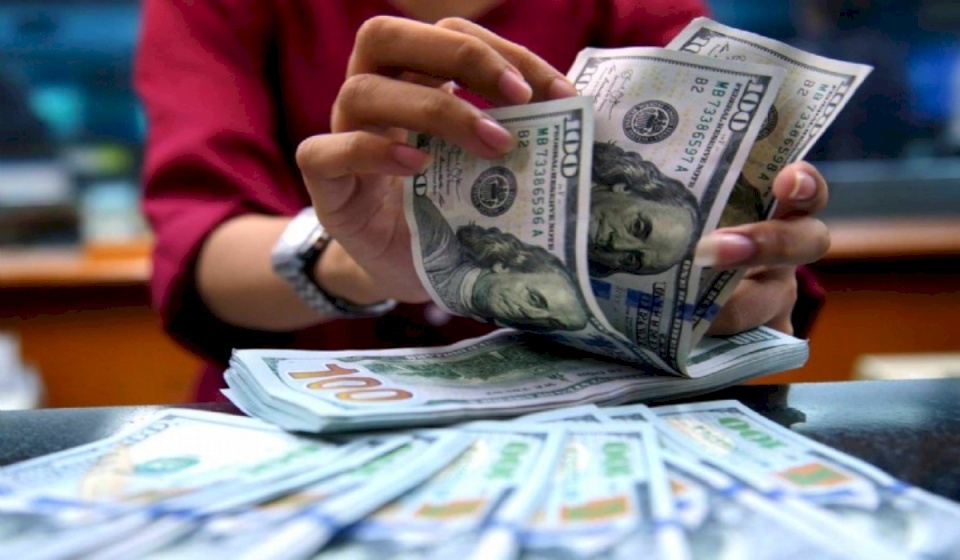
Dollar Prepares for Largest Weekly Gain in Over a Year
SadaNews Economy - The US dollar remained generally stable in Asian trading on Friday and was poised to achieve its largest weekly gains in over a year, driven by escalating conflict in the Middle East and increased demand for safe-haven assets.
The euro and yen continued to face ongoing pressure as oil prices rose due to the crisis, exacerbating inflation risks in energy-dependent economies and upending monetary policy expectations for the Federal Reserve and other central banks, according to "Reuters".
Previous hopes for de-escalation have evaporated, replaced by a state of uncertainty, following warnings from Iran that Washington will regret sinking an Iranian warship and comments from US President Donald Trump expressing his desire to participate in choosing the next Iranian president, following US and Israeli airstrikes that resulted in the death of Iranian Supreme Leader Ali Khamenei.
Tony Sycamore, a market analyst at "IG", wrote in a note: "If the conflict in the Middle East continues at its current pace, it is likely to lead to persistent inflation, a stronger US dollar, and significant reduction in the prospects of interest rate cuts by the Federal Reserve."
The dollar index, which measures the value of the US currency against a basket of currencies, slightly declined to 99.03, but it is still on track to achieve a weekly gain of 1.4%, the highest since November 2024. The euro steadied at $1.161 and is headed for a 1.7% decline this week, while the yen fell by 0.2% to 157.83 yen per dollar, and the British pound experienced a slight increase of 0.02% to $1.3358.
Tensions escalated on Thursday, as US and Israeli aircraft bombed areas in Iran, while Gulf cities faced renewed bombardments. In an interview with "Reuters", Trump described Ali Khamenei's son, Mojtaba Khamenei, the frontrunner to succeed his father, as an unlikely choice.
The US dollar was among the few gaining currencies during volatile trading sessions that led to declines in stocks, bonds, and even precious metals.
Nathan Suami, head of foreign exchange trading in Japan and North Asia and Australia at Citi in Singapore, said: "Overall, most of our clients are noting reduced risk in both G10 and emerging market currencies." He added that disturbances in the markets prompted traders and custodians to buy dollars in many local markets, while central bank support temporarily curbed Asian forex markets, but pressures from currency depreciation will increase as the conflict continues.
Bank of Japan Deputy Governor Ryozo Himino mentioned in parliament that the weak yen raises import costs, which may affect core inflation. If the conflict and the closure of the Strait of Hormuz continue for almost a month, its impact on growth in developing countries in Asia would be limited, according to Albert Park, chief economist at the Asian Development Bank.
The war has intensified fears of rising energy prices and the return of inflation, as overnight index swaps showed shifts in interest rate expectations at major central banks.
According to estimates from the London Stock Exchange Group, traders have pushed the next easing date for the Federal Reserve to September or October, while expectations for interest rate cuts from the Bank of England have decreased, while market bets on the European Central Bank raising interest rates this year have increased.
Sky Masters, head of market research at the "National Australia Bank", stated: "Concerns about inflation after the outbreak of the Russian-Ukrainian war and subsequent supply shocks are still very much present. We are witnessing significant repricing in overnight index swap curves and bond markets."
As the war continues, currency traders have overlooked economic data, as numbers released on Thursday showed that US unemployment claims did not change last week, while layoffs sharply declined in February, consistent with a stable labor market. Market attention is now focused on the February employment report, expected to be released today, with an anticipated increase of 59,000 non-farm jobs, while the unemployment rate is expected to remain at 4.3%.
The Australian dollar rose by 0.36% to $0.7031, while the New Zealand dollar increased by 0.17% to $0.5904.
In the cryptocurrency market, the price of Bitcoin fell by 0.93% to $70,482.16, while Ethereum dropped by 0.57% to $2,068.58.
 Follow the latest Sada News via Google News
Trump Imposes Tariffs on Canadian Imports... Ottawa Vows to Respond

Oil Prices Drop After Reports of Mediation Efforts Between the U.S. and Iran

Gold Price Rises Supported by Increased Buying Amid Lower Prices

Due to "Hazardous and Counterfeit Products".. Europe Fines "AliExpress" $627 Million

Gasoline Prices Exceed $4 Again in America Amid Resumed War

What was the financial reward for Spain after winning the World Cup?

Gold Stabilizes Amid US Interest Rate Outlook
