

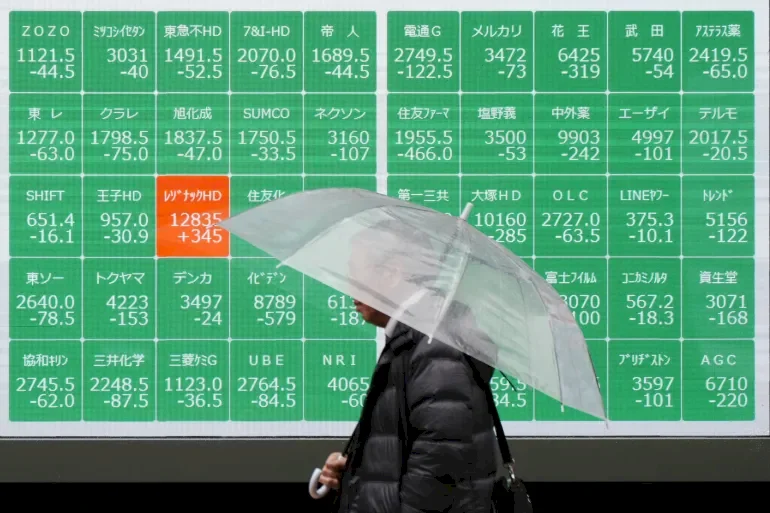
Severe Losses for Asian Stocks Amid Surge in Oil and Gas Prices
SadaNews - The repercussions of the expansion of the US-Israeli war on Iran have extended to the energy and financial markets, where oil and gas prices have risen, while Asian stocks faced severe losses led by South Korea and Japan.
LNG Prices Surge in Asia and Europe
LNG prices in Asia have surged to their highest level since 2023 following the suspension of gas supplies from the Gulf due to the disruption of shipping through the Strait of Hormuz. Traders reported that spot prices in the Asian market reached $25.40 per million British thermal units, which is over 100% higher compared to last week’s levels, suggesting continued upward pressure as long as Qatar's energy exports remain suspended and the vital trade route through Hormuz is disrupted.
Qatar produces about one-fifth of the world's LNG supplies, with a significant share going to buyers in Asia, including China, India, South Korea, and Taiwan. These countries are currently rushing to seek alternatives amidst fears of prolonged supply disruptions.
Bloomberg quoted IHS LNG analyst Ivan Tan stating that the immediate impact is "competition for shipments between Europe and Asia," as shipments are often diverted to higher-paying markets, with traders monitoring price differentials to determine the most profitable destination.
In Europe, gas prices have jumped to their highest level since 2023, having risen 70% since Friday, amidst uncertainties regarding the duration of Qatar's export suspension. The developments raise concerns about the European Union's ability to bolster its stocks for the upcoming winter while attempting to reduce its dependence on Russian gas imports.
According to Tan, China and India will be the most affected by the halt in Qatari supplies due to their level of exposure and may turn to alternatives like coal instead of purchasing high-cost spot shipments.
In the longer term, the consequences may prompt companies to "rethink their portfolio diversification strategies," he said.
Oil Prices Rise
Oil prices rose by 3% today, Wednesday, as the US-Israeli war on Iran disrupts Middle Eastern supplies; however, the pace of gains slowed compared to the previous two sessions after US President Donald Trump stated that the US Navy might begin accompanying ships through the Strait of Hormuz.
In the latest transactions, Brent crude rose by 3.33% to $84.08 while US crude increased by 3.31% to $77.03 per barrel, after reaching its highest level since January 2025 at Tuesday's settlement.
Both crude benchmarks rose by about 5% or more in the previous two sessions.
Expectations indicate that oil prices are likely to remain high in the near term as traders assess the risks of supply disruptions through the Strait of Hormuz.
JP Morgan predicted that crude oil supplies from Iraq and Kuwait could cease within days if the Strait of Hormuz remains closed, estimating a supply loss of up to 4.7 million barrels per day.
The Australia and New Zealand Banking Group raised its forecast for the average price of Brent crude to $90 per barrel and its forecast for LNG to $17 per million British thermal units for Q1 2026.
Goldman Sachs raised its forecast for the average price of Brent crude for Q2 2026 by $10 to $76 per barrel and by $9 for West Texas Intermediate to $71, adjusting its forecasts for Q4 2026 to $66 for Brent and $62 for West Texas Intermediate.
Asian Stocks
Under the pressure of rising energy product prices, Japanese stocks erased the gains made since the overwhelming victory of Prime Minister Sanae Takaiichi in early February elections, which came with promises for stimulus spending packages and tax cuts.
Japanese stocks closed down more than 3.6% today, Wednesday, after investors began pricing in the risks of the Middle East conflict extending longer with increased intensity, raising the total market decline for the week to nearly 8%.
The Nikkei 225 index fell by 3.61%, while the broader Topix index dropped by 3.67%, with major technology stocks such as SoftBank and Tokyo Electron - which had helped push indices to record levels last week - being among the most affected by the sell-off.
The Kospi index in South Korea lost more than 12%, having slid 7.2% yesterday, marking its worst two-day performance since the 2008 financial crisis.
Trading was halted for 20 minutes today, Wednesday, after the index fell more than 8% before reopening according to market rules.
The TAIEX index in Taiwan dropped by 4.4%.
In China, the Hang Seng index fell by 2.6% and the CSI 300 index by 1.3%.
 Follow the latest Sada News via Google News
The World Bank Warns: "The Worst-Case Scenario" for Global Growth is Approaching

Trump Prepares to Impose New Tariffs on Dozens of Economies

Gold Surpasses $4,100 as Selling Pressure Eases

Oil Rises for the Fourth Day as Supply Risks Escalate

An Additional $8 Billion.. A New Account from the Pentagon on the Cost of the War with Ira...

London Stock Exchange Enters the Era of 24/7 Trading

Shamaran Petroleum: Suspension of Oil Production in Duhok Fields in the Kurdistan Region o...
