

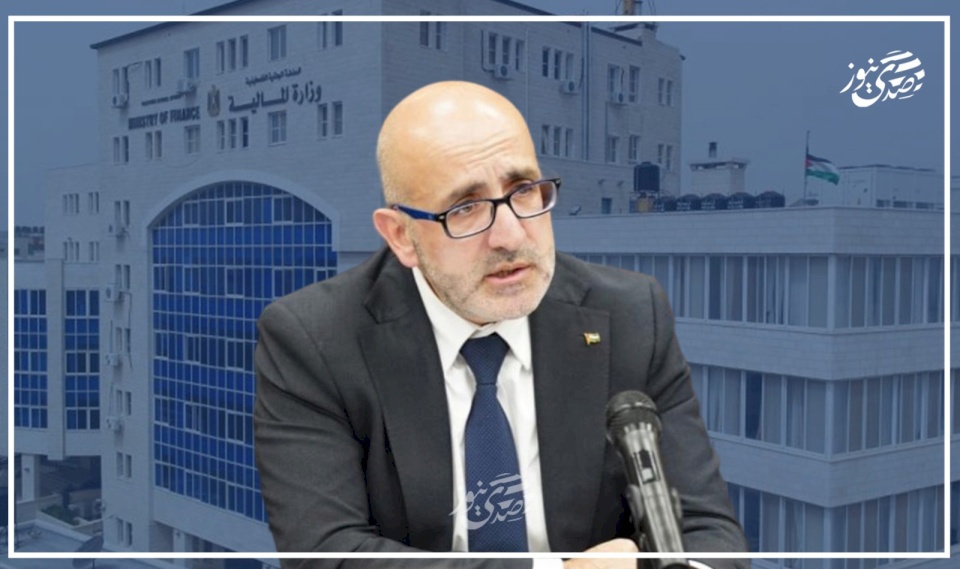
Exclusive SadaNews: Will the Palestinian government salary disbursement rate fall below 60% in the coming months?
Exclusive to "Sada News": "The solutions of the earth have ended," said Finance Minister Dr. Steifan Salama during a meeting with journalists to express that all technical solutions provided by the government to mitigate the financial crisis and provide a portion of the salaries to public sector employees, numbering about 172,000 in the civil and military sectors, have been exhausted.
Salama states that the year 2026 is the worst financially for the National Authority since Israel has not transferred any funds from Palestinian tax revenues (clearance) for ten months, which constitute about 68% of the total public revenues.
Following Salama's announcement of providing a 60% salary with a minimum of 2,000 shekels for employees next Monday, he indicated that this year is the financially hardest in the history of the Palestinian National Authority since its establishment in 1994.
With Israel continuing to withhold clearance funds and amidst uncertainty regarding the possibility of securing external aid this year, the National Authority has no revenues left except for what it collects from local taxes, which range between 350-400 million shekels monthly, while the National Authority's monthly expenses reach about 1.5 billion shekels. The minister pointed out that even if the National Authority reduced its services by ten degrees, at least one billion shekels would still be needed monthly, indicating that to disburse 60% of salaries, the government requires an amount of 720 million shekels, which is difficult to secure under current circumstances without the release of clearance funds or providing aid to cover the gap.
Salama clarified that the total deductions by Israel from clearance have reached 4.4 billion US dollars, and there are 475 lawsuits against the Authority (in Israeli courts) with a total value of 45 billion shekels, in addition to compensations amounting to about 20 billion shekels, which means that Israel is proceeding to "zero out" the clearance funds.
The local revenues in 2025 reached approximately 5 billion shekels, while the total clearance was 10.293 billion shekels, of which Israel transferred 1.951 billion shekels (for just the first four months of the year).
The debt of the National Authority at the end of 2025 reached about 15.426 billion dollars.
Salama stated, "If Israel had committed to transferring our tax revenues in full according to agreements, in 2025, we would have been able to pay the full salaries and ended the year with a deficit of less than 400 million shekels. However, due to the withholding of these revenues and deductions from them, we ended the year with an actual deficit exceeding 4.5 billion shekels."
Regarding external aid, Salama indicated that the National Authority received aid worth 850 million dollars, which is a significant improvement compared to previous years according to Sada News; however, under the emergency support mechanism approved by donors last year, only 250 million dollars were received out of the expected 1.2 billion dollars.
Amidst the uncertainty regarding the forthcoming aid this year, Salama anticipated that the situation would remain complicated and difficult.
In response to a question from "Sada News" about whether the difficult situation of public finances would lead the government to reduce the current disbursement percentage of 60% in the coming months, Salama said, "The situation is contingent on the financial capabilities available each month," which implies that he did not rule out that happening without a clear statement, while the government had previously insisted that it would not reduce this percentage.
For his part, economic expert Muayed Afana told "Sada News": The government has practically exhausted all technical solutions and is losing the margins that were possible during the previous period. Therefore, if the current conditions remain unchanged, meaning if clearance funds are not released or emergency aid is not provided to the National Authority, the government will surely not be able to provide the salary percentage it has been accustomed to over the past months.
He added, "What changes the current data is a breakthrough in the clearance issue or receiving urgent international support," pointing out that the situation will be difficult until next June until the European Union disbursement for this year is approved under the "Pegasus" mechanism, while World Bank assistance is approved in September.
Regarding other external aids, Afana indicated that the Spain grant recently announced was designated to support the health sector, while the rest of the countries benefited from the aid package by the end of last year, without the approval of new aid values for this year.
The scenario that the government built its perceptions for this year, according to Salama's statements, is based on excluding the release of clearance funds throughout this year, in addition to the limited external support, which means that if this happens, the government will be forced to consider other options, including paying salary installments lower than the current percentages or restructuring the administrative apparatus of the National Authority, including layoffs of employees.
As for the dues of public sector employees, which reached about 7.8 billion shekels by December 2025, they are far from being paid during this period, despite the finance minister's statements that "they are owed by the government."
 Follow the latest Sada News via Google News
Soaring Oil Prices Burn the Pockets of the Palestinian Citizen "The Poor"

Millions of Dollars in Losses.. "SadaNews" Reveals Shocking Figures for Traders from Pales...

The Problem of Shekel Overcrowding Worsens.. Fuel Station Owners Threatened with Closure o...

The Palestinian Economy at a Crossroads: 4 Files Awaiting Resolution

Government Debt Puts Health Sector on the Brink of Collapse

Currency Exchange Rates Against the Shekel (April 3)

Public Debt: Did the Palestinian Government Violate the New Law by Raising the Debt Ceilin...
