

Military Shipments to the Caucasus.. Is America Encircling Iran from the North?
SadaNews - With the escalation of regional tensions related to Iran, questions have arisen about whether the United States is preparing to encircle Iran militarily from its northern front, taking advantage of geopolitical shifts in the Caucasus region.
These questions are based on flight tracking data that has shown unusual American activity in Armenia and Azerbaijan in recent weeks.
But what do the data actually say? Do they reflect a military build-up paving the way for a potential attack, or a calculated logistical repositioning without direct involvement?
Monitoring U.S. Military Cargo Movement via Flight Data
Navigational data from the "FlightRadar24" platform showed that the U.S. Air Force conducted around 35 military cargo flights to both Armenia and Azerbaijan over a short period, with a noticeable upward trend.
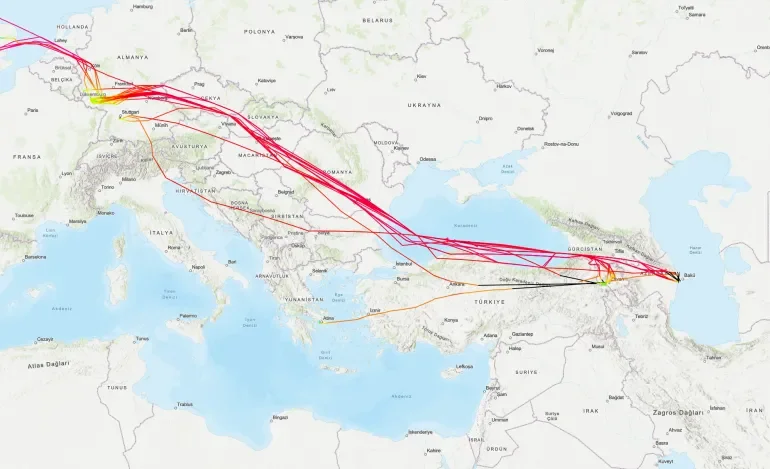
According to an analysis conducted by Al Jazeera, these flights began on January 30, 2026, at a limited pace and continued until February 5, before accelerating significantly starting February 6, peaking on February 10 and 11, with 6 flights per day, totaling 12 flights over two days.
Geographical Focus Towards Armenia and Azerbaijan
In terms of destination distribution, Armenia topped the list with 20 military cargo flights, compared to 15 flights to Azerbaijan. This relative discrepancy is striking, but it does not, in itself, constitute evidence of offensive intent, as much as it reflects a geographical choice for an area that serves as a logistical depth away from direct friction points.
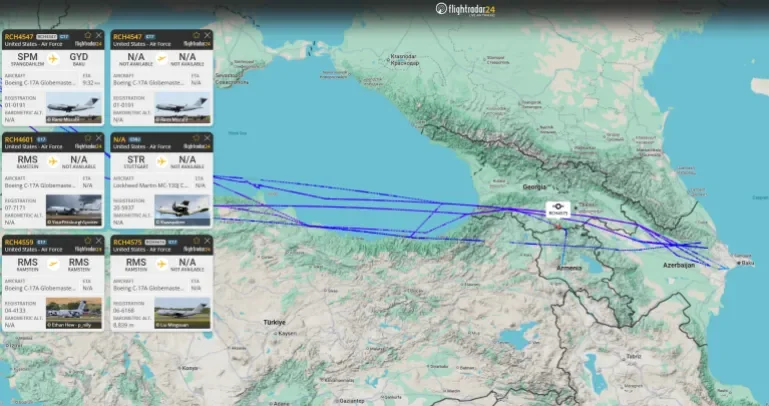
The two countries are located at Iran's northern border and are part of a sensitive Caucasian space that has witnessed competition between Russian and Western influence for years.
Where Did the Flights Originate?
Data showed that more than half of the flights originated from Ramstein Air Base in Germany, which is the largest U.S. military airbase in Europe and a major center for redistributing forces and equipment during escalatory times.
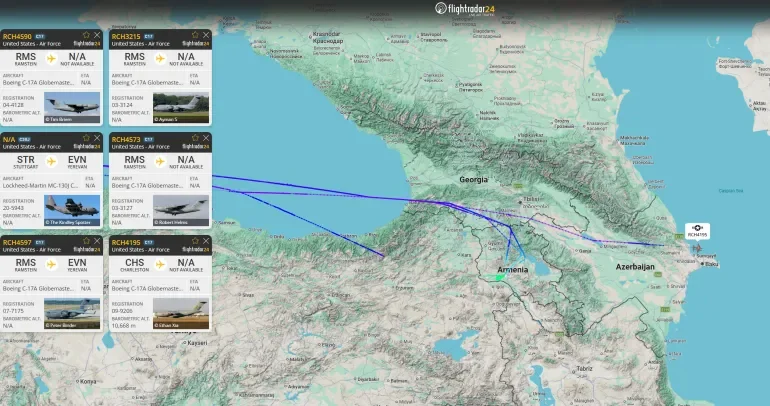
The majority of the flights were conducted using heavy cargo aircraft of the "Globemaster C-17" type, which are designated for transporting military equipment and supplies, with a maximum payload of about 78 tons.
In contrast, only 4 flights were recorded using 3 Lockheed Martin (MC-130J Commando II) aircraft, which are linked to supporting special operations forces.
This variance suggests that the airborne activity is primarily focused on logistics and readiness rather than potentially transporting special operations units or large combat forces.
Timing.. Coincidence or Coordination?
This aerial activity coincides with the visit of U.S. Vice President J.D. Vance to Azerbaijan, and previously to Armenia, over the past two days, which included the signing of economic and security agreements with the United States.
This activity also comes at a time of escalating political exchanges between Washington and Tehran, characterized by a hardening of rhetoric, an increase in indirect military movements, and an expansion of regional pressure circles.
This coincidence suggests a parallel political trajectory to the aerial movements, but it does not provide definitive evidence of a direct link between military shipments and specific offensive objectives.
The Trump Corridor Project
Alongside the aerial movements, the regional discussion highlights the transportation corridor project known as TRIPP, which is sometimes referred to as a rebranded version of the "Zangezur" corridor.
This project is presented in some analyses as a geoeconomic pressure tool on Iran, as it could potentially reduce its role as a land corridor linking Russia and Europe via Armenia, cutting off one of the traditional land communication routes that Tehran has relied on for decades.
In Summary.. Military Encirclement or Escalation Management?
The flight tracking data, so far, do not provide evidence of a preparatory American military mobilization to encircle Iran from the northern front.
However, they reveal a different pattern of managing influence and pressure, based on indirect aerial repositioning and building a flexible logistical structure deep in the Caucasus.
While economic corridor projects remain part of potential geopolitical pressure tools, the data effectively demonstrates Washington's reliance on what can be described as "silent logistics" as a means to enhance readiness and maneuverability, with all scenarios remaining possible regarding American actions against Iran if ongoing negotiations falter.
 Follow the latest Sada News via Google News
Turkish Interior Minister in Damascus to Discuss Security Cooperation and Sign a Memorandu...

From New York.. The Head of Syrian Intelligence Defines Damascus's Security Priorities

Dozens of Drones Target Moscow as Zelensky Ridicules the "Donbas Complex"

Venezuela: Total or Partial Damage to More Than 58,000 Buildings Due to the Earthquakes

Palestine Participates in the Event Organized by the General Secretariat of the Organizati...

Berri: The Agreement with Israel Will Not Be Implemented and There Is No Contact Between M...

Israeli Shelling on Dar'a Countryside and Damascus Calls on the UN to Stop Violations
