

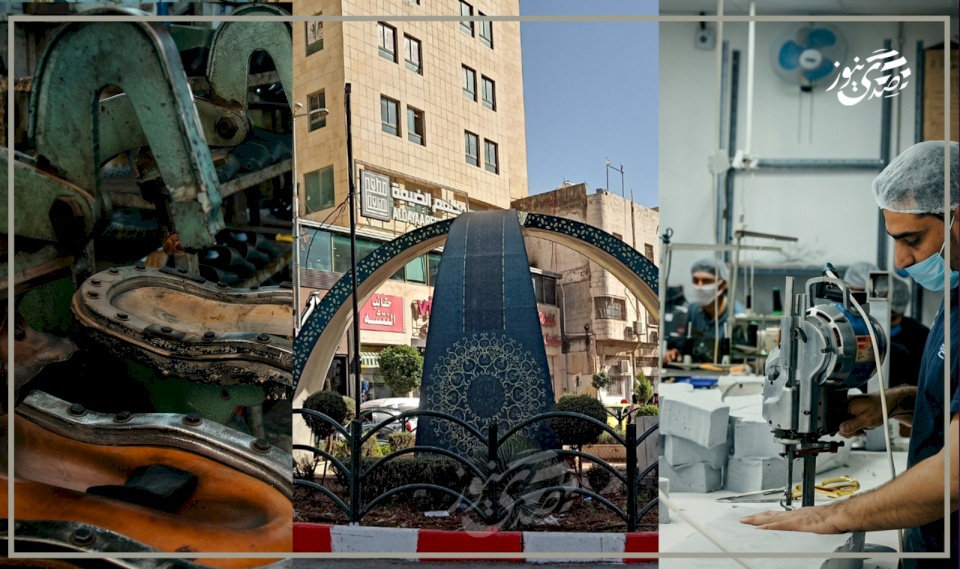
Hebron.. The Empire of the Palestinian Economy that Horrifies Israel
Special for SadaNews: Recently, the city of Hebron has witnessed a campaign of incitement from the Hebrew media, targeting its industries and commerce, which are among the main pillars of the Palestinian economy. The Hebrew newspaper Yedioth Ahronoth published an extensive report prepared by its settlements correspondent in Hebron, focusing on accusations of forgery and smuggling, linking them to funding what Israel calls "terrorist organizations". This report is not just a media material but reflects a systematic Israeli policy aimed at undermining and weakening the Palestinian economy, especially since Hebron has proven its resilience during the recent war, despite the halt of labor in the occupied interior, and it absorbed a large part of the workforce that lost its jobs in Israel, which made the occupation sense a real threat from Hebron's economic strength.
Targeting Hebron economically was not an isolated event but rather an extension of a continuous Israeli policy that initially struck cities in the northern West Bank like Tulkarm, Nablus, and Jenin. These cities experienced a full year of military operations that destroyed facilities, shops, and infrastructure, severely obstructing movement. The numerous checkpoints and gates at the entrances to villages and cities made the routes for trucks and merchants take hours, reducing the possibility of getting goods to the markets in a timely manner and significantly weakening commercial activity.
In addition to that, Palestinians in the interior no longer shop in the northern West Bank cities as they used to, reflecting a systematic plan to strip these cities of their vital economic role. Moreover, the repeated closures of the Al-Karama commercial crossing, which is a vital artery for goods entry, have directly impacted Palestinian trade, as it was closed for long periods to trucks, resulting in massive losses. This is compounded by the prevention of the transfer of clearance funds and taxes, which worsened the Palestinian economic crisis. This clear Israeli methodology in dealing with the Palestinian economy follows a studied plan, phase by phase, to now extend to Hebron's factories and merchants as the beating heart of the Palestinian economy.
The Hebrew report that SadaNews followed described Hebron as "the fake empire," alleging that its factories produce hundreds of thousands of counterfeit shoes for global brands such as Nike and Adidas, market Chinese jeans labeled as Diesel in Nablus, in addition to other products like marijuana candy under well-known brand names. The report went on to say that these industries rake in billions of dollars, and their profits are funneled to "terrorist organizations" in the West Bank, as per its wording. It also mentioned Israeli raids on buildings in Hebron, during which complete production lines for counterfeit sports shoes were revealed, in an attempt to portray the city as a dual threat: economic and security.
The incitement did not stop at the economic level alone; it also transcended to the political and security dimensions, as the report linked Palestinian trade to funding "Palestinian organizations," a discourse aimed at justifying any future Israeli measures against Hebron's economy, including raids, closures, or imposing new restrictions, which the occupation has already initiated in southern Hebron. Israel seeks through this narrative to gain international cover for any escalatory steps and to portray Palestinians as both an economic and security threat.
Regarding the alleged Israeli losses, the report mentioned that the state auditor in Israel estimated in 2020 the losses in tax revenues at about 1.7 billion shekels annually, while it is currently estimated at about 4 billion shekels annually. These figures are used as a propaganda tool to depict Palestinians as the direct cause of economic crises within Israel, reflecting a consistent policy of blaming Palestinians for any economic disruption.
This targeting is not new; the newspaper Israel Hayom previously published similar reports, which SadaNews followed at the time, accusing Palestinian traders of leaking goods from Israeli ports and selling them within Israel without paying full taxes, which allegedly led to losses of billions of shekels. These repeated accusations reveal a consistent Israeli strategy aimed at striking Palestinian traders and distorting their image in public opinion.
Thus, the Israeli incitement against Hebron’s trade and industry is not just a passing media campaign but part of a colonial project that seeks to destroy and weaken the Palestinian economy. Israel knows that Hebron represents the heart of the Palestinian economy, and its strength and stability pose a threat to its project, and therefore it seeks by all means to distort and undermine it. Just as the world has turned a blind eye to the martyrdom of over 71,000 Palestinians in Gaza, it may remain a bystander to Israel’s attempts to destroy the economy of Hebron and other Palestinian cities without taking any action.
 Follow the latest Sada News via Google News
High-level sources reveal to SadaNews: Washington seeks to hold a Gaza Reconstruction Conf...

Iraqji Reveals Details of the Attack on the Iranian Supreme Leader's Headquarters

صراع على إرث خامنئي وسط غياب مجتبى.. والمتشددون يتهمون قادة إيران بـ«الانقلاب»

The European Union Reiterates Its Call for Israel to Refrain from Expanding Settlements in...

"Mamdani Berlin".. The German Left Bets on a Politician of Turkish Descent to Lead the Cap...

Hebrew Channel: Kushner Pushing to Enhance Communication Between the United States and the...

SadaNews Report: Israeli Elections with a Settlement Flavor!
