

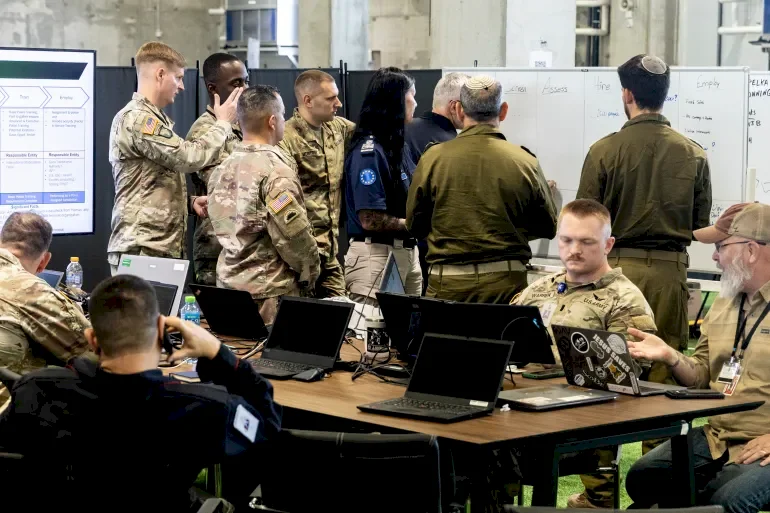
What role does the Civil-Military Coordination Center for Gaza play?
SadaNews - The Civil-Military Coordination Center for Gaza, launched by the United States following the ceasefire between Israel and Hamas, is facing difficulties in executing its assigned tasks of monitoring the truce and enhancing the delivery of humanitarian aid.
The center's goal is to pave the way for the next steps of U.S. President Donald Trump's peace plan for the Palestinian territory after the devastating two-year war.
An European diplomat told "Agence France-Presse": "At first, no one knew what it was, but everyone wanted it."
He added: "People are now somewhat disappointed because we feel that nothing is moving, but we have no choice... either to keep it or to talk informally with the Israelis."
For his part, a source in the humanitarian field who has visited the center several times to discuss the issue of finding shelter for hundreds of thousands displaced by the Gaza war said: "Sometimes we think we've hit rock bottom, but we keep digging."
The center, located in a large warehouse in the city of Kiryat Gat in southern Israel, has been presented to stakeholders such as NGOs, UN agencies, and diplomats as a body that shapes new ideas for post-war Gaza.
U.S. Central Command spokesman in the Middle East, Captain Tim Hawkins, told "Agence France-Presse": "When we opened it, we made it clear that it focuses on two things: first, facilitating the flow of humanitarian, logistical, and security aid to Gaza, and second, helping with real-time monitoring of the ceasefire agreement's implementation."
Many countries and stakeholders in the humanitarian field reported that they rushed to the project in hopes of gaining a new partner to communicate with to find solutions, namely the United States.
"Nothing has changed"
Two months after the launch of the Civil-Military Coordination Center for Gaza, many humanitarian workers contacted by "Agence France-Presse" expressed that they feel the U.S. ability, or willingness, to pressure Israel is limited.
A humanitarian engineer reported: "Initially, the Americans informed us that they were beginning to discover that Israel was prohibiting the entry of a wide range of goods into Gaza - the famous list of dual-use goods - and they seemed shocked, and we thought we would finally overcome this obstacle."
He noted: "But the truth is that nothing has changed at all."
Visitors to the center describe a large warehouse where many American and Israeli military personnel gather, along with others working in humanitarian fields, diplomats, and advisors.
The first floor is dedicated to Israeli staff, while the third is for American soldiers, and visits to either of these floors are prohibited.
The second floor, where artificial grass has been laid, is an open reception area where diplomats and UN agency workers convene.
A diplomat remarked: "It resembles a co-working space, but individuals in it wear uniforms." Other visitors saw a board with the question "What is Hamas?" written on it.
A source working in the humanitarian field stated: "Discussions revolve around everything, from the distribution of water and food to security."
However, a diplomat pointed out that "this is not the place where decisions are made," referring to parallel discussion channels, including a team overseen by Aryeh Lightstone, one of the aides to U.S. envoy Steve Witkoff in Tel Aviv.
"We have lost our moral compass"
Numerous diplomats and humanitarian sources criticized the absence of Palestinian voices and the fact that they were consulted due to their expertise but not for their opinions regarding the best way forward.
Another problem is the emergence of ideas that are largely rejected by the international community, particularly the establishment of "alternative safe communities" in Gaza.
The idea revolves around gathering residents of Gaza who have been "vetted" and are not associated with Hamas within communities built from scratch in the "green zone" in Gaza, where essential services will be provided under Israeli military control.
A diplomat said: "We have lost our moral compass in law."
He added: "There is a very clear tension between the idea that one is allowed to do almost anything (this creativity is needed) and the nature of international humanitarian law itself, which is inherently fixed and unchangeable."
The most repeated criticisms are that political questions such as who should govern Gaza and who should be responsible for security are excluded from discussion, while discussions drift toward practical questions centered on the "how".
A diplomat remarked: "They are thinking about where to build wastewater treatment plants. They do not think about who will have to operate the wastewater treatment plants or who will pay the people who operate them."
Ultimately, several humanitarian and diplomatic sources condemned what they considered a waste of time by the Civil-Military Coordination Center for Gaza in achieving negligible results.
Captain Hawkins acknowledged the existence of some "tensions and challenges" without providing details, but pointed out to successes achieved such as opening more crossings for delivering aid to Gaza.
He told "Agence France-Presse": "We are making progress... fully aware that there is more work to be done."
 Follow the latest Sada News via Google News
High-level sources reveal to SadaNews: Washington seeks to hold a Gaza Reconstruction Conf...

Iraqji Reveals Details of the Attack on the Iranian Supreme Leader's Headquarters

صراع على إرث خامنئي وسط غياب مجتبى.. والمتشددون يتهمون قادة إيران بـ«الانقلاب»

The European Union Reiterates Its Call for Israel to Refrain from Expanding Settlements in...

"Mamdani Berlin".. The German Left Bets on a Politician of Turkish Descent to Lead the Cap...

Hebrew Channel: Kushner Pushing to Enhance Communication Between the United States and the...

SadaNews Report: Israeli Elections with a Settlement Flavor!
