

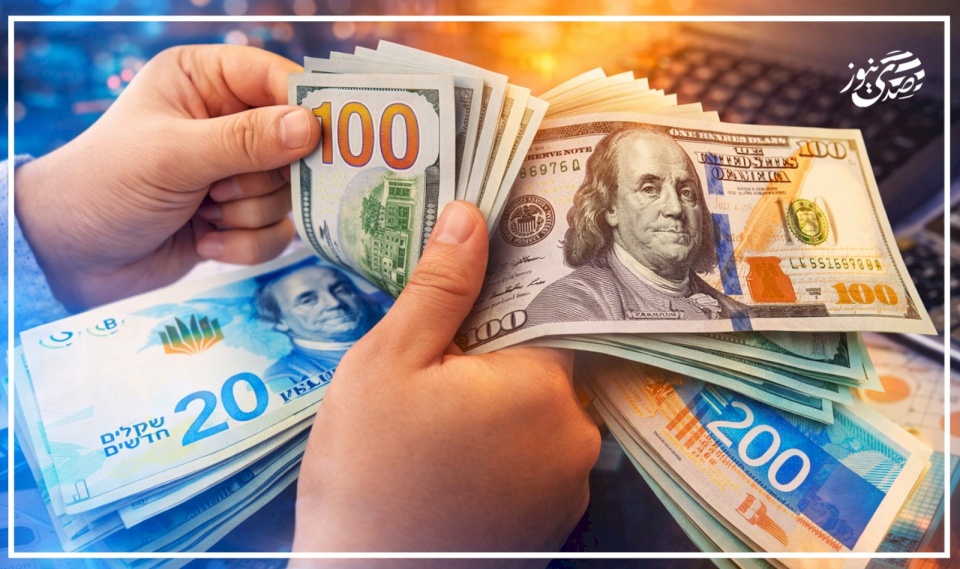
The Dollar Falls and the Shekel Gains... Will the Palestinian Employee Bear the Cost?
SadaNews - "A benefit from harm" is an ancient Arabic proverb, used when the harm to one person benefits another. This applies to the decline in the exchange rate of the dollar against the Israeli shekel, given the multiple currencies used in the Palestinian market (shekel, dollar, dinar) due to the absence of a national official currency.
This decline in the dollar's exchange rate will not affect those who receive their salaries in shekels; rather, it may alleviate their burden of meeting financial obligations due in U.S. dollars. However, on the contrary, it casts a heavy shadow over employees who receive their salaries in dollars, as well as consumers and producers dealing primarily in that currency. Moreover, some citizens have saved significant amounts in dollars to exchange later when the dollar's exchange rate against the shekel rises.
What is the nature of this impact?
The impact of the dollar's depreciation against the shekel on employees in various sectors is proportionate to the dollar's decline. For example, if the dollar's decline over the year is 10%, then their income automatically decreases by 10%, as the purchasing power of the currency diminishes when converting from dollars to shekels,” said economic journalist Ayham Abu Ghosh in an interview with SadaNews Economy.
He pointed out that the most affected groups are real estate and land traders, "as they conclude agreements or tenders in dollars, which then decrease later due to the agreements signed at a certain exchange rate.
Regarding the group that saved their deposits in dollars, Abu Ghosh explained in a talk with SadaNews Economy that the impact on them is of the same magnitude as the decline, unless they decide to transfer their dollars to less risky investments. He noted that investors usually create a balance in their investments, not investing all their money in one area, whether it be currency, company shares, or precious metals.
Institutions Fix the Dollar's Exchange Rate Against the Shekel
It is worth noting that some institutions in Palestine fix the dollar's exchange rate against the shekel for their employees to avoid losses and ensure their salaries are not affected by fluctuations in the exchange rate.
Ayham indicates that "under normal circumstances, every country in the world pays its employees in its official currency, but the absence of a national currency in Palestine has made currency diversity a matter that benefits some and harms others.”
He continued: "Institutions that fix the dollar exchange rate do so because they have the financial capacity to compensate employees and bear part of the losses, but it is challenging for all institutions in the homeland to adopt this mechanism, especially small institutions."
Possible Scenarios
There are several scenarios proposed by experts and economic analysts, with differing opinions due to the tense political situation and its impact on the global economy. How low might the dollar's exchange rate drop?
Ayham Abu Ghosh believes that "it is impossible to ascertain any specific scenario, relying on financial analysis readings and estimates from banking institutions, whether in "Israel" or abroad, which expect that the dollar will remain low against the shekel in the coming period. This is linked to the transformations that will occur in the United States, whether regarding interest rates, appointing a new central bank governor, or the policies adopted in the United States regarding international trade and global disputes.”
He added: "As for the Israeli side, the dollar's exchange rate against the shekel largely depends on the surrounding geopolitical developments, especially amid discussions about the possibility of military escalation between Israel and Iran, alongside the approaching elections, all of which directly impact currency stability. In this context, several potential scenarios emerge, as one analysis in the Hebrew media indicates the possibility of the dollar's exchange rate dropping to around two shekels. This scenario is described as a major disaster for the Israeli export sector, but is considered unlikely,” he added: "Indicators confirm that if the dollar rises against the shekel in the upcoming period, it is likely to move within a margin ranging from 2.8 shekels as a minimum to 3.3 shekels as a maximum over the next six months, with the possibility of unexpected surprises in light of the fragility of the political and economic landscape, although the likelihood of this is low.”
He concluded by saying: "The scenarios remain subject to a set of political and economic factors, both at the global level in the U.S., and at the regional level in 'Israel'.”
 Follow the latest Sada News via Google News
Soaring Oil Prices Burn the Pockets of the Palestinian Citizen "The Poor"

Millions of Dollars in Losses.. "SadaNews" Reveals Shocking Figures for Traders from Pales...

The Problem of Shekel Overcrowding Worsens.. Fuel Station Owners Threatened with Closure o...

The Palestinian Economy at a Crossroads: 4 Files Awaiting Resolution

Inflation Expectations in Israel Stabilize at 1.5%

Ministry of Economy Announces the Opening of Import Application Submissions for Commodity...

Relative Stability of the Dollar Near 3.04 Shekels and Predictions of Returning Inflationa...
