

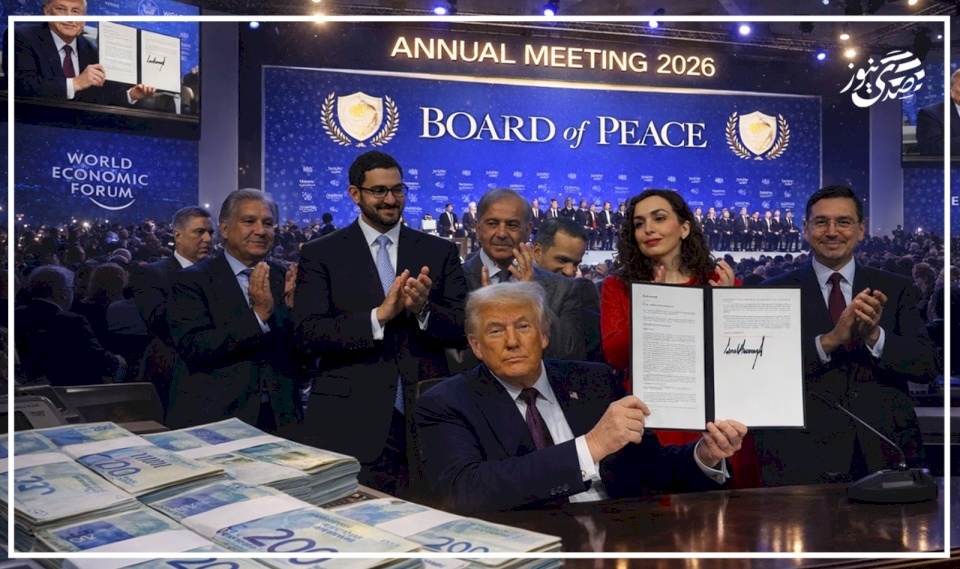
Will "Israel" Transfer the Clearance Funds to the Peace Council?
Exclusive to SadaNews: Amid the suffocating financial crisis faced by the Palestinian National Authority, the issue of the clearance funds withheld by Israel emerges as one of the most significant files determining the future of the economic and political situation in Palestine. With accumulating debts and a declining ability of the government to meet its commitments, a fundamental question arises: Will Israel resort to transferring part of these funds to what is known as the "Peace Council," in a move that transcends the financial dimension to become a political pressure tool that could redraw the Palestinian scene to serve its interests?
Recent figures from the Palestinian Ministry of Finance and Planning revealed that the total government debts and accumulated obligations to various parties reached approximately 47.3 billion shekels by the end of 2025.
The figures show that the largest creditor of the government by the end of December 2025 was the retirement fund, with debts amounting to around 15 billion shekels. It is noteworthy that these debts follow three pathways: either funds borrowed by successive governments from the fund, or failure to transfer funds related to employee contributions to the retirement fund, or failure to transfer contributions for government pension salaries.
Loans from the Palestinian banking sector ranked second with debts reaching approximately 10.9 billion shekels, followed by private sector arrears amounting to about 8 billion shekels, while unpaid employee dues reached approximately 7.8 billion shekels. Notably, public sector employees have not received a full salary since November 2021.
External borrowing amounted to about 4.3 billion shekels by the end of last December.
Observers attribute these accumulated debts to several reasons, including the mismatch between expenditures and revenues over the past years, which has resulted in a financial deficit that the National Authority can no longer manage. However, the main reason remains Israel's withholding of clearance funds or imposing deductions from them, which deprived the public treasury of 68% of its revenues, exacerbating the financial crisis and preventing the Authority from managing this debt.
Although the amount of withheld and confiscated clearance funds reaches approximately 15 billion shekels, representing less than a third of the public debt, experts and observers emphasize that the National Authority cannot repay its debts based on the available resources. However, if these funds are made available, they would enable the Authority to manage its debt and alleviate the burden of the financial crisis that has significantly impacted the overall economic cycle.
In an attempt to drain the clearance funds and push for a financial collapse, Israel has completely halted its transfers of clearance funds for nearly nine months, noting that it had not been transferring more than a third of them since the events of October 7, 2023, following additional deductions related to the salaries of National Authority employees in the Gaza Strip, estimated at approximately 272 million shekels per month.
Government Communication Director Dr. Muhammad Abu Rab recently indicated in media statements that there has been no breakthrough regarding the clearance issue despite international pressures in this direction. Meanwhile, a senior Palestinian official mentioned during his meeting with journalists that the Israeli side had proposed several months ago to transfer a small part of the clearance funds to the Palestinian Authority in exchange for transferring salary allocations for employees in Gaza to the Gaza Strip (without clarifying their uses), which widely opens the door to entrenching the separation between Gaza and the West Bank, a matter that the Palestinian side rejected.
Will the clearance funds go to the Peace Council?
An unnamed economic expert stated that the clearance funds have become hostage to political solutions and there is no prospect for their release soon, which could deepen the financial crisis for the National Authority, without ruling out the transfer of part of this money for the benefit of the Peace Council to provide financial resources for the administrative committee and ensure its success.
In turn, economic expert Dr. Thabet Abu Ras told "SadaNews": If Israel is interested in the success of the administrative committee in the Gaza Strip and in undermining the financial plans of the Palestinian Authority in the West Bank, I estimate that it could transfer part of the clearance allocations to the Gaza Strip.
He added: "If this scenario occurs, it places the Authority at a dangerous financial crossroads, as such a measure would extricate Israel from the bottle neck regarding its obligation to transfer clearance revenues to the Authority's accounts, under the pretext of transferring revenues to the Gaza Strip on the grounds that the administrative committee is considered one of the Authority's arms (based on expected Israeli justifications)."
Finance Minister Dr. Estifan Salameh estimated in a meeting with journalists that the total amount of cases filed in Israel against the National Authority amounts to around 20 billion shekels, which would mean that a ruling in these cases would result in a zeroing out of the withheld clearance funds.
Recent data from the Ministry of Finance and Planning showed that the total recorded clearance funds by the end of 2025 reached approximately 10.53 billion shekels, while the National Authority received only 1.95 billion shekels, or about 18.5% of the total realized clearance funds, due to Israel's refusal to transfer these funds. The data reveals that the last tranche of clearance funds received by the National Authority was in May of last year.
 Follow the latest Sada News via Google News
High-level sources reveal to SadaNews: Washington seeks to hold a Gaza Reconstruction Conf...

Iraqji Reveals Details of the Attack on the Iranian Supreme Leader's Headquarters

صراع على إرث خامنئي وسط غياب مجتبى.. والمتشددون يتهمون قادة إيران بـ«الانقلاب»

The European Union Reiterates Its Call for Israel to Refrain from Expanding Settlements in...

"Mamdani Berlin".. The German Left Bets on a Politician of Turkish Descent to Lead the Cap...

Hebrew Channel: Kushner Pushing to Enhance Communication Between the United States and the...

SadaNews Report: Israeli Elections with a Settlement Flavor!
