

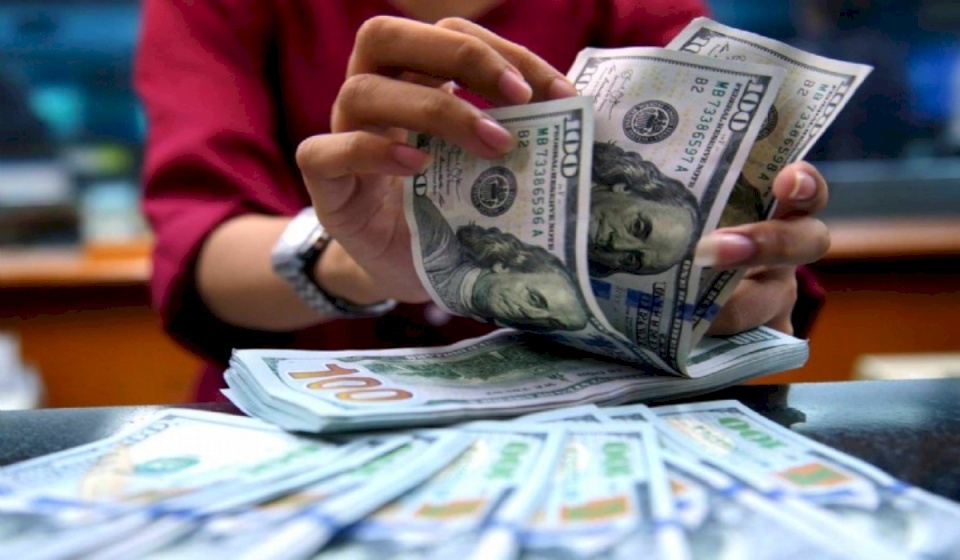
6 Investment Banks: Dollar Likely to Fall Again in 2026
SadaNews Economy - Deutsche Bank and Goldman Sachs, along with other banks on Wall Street, expect the US dollar to resume its decline in 2026 as the Federal Reserve continues to gradually lower interest rates.
The dollar has stabilized over the past six months after experiencing its largest decline since the early 1970s in the first half of the year when the trade war launched by President Donald Trump caused chaos in global markets.
However, strategists expect the dollar to weaken again in 2026 as the US central bank continues to ease monetary policy, while other central banks maintain stable interest rates or move towards raising them.
This disparity will encourage investors to sell US debt and shift liquidity to countries that offer higher interest rates.
Consequently, analysts from more than six major investment banks predict that the dollar will decline against major currencies like the yen, euro, and British pound.
According to consensus estimates compiled by Bloomberg, the widely followed Dollar Index is expected to drop by about 3% by the end of 2026.
David Adams, head of foreign exchange strategy for the G10 at Morgan Stanley, who expects the dollar to fall 5% in the first half of the year, said: "There is ample room for markets to price in expectations of larger interest rate cuts". He added: "This allows plenty of scope for further dollar weakness".
The expected decline in the dollar is anticipated to be weaker and less inclusive compared to this year, when it fell against all major currencies, causing the Bloomberg Dollar Spot Index to drop by about 8%, marking its deepest annual decline since 2017.
These forecasts are based on the assumption that the weakness in the US labor market will continue, which remains uncertain given the unexpected resilience of the economy post-pandemic. Additionally, predicting currency movements is a significant challenge.
Why Did the Dollar Decline and Will It Continue to Decline?
When the dollar was rising late last year due to a surge in investor interest in the so-called "Trump trade" that benefits from his growth-boosting policies, strategists anticipated that the rise would change course by mid-2025, but they were surprised by the extent of the decline in the first half of the year. Strategists now see that overall trends as the new year approaches pave the way for a dollar decline.
Traders' pessimistic expectations for the dollar coincide with their estimates of the Federal Reserve cutting interest rates twice next year, by a quarter of a percentage point for each cut.
There is even a possibility that the Federal Reserve Chairman chosen by Trump to replace Jerome Powell could face pressure from the White House to cut rates further.
The Global Impact on the Dollar and Vice Versa
At the same time, the European Central Bank is expected to maintain interest rates at their current level, while the Bank of Japan gradually raises rates.
Louis Oganes, head of global macroeconomic research at JP Morgan in London, stated during a press conference on Tuesday: "We see the risks tilt more against the dollar than for it".
A weaker dollar has a cascading effect on the US economy overall, raising import costs, increasing the value of foreign earnings for companies, and boosting exports - which may be welcomed by the Trump administration that criticized the US trade deficit.
This could prolong the upswings in emerging markets as investors shift their money there in search of higher interest rates.
"Interest Trade" Deals
This shift has propelled "interest trade" deals in emerging markets - based on borrowing from low-interest countries and investing in places with higher yields - to achieve their highest returns since 2009.
Both JP Morgan and Bank of America see the potential for this trade to yield additional gains, pointing to currencies like the Brazilian real and several Asian currencies like the South Korean won and the Chinese yuan, respectively.
Analysts at Goldman Sachs, led by Kamaksia Trivedi, stated this month that the market has begun to price in more optimistic economic expectations for other currencies within the G10 - like the Canadian and Australian dollars - following stronger-than-expected data releases.
They noted that "the dollar tends to decline when other economies in the world perform better".
The Last Hope for the Dollar to Rise
Opponents predicting the dollar will rise against some other major currencies primarily cite the strength of the US economy.
Analysts at Citigroup and Standard Chartered indicated that this growth, driven by an AI boom, will attract investment flows into the US, thereby strengthening the dollar.
The Citigroup team, led by Daniel Touboul, wrote in their annual forecasts: "We believe that the dollar has a strong chance to regain its momentum in 2026".
Wednesday's meeting highlighted the potential for growth exceeding expectations after policymakers at the Federal Reserve adjusted their 2026 forecasts. However, they cut interest rates by a quarter point and continued to anticipate another similar cut next year.
The Fed's Message on Interest Rates
Jerome Powell also reassured markets regarding any concerns about the likelihood of the Fed moving towards raising interest rates, indicating that the current discussion centers on whether to continue cutting rates or to maintain them at their current level, given the balance of power between a weak labor market and ongoing inflation above the target level.
His comments provided relief in the markets, as some traders feared the Fed would send a more hawkish message.
As bond yields fell, the Bloomberg Dollar Index decreased by 0.7% on Wednesday and Thursday, marking the largest drop over two days since mid-September when traders anticipated a resumption of the interest rate cut cycle.
"The Dollar is More Expensive Than Its Fair Value"
In an annual forecast memo directed at clients late last month, George Saravelos of Deutsche Bank, head of global foreign exchange research in London, and his colleague Tim Baker in New York, wrote that the dollar has benefited from a "remarkably resilient" economy and rising US equity prices.
Nevertheless, they indicated that the dollar is priced above its fair value, and they expect it to decline against other major currencies next year as growth recovers and equity returns rise in other regions.
They concluded: "If these forecasts come true, they will affirm that the exceptionally long dollar upcycle of this decade has ended".
 Follow the latest Sada News via Google News
London Stock Exchange Enters the Era of 24/7 Trading

Shamaran Petroleum: Suspension of Oil Production in Duhok Fields in the Kurdistan Region o...

Dollar Steadies Near One-Week High Amid War Developments

Trump Imposes Tariffs on Canadian Imports... Ottawa Vows to Respond

Oil Prices Drop After Reports of Mediation Efforts Between the U.S. and Iran

Gold Price Rises Supported by Increased Buying Amid Lower Prices

Due to "Hazardous and Counterfeit Products".. Europe Fines "AliExpress" $627 Million
