

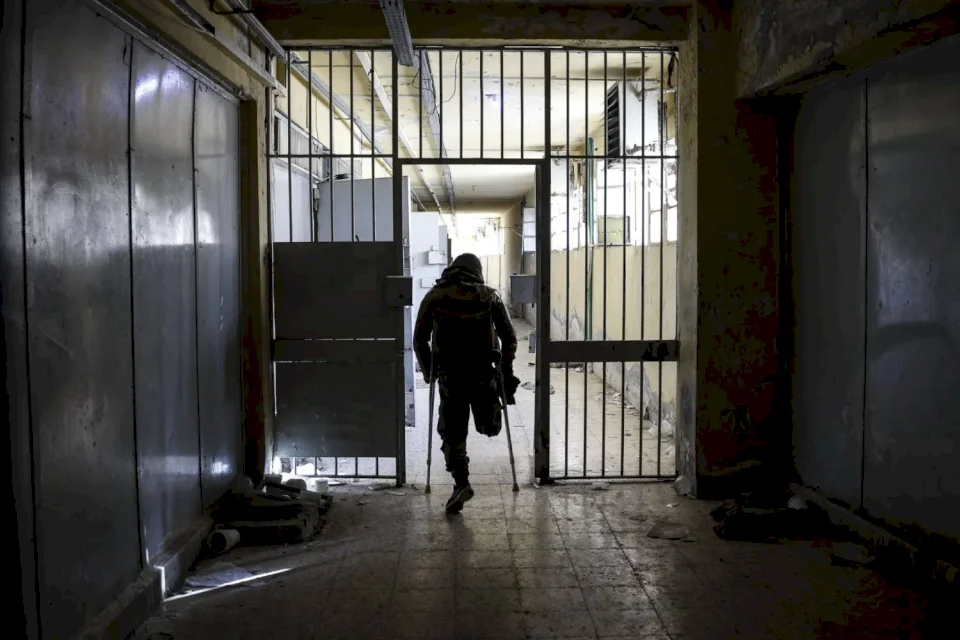
Asad's Centers and Prisons Transform into Filming Locations in Syria
SadaNews - After the overthrow of Assad's regime, security sites and prisons that were symbols of power, torture, and horrific violations have turned into filming locations for Syrian drama. On the runway of the Mezze Military Airport near Damascus, the crew of the series "Aila Al-Malik" stands ready to film a scene of an influential character escaping in the last hours of Bashar Assad's rule.
While director Muhammad Abdul Aziz issues instructions via radio to the crew, he describes that moment saying: "It's hard to imagine that we are filming here; Mezze airport was a symbol of military power. Now we are creating drama about the fall of that power."
"Aila Al-Malik" is one of several dramas that will be aired during Ramadan, being filmed in sites that were previously inaccessible to Syrians, ranging from security centers to intelligence branches, which have now transformed into open filming spaces.
The series revolves around a family from Damascus during the last months of Assad's rule and highlights the social and political factors that contributed to his downfall.
"From a Place of Torture to a Space of Creativity"
The director tells AFP, "It's a strange feeling; the places from which Syria was ruled have turned into studios, from the Palestine branch to the Mezze Military Airport, from a place that was ruled by iron and fire to a space where we experiment with creative tools."
The Mezze Military Airport has long served as an air base and detention center under the military intelligence, while the Palestine branch is known as one of the most notorious detention centers associated with fear and violations. Today, the filming crew passes between burned vehicles and staged explosions in scenes that, according to the director, represent "the moment of freeing detainees with the collapse of the security apparatus."
After the fall of the previous regime, hundreds flocked to the security branches across the country searching for family members who had entered and never returned, while thousands of inmates emerged from their cells.
"A Name that Instills Fear"
Abdul Aziz adds that "the Palestine branch was a cornerstone of the security system; just mentioning its name instilled fear in people's hearts. Today, we are filming full scenes inside it while taking care of the documents that must be archived without tampering with them."
In the vicinity of Assad's home in the upscale Al-Malki area of Damascus, which was entered and looted by Syrians on the night of Assad's escape to Russia, actors perform a fight scene.
Abdul Aziz states, "The security grip no longer exists; we filmed scenes in Al-Malki Square and a fight involving more than 150 people and gunfire... This would have been impossible to carry out."
The crew is completing the editing process in a traditional Damascus house in one of the city's ancient neighborhoods. There, writer Maan Suqbani, 35, sits in front of a small screen discussing with the director the arrangement of scenes before finalizing the version.
The writer explains that the reading committee of the Ministry of Information still exists but seemed more flexible during the reading of "Aila Al-Malik... we submitted the script, and the censorship comments were very minimal."
"Fear of Actors"
Breaking taboos isn't limited to this work alone. Director Layth Hajo is producing the series "The Syrian Enemies," inspired by a novel by Syrian writer Fawwaz Haddad.
The series' media director, Amin Hamada, explains that in this work, "individual lives intersect with state security agencies in a complex web of suspicion and fear, and power appears capable of turning citizens into adversaries at the mere suspicion of their loyalty."
Moreover, director Muhammad Lotfi revisits the events of a rebellion that took place in Sednaya Prison in 2008, which ended with the deaths of dozens of prisoners and guards in a project written by Samer Radwan featuring a selection of Syrian actors such as Jamal Suleiman.
The director says, "The work was written more than two years ago, and we intended to implement it before Bashar Assad's fall," but several challenges prevented it, particularly the "fear" of the actors at that time from the authorities' reaction, and the obstacle of choosing filming locations since filming in Syria was nearly impossible.
Sednaya Prison
Now, however, the team intends to film in the prison, which had been a taboo for decades, and is considered one of the sites that witnessed severe violations and cases of enforced disappearances.
Lotfi states, "The new authority welcomed the project and provided logistical support and extensive facilitation for filming inside Sednaya Prison."
He adds that it is now possible to "convey the suffering of prisoners and the practices of power from inside the actual place" after that was once a figment of imagination.
Since the overthrow of Assad's rule a year ago, the drama sector in Syria has witnessed remarkable transformations, with dozens of actors, technicians, and directors returning to the country after years of exile, especially due to their affiliation with the opposition.
 Follow the latest Sada News via Google News
FIFA Referees Committee, Led by Colina, Clarifies Cases from Egypt vs. Argentina Match

The Egyptian Federation Files Official Complaint Against Referee Letexier

Do You Know How to Comfort Someone Who is Crying? Here's What to Say and Do in Tough Momen...

"Backrooms": From Digital Legend to Cinematic Phenomenon

Prediabetes.. The Silent Bomb Carried by Millions Without Their Knowledge

From Sweden 1958 to the Epic of Egypt 2026.. Argentina's History with World Cup Comebacks

After the South Africa Precedent.. Nigeria Investigates the Encroachment of Technology Com...
