

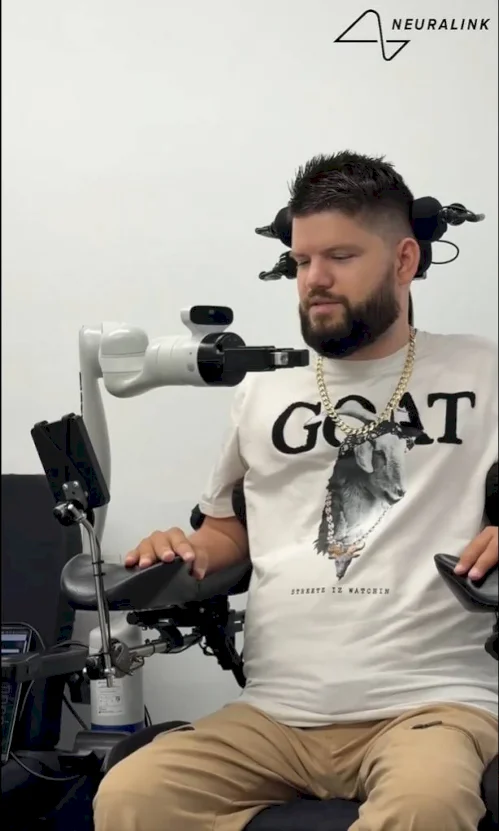
Brain Chip Enables Patients to Move Robotic Limbs with Just Thought
SadaNews - Elon Musk's company "Neuralink" announced that its implanted brain chip is now capable of assisting patients in moving robotic limbs using neural signals, in what is considered one of the most significant advancements in the field of neural computer interfaces, according to "Euronews".
This progress comes while the device is still in the clinical trial phase; the tests are focused on the safety levels and the chip's functionality in individuals suffering from diseases and injuries that limit their mobility.
In a video released by the company on the "X" platform, American patient Rocky Stoutenburgh, paralyzed since 2006, was seen moving a robotic arm using just his thoughts before lifting the arm to his face and kissing it in a striking scene.
Neuralink stated in a statement via the platform that "participants in our clinical trials have been able to expand the scope of digital control to include physical devices such as assistive robotic arms," noting that the company plans to "expand the list of devices that can be controlled via the chip in the future".
This technology aims to help patients with paralysis to use their personal devices and regain some of their mobility through an interface known as "Brain-Computer Interface" (BCI), which is capable of interpreting signals from the brain and converting them into digital commands.
According to the company, since January of last year, the chip has been implanted in 12 patients until September 2024. The first participant suffered from paralysis due to a spinal cord injury and was able, thanks to the chip, to play video games and chess by thought alone.
The remaining volunteers either suffer from spinal cord injuries or from amyotrophic lateral sclerosis (ALS), a disease that gradually leads to loss of control over the body's muscles.
Musk revealed that over 10,000 people have registered in Neuralink's patient registry in hopes of participating in future trials.
Neuralink is one of several companies working in the field of developing brain-computer interfaces, while data from American clinical trials indicate that similar technologies are being tested to assist those with cerebral palsy, dementia, strokes, and other complex health conditions.
 Follow the latest Sada News via Google News
After Deschamps' Departure... Zinedine Zidane Tops the Candidates to Lead France

Mbappe Surpasses Messi and Becomes the All-Time Top Scorer in the World Cup

England Defeats France and Achieves Largest World Cup Achievement Since 1966

Messi Refused to Play for Spain and Missed 3 World Cups

Publishers Sue Google for Allegedly Using Books to Train Artificial Intelligence

Google Expands Capabilities of Google Search Console to Support Social Media Accounts

The Mediterranean Table... An Ancient Diet Revealing Its New Secrets for Health and Longev...
