

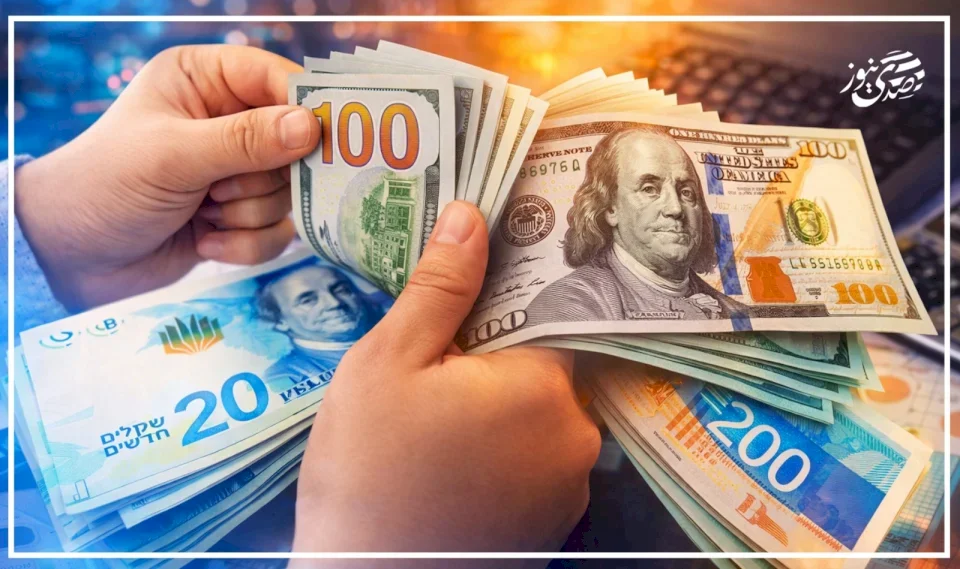
After Iran Announces Suspension of Attacks.. Shekel Returns to Gain Against Dollar in a Volatile Week
SadaNews Economy Translation - The Israeli shekel gained against the dollar on Monday evening, following Iran's announcement to suspend military attacks against Israel.
The dollar stabilized at around 2.93 shekels after rising to 2.9877 shekels following gunfire exchanges with Iran last night and this morning.
According to the Hebrew economic newspaper Calcalist, this represents a slight increase compared to its exchange rate of 2.90 shekels on Friday. According to SadaNews Economy translation.
The euro stabilized at 3.36 shekels, compared to 3.38 shekels on Friday.
In the international market, the dollar index fell by 0.1% against a basket of six major currencies, reaching 99.71 points.
The website stated that these recent developments add to one of the most turbulent weeks seen in the local foreign exchange market in recent years.
A combination of statements from the Governor of the Bank of Israel and declines in global markets led to a drop in the shekel's exchange rate by more than 5% against major currencies in less than a week.
Orr Buria, Chairman of Poria Finance, viewed this situation as a sharp but expected correction following a long period of rapid and unusual appreciation of the Israeli currency.
Buria indicated that the underlying economic picture has not changed, as the current account surplus, the strength of the high-tech sector, the volume of foreign investments, and the ongoing improvement in the macroeconomic environment are all factors supporting the shekel's strength in the long run. Therefore, any sharp rise in foreign currency exchange rates represents an opportunity to liquidate foreign currencies and increase investments in the shekel. According to SadaNews Economy translation.
The shekel has seen a sharp increase in recent months against both currencies, negatively affecting many sectors, from exports to high technology, resulting in large layoffs in this sector, while economic circles have called on the Bank of Israel to intervene in the foreign exchange market. However, the bank’s governor, Amir Yaron, confirmed that it is not the right time for that.
Nonetheless, the bank acknowledged on Sunday that it intervened in the foreign exchange market last month by purchasing an amount equivalent to $801 million.
This marks the bank's first intervention since the onset of the COVID-19 pandemic.
A senior official at the Bank of Israel explained to Yedioth Ahronoth that the intervention was not intended to influence the exchange rate as usual, but was triggered by "discovered irregular activity in the foreign exchange market that required intervention in trading.
The Bank of Israel refrained from describing the intervention as "speculative activity" in the foreign exchange market, but experts claimed that this is essentially an explanation of the vague phrasing regarding the circumstances of this rare intervention.
Meanwhile, brokers claim that the Bank of Israel intervened in trading last Friday as well, contributing to the dollar's sudden rise to over 2.90 shekels per dollar, after having already dropped to less than 2.80 shekels in last week's trading.
The Bank of Israel declined to comment on this, stating that it only discloses its activity in the foreign exchange market in its monthly report published at the beginning of each month.
Economist Amir Kaganovich stated that there are three main events affecting currency trading: first, escalating tensions with Iran and Lebanon, second, the technology sector, which I believe that most of the shekel's movements came as a result of declines in this sector globally, and third, the Bank of Israel, which surprised investors by announcing its return to large-scale purchases of foreign currencies, pushing them into the market, which likely led to the shekel's weakness in recent days.
He added: I believe, by the way, that among these three events, although many may think the Bank of Israel is the cause, the technology sector is currently the most sensitive to other exchange rates, and this is actually a result of technology.
In this context, the Hebrew economic newspaper Globes revealed that representatives of global technology companies operating in Israel, as well as officials from the Ministry of Finance and the Tax Authority, met again this morning via Zoom.
This meeting comes amid the ongoing crisis related to the declining dollar exchange rate and its significant impact on the sector.
Among the key steps proposed for discussion is the possibility of providing exemptions in national insurance, focusing on discounts or deferrals of payments by employers for industrial workers, to directly compensate for the increase in wage costs in shekels. Additionally, there was a proposal to explore new employee benefits and tax incentive mechanisms that would allow companies to retain highly skilled employees without increasing expenditures in dollars.
At the same time, despite the Finance Ministry's initial reservations, it did not outright reject the idea of allowing tax payments in dollars this time. Representatives from the Finance Ministry at the meeting expressed openness to the possibility of large companies managing their tax obligations directly in foreign currency to avoid currency conversion losses.
Technology experts criticized the absence of the Governor of the Bank of Israel from the meetings, especially given the presence of all senior officials from the Ministry of Finance, considering the bank's activity in purchasing dollars, which was recently revealed, to be exaggerated, very delayed, and insufficient to change the current situation.
The newspaper states, as translated by SadaNews Economy: The Finance Ministry recognizes that the main intervention regarding the dollar's devaluation may be financial rather than monetary, and that most of the measures approved by the ministry serve the interests of small and medium-sized Israeli companies through a grant fund established by the Innovation Authority, similar to the aid funds created at the beginning of the Iron Sword War or during the COVID-19 pandemic.
This meeting comes after a heated discussion held last week, where technology company owners presented alarming data regarding the dollar's declining exchange rate, leading to a real increase of about 30% in wage costs for workers in the high-tech sector in Israel since 2021.
 Follow the latest Sada News via Google News
Soaring Oil Prices Burn the Pockets of the Palestinian Citizen "The Poor"

Millions of Dollars in Losses.. "SadaNews" Reveals Shocking Figures for Traders from Pales...

The Problem of Shekel Overcrowding Worsens.. Fuel Station Owners Threatened with Closure o...

The Palestinian Economy at a Crossroads: 4 Files Awaiting Resolution

Palestinian Statistics: Decrease in the Construction Costs Index for Buildings, Roads, and...

Currency Exchange Rates Against the Shekel on Sunday (July 26)

Salama: The government has a clear action plan to introduce more governance measures in th...
