

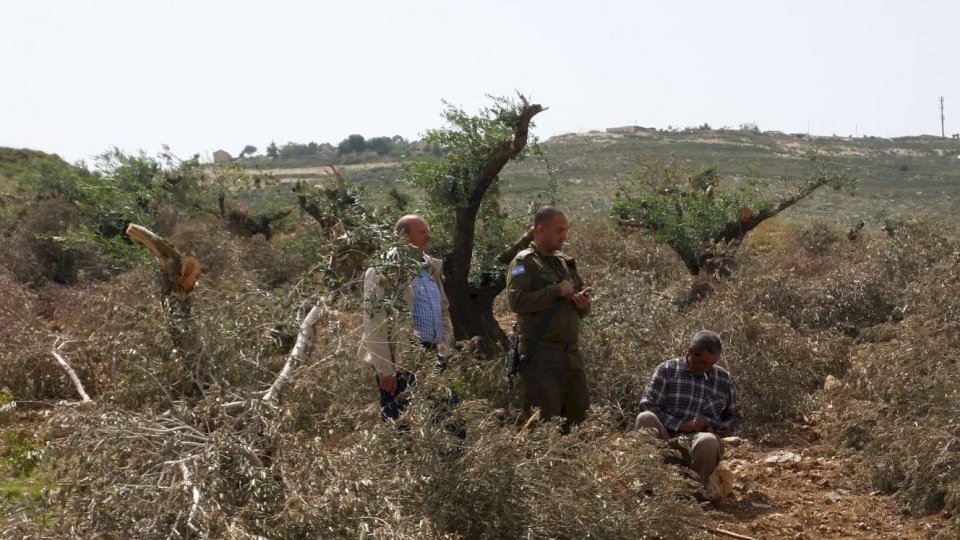
"Resistance to the Wall": The Occupation Issues Military Orders to Remove Trees from 69 Dunams of Land in Nablus Governorate
SadaNews - The Wall and Settlement Resistance Authority revealed that the occupation authorities issued 3 orders to take "security measures" aimed at removing vegetation and uprooting olive trees from the lands of the villages of Salem, Burin, and Madama in Nablus governorate, affecting an actual area estimated at about 68.7 dunams, including a strip of land extending 5,567 meters in the lands of Burin and Madama.
The Authority explained, in a statement issued today, Saturday, that an analysis of the orders reveals that two of them, namely orders 79/26 and 80/26, target nearly the same site in the lands of Salem, with a fundamental difference in the deadlines for implementation and objection, while order 83/26 targets a long corridor between the lands of Burin and Madama.
It noted that the primary danger of these orders does not only lie in the targeted areas and trees, but in the fact that they were issued after the occupation forces had already carried out removal operations on the ground, turning them from prior decisions for implementation to subsequent procedural cover for a completed action.
It indicated that although their texts grant citizens periods for objection, the issuance of these orders after the uprooting of trees, and allowing some of them to be executed immediately upon signing or within only three hours, nullifies the substance of the right to object, reducing it to a mere formal procedure that cannot prevent harm or protect property. Thus, military orders are used to legitimize the imposed reality with subsequent effect, not to guarantee the landowners' right to actual objection before their lands and properties are affected.
It continued: The orders for "taking security measures" numbered 79/26, 80/26, and 83/26 reveal a very dangerous pattern in the use of military legislation, as the orders were issued, according to field data, after the occupation forces had begun or actually completed the process of tree removal, transforming them from previous decisions for implementation into tools for providing subsequent procedural cover for a reality imposed by force. Although they include texts allowing for objection, the immediate execution in order 79, the deadline of no more than three hours in order 83, and the explicit provision permitting objections even after the completion of the work, render this right devoid of its preventive substance. The right to objection is not effective if granted after the occurrence of harm, especially when it involves uprooting trees and a permanent change in the nature of the land that cannot be remedied merely by accepting a subsequent objection.
 Follow the latest Sada News via Google News
"Resistance to the Wall": The Occupation Issues Military Orders to Remove Trees from 69 Du...

Jordan Condemns the Escalation of Settler Terrorism in the West Bank and Holds the Occupat...

Establishment of 4 Settlement Outposts in the Surrounding Areas of Nablus

Report: Colonial Settlements and Pastoral Farms Expand in Area Classified as (B) with Faci...

اعتقالات ومداهمات وتشييع بلا مشيعين.. بلدة تل تحت الحصار الإسرائيلي

Occupation Launches Wide Campaign of Raids and Arrests in the West Bank

Amid Diplomatic Activity.. Trump Gives Iran the Choice Between Peace and Escalation as His...
