

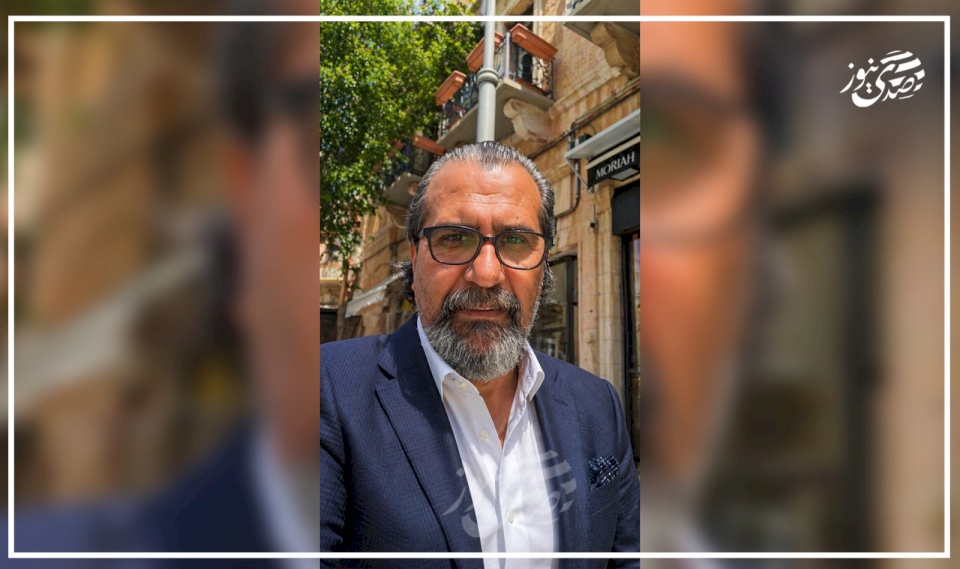
On the anniversary of the passing of Faisal Al-Husseini... The last guardian of Ilya
He was the last guardian standing on the walls of the city that never sleeps... He was not just a man walking on the earth, but resembled an ancient olive tree whose roots were planted deep in history, until its branches came to know the secrets of conquerors, saints, prophets, and passersby... When he entered the old alleys, the stones felt they were reclaiming their original names, and the arches burdened with dust would lift their backs a little to let his majesty pass beneath them... He was more than just a politician or leader; he resembled an ancient monk who rose from the pages of legends bearing the keys to a city that was lost between the fingers of kings, sultans, and soldiers...
He was the son of the caretaker of the old city... which has borne many names through the ages... once called Ilya when the sky was closer to the earth, and once named Orsalem, when the prayers of humans mixed with the tears of prophets, and once it was a city of peace that never knew peace, and once a jewel of the East contended over by empires like wolves fighting over a solitary moon on a winter night... But he knew that names are merely garments that cities change, while the spirit remains the same... And so he carried its spirit on his shoulders as people carry their children fleeing from the storm...
He understood that cities have hidden hearts, and that the heart of Ilya was not just in the domes and walls, but in the homes that preserve memory from fading away... That is why the House of the East became more than just an old stone structure... It resembled a castle from another time, or a last tent still lit amid a long desert of darkness... There, in that house standing like an old guardian at the edge of dreams, the city would reclaim its voice whenever silence tried to suffocate it... The House of the East was like a great mirror where the city saw its true face, far from the masks imposed by wars, maps, and soldiers... The house was not merely a political headquarters as strangers presumed, but a small temple of memory, and a port where the ships of stories arriving from exile docked... Its walls knew the names of mothers who awaited their sons, and echoed the long meetings that resembled sessions of ancient sages trying to save a city from drowning... Anyone entering it felt as if they were entering the heart of the city itself, not an ordinary house... Even its windows seemed to watch the alleys with noble sadness, as if they knew that the new maps were attempting to uproot the meaning from the place...
He was the last guardian of Ilya... moving in the House of the East like an ancient hermit in his final temple... There, his voice would rise proclaiming that this city is not for sale, nor is it a footnote on a passing negotiation table, but the spirit of an entire people... He always repeated that the battle for place is not a battle of stones alone, but a battle of existence, awareness, and memory... He would say that the most dangerous thing that could happen is for people to become accustomed to loss, and to accept absence as if it were eternal fate...
He resembled Saladin when he returned from the ruins of wars to restore the city’s face, but he did not possess an army of knights nor banners of silk... His weapons were words, patience, and memory... He knew that cities do not fall only when armies enter them, but when their people lose the ability to remember them... That is why he guarded memory more than he guarded stones... He feared for the story more than he feared for the walls, for walls may crumble and then be rebuilt, but if the story dies, nothing will remain but emptiness... He walked the streets of the city like a Sumerian priest in an ancient temple, knowing that every stone holds a legend, every window hides a prayer, and every stone staircase bore witness to the footsteps of prophets, soldiers, lovers, and the crucified... When he spoke of the city, you felt it was not a place, but a living being that breathes, suffers, ages, and resists. It was, for him, an old woman wearing the robe of rain, sitting at the gate of time waiting for her children who became lost in exile... He believed that the people of the city are its true walls. He did not see heroism merely in grand slogans, but in the endurance of people within their homes, in opening old shops every morning, in the sounds of children running near the walls, and in a woman hanging laundry on a balcony overlooking sorrow. He would say that those who remain in the city are the ones who write its true history, and that presence itself is a form of resistance. Therefore, he kept urging people to cling to life as a drowning man clings to a last piece of wood in the sea...
And when the protector of memory departed, it felt as if someone had uprooted a pillar from the hidden temple that supported the spirit of the city... His death was not merely the absence of a man, but it seemed as if time itself stumbled and fell... After him, the alleys grew colder, windows started closing early, and the domes appeared as if they were swimming alone in a distant sky that could not hear prayers... Even the wind that used to pass over the walls lost some of its sound, as if it were searching for him among the faces and could not find him...
Also after him, the House of the East became like an abandoned palace in an ancient legend... The doors that used to echo with footsteps became shrouded in silence, and the corridors that once held the sounds of long discussions seemed to have lost their pulse... The house resembled a large ship that suddenly docked in the harbor of oblivion. When it was closed, many felt that the city itself had closed a window it breathed through... The closing of the House of the East was not just shutting a building; it was an attempt to suffocate the meaning it represented, the meaning that said this city has its people, its memory, and its undying heart...
After his departure, darkness spread in the old corridors like black ink spilled over a sacred manuscript... Strangers became more numerous than the rightful owners of the place, and stones began to learn another language that resembled neither the call of the muezzins nor the bells of churches. Absence crept slowly, like rust creeping on an abandoned sword... Everything seemed to be transforming into a large museum of memories, a city suspended between life and legend, between prayer and ruin...
The city after him resembled Troy after it burned, standing on ashes attempting to remember the faces of those who died defending it... People walked in its markets like survivors of a flood, carrying the remnants of their names on weary shoulders. No one raised their voice as he did anymore, nor gathered the fragments of the story as he collected them. Everyone spoke of the place, but few knew its soul as he did...
He resembled Gilgamesh in his long journey in search of immortality, but he knew that true immortality lies not in the body but in the legacy one leaves in the memory of their city. That is why his name remained etched in the stones and in the voices of the vendors and in the aroma of bread rising from the ovens of the old town. Even the children who never saw him came to hear about him just as people hear of the old knights who guarded cities from falling.
And on the nights when fog covers the walls of the city, it seems as if he is still there, walking near the old doors, checking on the guards, patting the shoulders of passersby, and whispering to the stones not to forget their name... As if his spirit transformed into a specter hovering over the domes, the stone stairs, and the ancient trees... As if the city itself began to hold his voice in its crevices as the seas hold the echoes of sunken ships.
Faisal Al-Husseini understood what many did not. He understood that the city is not just a battle over land, but a battle over meaning. And whoever loses the meaning of the city loses it even if they stand over its stones. That is why he fought to keep the story alive, to keep people capable of naming things by their old names, so that the alleys do not turn into mere tourist maps devoid of spirit. He would repeat that the city does not need to be wept over as much as it needs someone to live in it, protect its memory, and prevent its uprooting from the hearts of its people.
He knew that great cities resemble the phoenix, burning and then arising from the ashes, but he feared the day would come when the phoenix finds no ashes to return from... Therefore, he continued to carry the city in his heart like people carry a last prayer in times of ruin. He understood that those who seek to steal a place always begin by stealing memory, changing names, erasing stories, turning the sacred into mere fleeting scenes in a tourist image... After him, night became longer... The minarets appeared as if they were calling out into a distant void... The ancient trees in the old squares resembled old women waiting for children who would not return. Even the pigeons that used to soar over the domes seemed to have lost their way. The city slowly entered into an isolation resembling that of defeated kings in ancient legends.
Yet, something of him remained in it. It lingered in the faint voices emerging from the old shops, in the dust-covered books on the shelves, and in the eyes that continue to look steadfastly at the sky despite everything. It remained in the stubbornness of the city itself, that which resembles a woman who does not cease to dress her wounds and then rise again.
Faisal Al-Husseini knew that cities do not die all at once, but die when their people stop dreaming of them. Therefore, he continued until his last days to plant dreams in hearts as a farmer sows his seeds in land threatened by drought. He believed that dreaming is a form of resistance, and that those who dream are not easily defeated.
Today, when you walk through the old streets of Ilya, you feel that his shadow still hangs among the stone arches. As if the stones preserve the sound of his footsteps, and the old doors await his return one morning, carrying his voice, his smile, and his old determination. Perhaps this is why the city, despite all that has befallen it, still stands to this day. It stands like an olive tree battered by storms but refuses to fall.
Thus, the man became part of the legend of the place. He was no longer just a name in a book or a photo hanging on a wall, but resembled the figures that exist between reality and symbol. He became one of those who, after their death, transform into unseen guardians of ancient cities. When people mention him, they do not remember him as a passing politician, but as the last knight who tried to prevent the night from swallowing a city that always stood between heaven and the abyss.
In the end, perhaps Faisal Al-Husseini was not just a man who lived and died, but a mirror of the spirit of the city itself. A city that tires but does not break, grieves but does not silence, and remains, despite everything, standing on the edge of time, carrying its old names in its heart like an eternal charm against forgetfulness.
 Follow the latest Sada News via Google News
Khalil Al-Hayya as President of Hamas.. Continuation of the Founders' Approach

The Annihilation of Sportsmanship

Until When Will the Palestinian Citizen Pay the Price of an Endless Phase?

7-10 Billion Shekels.. The Bill for the Absent Worker from Brussels

Why Does Marwan Barghouti Remain the Key to Unity and Settlement?

The Joy That Passes Through Barriers

Post-Palestinian Elections: Who Holds Legitimacy and Who Has the Ability to Govern
