

Elites and Homelands
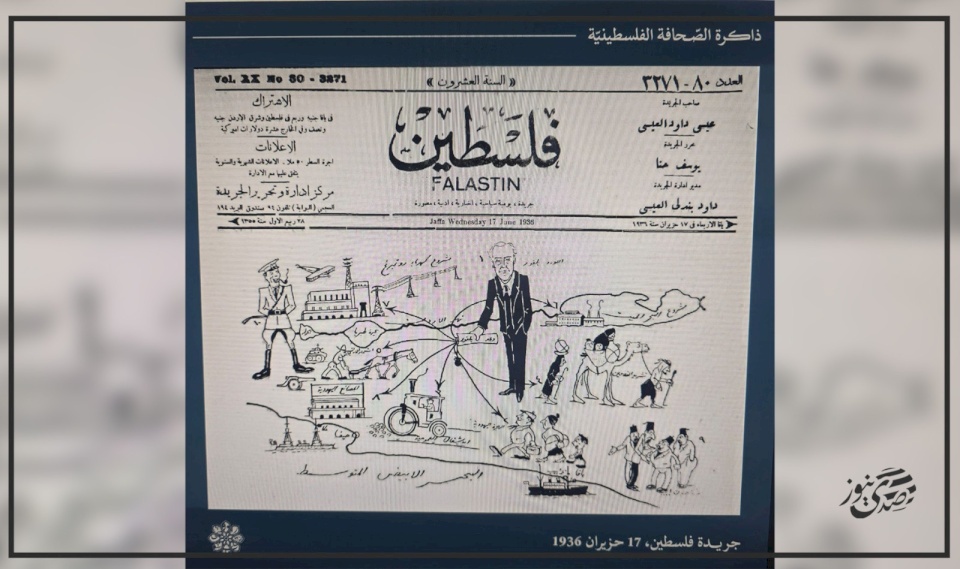
In politics, history does not leave; it recycles itself in harsher and more intelligent forms. Since the 1930s, when Palestine was under the weight of the British mandate and the political transformations resulting from the Balfour Declaration, the political scene reflected a crisis deeper than just a struggle with an external colonial power. The real conflict lay in the ability of political elites to envision the future while the arena was filling up with competition for influence and representation more than concern for building a unified national strategy. In the famous cartoon published by Palestine newspaper in 1936 during the Great Palestinian Revolt, the criticism was not only aimed at the political reality but also served as an early warning that preoccupation with internal conflicts might grant history a chance to pass over peoples without waiting for them.
In that time, British Foreign Secretary Arthur Balfour appeared symbolically in the drawing, maneuvering the strings of the political game. The British policies related to the Balfour Declaration represented the foundation that contributed to shaping the features of the Zionist project economically and politically within Palestine, whether by encouraging immigration or supporting the new economic structures, such as industrial projects, energy, and the economic infrastructure that began to gradually form at that time. The conflict was not merely a direct military or political confrontation; it was a struggle against time itself. Those who have the ability to organize collective political decision-making possess the capacity to influence the course of history.
Today, the picture seems more complicated, yet it carries the same features in new forms. The Palestinian scene suffers from a profound political and institutional division between institutions linked to traditional political representation, like the Palestine Liberation Organization and the Palestinian National Authority, versus other political and military forces such as Hamas and Islamic Jihad. This fragmentation has transcended mere political disagreement and has become a political structure that continually reproduces itself at a time when Palestinians face an uneven balance of power against Israel, which is politically and militarily supported by its allies, led by the United States.
In this context, the new warning emerges linked to what the American political discourse presents at this current stage, especially concerning the policies of the current American president Trump, who is leading political moves within what is known as the 21-point peace initiative. Some analysts believe that what is proposed in this initiative could reshape the concept of a political solution in the region, particularly concerning the idea of a Palestinian state and the right of the Palestinian people to self-determination. The danger here does not only lie in foreign policies but in the possibility of repeating the same historical mistake: becoming preoccupied with internal conflicts and allowing major international transformations to pass without possessing a unified national program capable of addressing these changes.
History reminds us that neglecting the plans of major powers in the past was not merely a fleeting political mistake, but one of the factors that contributed to forming a subsequent tragic reality. Today, the challenge does not seem very different; the Palestinian cause, despite its symbolic and global media presence, has not always succeeded in turning this symbolic capital into a pressure political force capable of imposing new equations because the Palestinian political voice has sometimes remained multifaceted, governed by disparities in perspectives regarding the nature of the conflict itself: is it a long-term liberation struggle? Or a gradual negotiation path? Or an open-ended political confrontation?
The difference between the past and the present is not in the intensity of the conflict but in the complexity of its tools. In the past, colonialism appeared directly and clearly. Today, the conflict takes on quieter political, economic, and diplomatic forms, yet it is no less severe on the ground. Peoples are not always defeated on the fields of direct battles; they may be drained when their leadership becomes more preoccupied with managing internal party competitions than formulating an inclusive national project capable of confronting major historical transformations.
Perhaps the most pressing question today remains the same one that history posed nearly a century ago: Does the strength of peoples lie in their ability to confront external adversaries only, or in their ability, first and foremost, to build a national decision unity capable of transforming challenges into a future political project? Nations that allow history to write their fate instead of writing it themselves often find themselves repeating the same harsh lessons across generations.
 Follow the latest Sada News via Google News
The Annihilation of Sportsmanship

Until When Will the Palestinian Citizen Pay the Price of an Endless Phase?

7-10 Billion Shekels.. The Bill for the Absent Worker from Brussels

Why Does Marwan Barghouti Remain the Key to Unity and Settlement?

The Joy That Passes Through Barriers

Post-Palestinian Elections: Who Holds Legitimacy and Who Has the Ability to Govern

A Personal Perspective .. What Jerusalem Needs "Now, Not Tomorrow"
