

Why Do Syrians See Their Forgotten History in the Caves of Mount Qasyoun?
SadaNews - Mount Qasyoun is one of the most prominent natural landmarks in Damascus, and one of the sites most connected to the collective memory of Syrians. Its significance goes beyond its geographical elevation overlooking the capital; it also encompasses a historical and cultural site associated with events and narratives passed down by ancient sources, maintaining its status as a point that reveals the city through its architectural layers and transformations over the centuries.
A Strategic Overlook of the Capital
The mountain is located to the north of Damascus, extending along the city for several kilometers, with an elevation of about 1,150 meters above sea level.
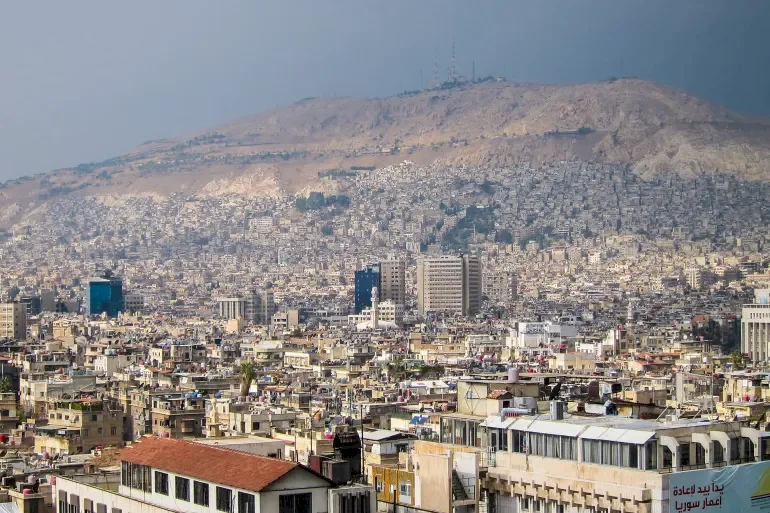
This height provides a direct view of both the old and modern neighborhoods of Damascus, from the historical city walls to the new urban expansions.
From its summit, the outlines of the capital can be clearly traced; the ancient district is visible, including the Umayyad Mosque and Hamidiyeh market, alongside neighborhoods such as Mazzeh, Kafr Sousa, Abu Rummaneh, and Al-Malki.
The view also reveals the urban expansion the city underwent during the twentieth century, encapsulating the transformation of Damascus from a walled city to an expansive capital.
Presents in Historical Sources
Qasyoun is linked to several religious and historical narratives. Islamic sources mention that at its base or in its caves, there are places attributed to prophets, and its name is associated with what is known as "the Cave of the Blood," where traditional accounts suggest that Cain killed his brother Abel. Despite disagreements among researchers regarding the accuracy of these narratives, they have contributed to cementing the mountain's presence in the popular consciousness.
Damascene historians, including Ibn Asakir in his book "The History of Damascus," referred to the mountain as part of the geographical scene surrounding the city since its inception.
It has been repeatedly mentioned in the writings of geographers and travelers who passed through Damascus, considering it a stable element in describing the capital.
Urban Development on the Slopes
The slopes of Qasyoun have witnessed significant urban expansion over the past decades, with residential districts gradually extending upwards towards the highlands.
This expansion has altered the natural scene of the mountain, making it part of the city’s urban fabric rather than just a natural background.
Some of its areas have turned into popular spots for residents to enjoy panoramic views of the capital, especially during national or religious occasions, when Damascus appears from above as a connected network of lights revealing its vastness and diverse neighborhoods.
A Symbol in Cultural Memory
Qasyoun has appeared in Syrian poetry and literature as a witness to the city’s transformations. Its name has been used in literary texts and national songs, becoming a symbol of steadfastness and elevation.
Its name is also associated with popular phrases that indicate its status in the public imagination, becoming closely linked to mentions of Damascus in many contexts.
This cultural presence has reinforced its status as more than just a geographical location; it has turned into a signifier of the capital itself. Referring to Qasyoun is often a direct reference to Damascus, its history, its inhabitants, and the details of their daily lives.
An Overlook Revealing the City’s Layers
The summit of the mountain offers a comprehensive view allowing for a reading of the architectural composition of Damascus. The historical core of the city can be distinguished by its markets and alleys, followed by the modern expansions that emerged in later periods.
The differences between densely populated old neighborhoods and modern areas with wide streets and multi-story buildings are also clearly visible.
The view also reveals the green expanse of the Ghouta orchards that historically formed an agricultural belt around the city, despite the decline in its areas in recent decades. In this sense, the mountain provides a visual reading point for the environmental and urban transformations that Damascus has undergone.
A Religious and Touristic Dimension
In addition to its historical symbolism, Qasyoun has remained a destination for visitors wishing to see the capital from above, with several shrines and sites in its area visited by some for religious reasons, alongside being a site that offers a general view of the city.
This diversity has helped cement its place within the map of domestic tourism, combining natural and historical dimensions, and providing visitors with an opportunity to see Damascus from a different perspective that reflects its vastness and diversity.
A Witness to the Capital's Transformations
Throughout the centuries, Mount Qasyoun has remained present in the backdrop of the Damascene scene, witnessing the succession of states and emirates, the transformations of the urban structure, and the shifts in lifestyle in the capital.
With each historical phase, the mountain has remained a fixed point in geography, while the details of the city change at its foothills, yet it remains a unifying element in its overall image.
In this regard, Qasyoun forms one of the keys to understanding Damascus; it is not merely a natural elevation, but a space that reveals from above the history of a city considered one of the oldest continuously inhabited capitals in the world, encapsulating in its scene accumulated temporal layers that reflect its civilizational depth.
 Follow the latest Sada News via Google News
After Deschamps' Departure... Zinedine Zidane Tops the Candidates to Lead France

Mbappe Surpasses Messi and Becomes the All-Time Top Scorer in the World Cup

England Defeats France and Achieves Largest World Cup Achievement Since 1966

Messi Refused to Play for Spain and Missed 3 World Cups

Publishers Sue Google for Allegedly Using Books to Train Artificial Intelligence

Google Expands Capabilities of Google Search Console to Support Social Media Accounts

The Mediterranean Table... An Ancient Diet Revealing Its New Secrets for Health and Longev...
