

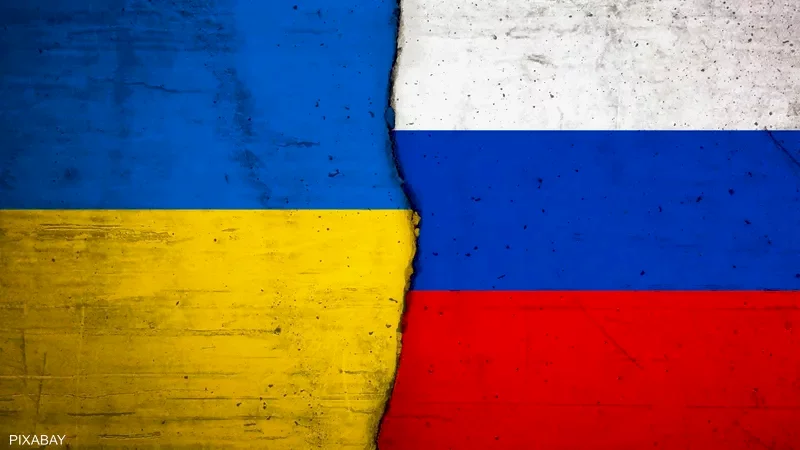
Russia Accuses the West of Executing a "Nuclear Adventure" in Favor of Ukraine
SadaNews - As the fourth anniversary of the beginning of the Russian war on Ukraine approaches, Russian intelligence has released a statement accusing Western powers of working to supply Ukraine with nuclear equipment and technology that would enable it to change the balance of the war or extract better negotiating terms.
According to the Russian narrative, this Ukrainian-Western maneuver is not surprising, as it comes in a very complex international scene, unlike anything the world has seen since the beginning of the 21st century, where the confrontation between Russia and the West has reached dangerous levels amid the termination of the "New START" treaty, the last agreement that constrained major nuclear powers.
Russian President Vladimir Putin placed this alleged threat within the context of what he described as continuous efforts to inflict a "strategic defeat" on his country, warning that Russia's adversaries "know what will happen if they use a nuclear element" in any attack against it.
So what are the details of this new Russian accusation, what are its backgrounds, and is it merely part of the psychological warfare between Russia and the West?
What are the details of the Russian allegations?
According to a statement published by the media office of the Russian Foreign Intelligence Service on February 24, 2026, Britain and France stand behind an attempt to supply Ukraine with nuclear weapons and technology, as London and Paris believe that "Kyiv would then be able to look forward to better terms for ending hostilities" in its war against Russia.
The British-French scheme - according to Russian intelligence - involves a secret process to transfer European components, devices, and technologies to Ukraine. Specifically, the French micro warhead of the "TN-75" type was considered to be mounted on the "M51.1" ballistic missiles launched from French nuclear submarines.
Russian intelligence sees the goal as providing Ukraine with a "wonder weapon" in the German term "Wunderwaffe," which it could rely on as a nuclear weapon or at least a "dirty bomb," referring to a bomb consisting of conventional explosives packed with radioactive materials to spread in the air upon detonation.
Remarkably, the statement noted that Russian intelligence indicated that Germany wisely declined to participate in this "dangerous adventure."
Russian intelligence stated that the British and French are seeking to obscure the transfer of nuclear technology to Kyiv under the guise that it was developed by Ukraine.
Following the release of the intelligence statement, the Kremlin stated that Russia would take into account this information regarding London and Paris's intent to arm Kyiv with nuclear weapons during negotiations to end the war.
For its part, the Russian Federation Council (the upper chamber of parliament) indicated that Russia would treat the sending of nuclear weapons to Ukraine by Britain and France as a joint attack, warning that this step would lead to escalating the conflict and creating threats to the security of Russia and the European region.
Meanwhile, Dmitry Medvedev, deputy chairman of the Russian Security Council and the third president of Russia following the dissolution of the Soviet Union, stated that the transfer of nuclear technologies to Kyiv is a "direct path to a world war," warning that his country may launch nuclear strikes against Britain and France if they provide Ukraine with nuclear weapons.
This is not the first time Russia has accused Ukraine of seeking a nuclear bomb; during the eighth month of the war, Moscow accused Kyiv of beginning to implement a plan to use a "dirty bomb," demanding that it and its Western allies cease steps that could lead the world to a nuclear disaster.
How do we understand Russia's position?
"A desperate attempt": Moscow believes that London and Paris - whose positions now differ from the United States, which is keen to end the war even at the cost of significant Ukrainian and Western concessions - have come to the conclusion that conventional military means are no longer sufficient to defeat Russia or decisively change the balance of power.
Therefore, Russia considers providing Ukraine with nuclear weapons or a "dirty bomb" to be a Western attempt to grant it a "desperate" strategic leverage to extract better negotiating terms amid a stalemate on the battlefield.
Ukrainian capabilities: Russian accusations are based on the fact that Ukraine possesses an advanced nuclear scientific and industrial base dating back to the Soviet era, including research reactors (such as the Nuclear Research Institute in Kyiv) and uranium mines (such as the Jovta Voda plant). Moscow claims that Kyiv is getting closer, thanks to British technical support, to manufacturing a "dirty bomb."
Russia sees that Ukraine, after what it considers a collapse of the security guarantees it received under the "Budapest Memorandum" in 1994, now views its abandonment of its previous nuclear arsenal as a historical strategic mistake that left it exposed to invasion.
International vacuum: With the termination of the "New START" treaty in February 2026 and the collapse of international monitoring mechanisms, Russia feels that the world has entered an "open arms race." In this context, according to Russian calculations, it seems logical for Ukraine to seek to possess its own deterrent, especially with growing doubts about the sustainability of traditional Western security guarantees in the long term.
How do we understand the West's position?
Undermining the nuclear umbrella: In 2026, discussions accelerated in Europe regarding the need for strategic defense independence, especially with rising doubts about Washington’s commitments under the Donald Trump administration. French President Emmanuel Macron proposed expanding the scope of the French nuclear deterrent to serve as a "European umbrella."
This move poses an existential threat to the Russian strategy, which relies on dividing Europe and dealing with each country individually. By accusing France and Britain of being involved in spreading nuclear weapons in Ukraine, Russia aims to deter other European nations from accepting French protection or nuclear cooperation with Paris and London.
Coercive diplomacy: Western strategic analysts, like Lawrence Freedman, argue that the Russian nuclear threat is used as a "persuasion" tool that suggests the costs of the continuing conflict for the West will outweigh any potential benefits.
By promoting the narrative of the West transferring nuclear technology, Moscow places Western powers in a defensive position, hinting that it may have to use its tactical nuclear weapons in response to this alleged threat.
This kind of "blackmail" aims to push Western powers to reduce the volume of advanced conventional military assistance (such as aircraft and advanced tanks). It is an attempt to impose new "red lines" at a time when Russia feels that the old lines have been crossed without sufficient consequences.
Ukrainian and British Denials
Ukrainian Foreign Ministry spokesperson Hryhoriy Tyhiy described the Russian allegations as "pure nonsense" and a desperate attempt by Russian foreign intelligence "to fabricate fairy tales to compensate for failures on the front."
Kyiv reiterated its full commitment to the Treaty on the Non-Proliferation of Nuclear Weapons, reminding the world that it is the only country that voluntarily relinquished the world's third-largest nuclear arsenal in the 1990s in exchange for security guarantees that Russia, it claims, has violated.
For its part, Britain stated that Russia's claims are baseless. A government spokesperson said, "This is a clear attempt by Vladimir Putin to divert attention from his horrific actions in Ukraine."
Between the Russian narrative of the "wonder weapon" and the Western fears of Russia’s ambitions, the reality on the ground remains the ultimate arbiter. Accusing London and Paris of seeking to arm Kyiv with nuclear weapons may be the peak of verbal combat.
However, at the same time, it shows that the conflict in Ukraine has gone beyond that geography to become a struggle for the shape of the new global order; a system in which "nuclear horror" seems poised to become a cornerstone once again.
 Follow the latest Sada News via Google News
Macron: France Requested EU Assistance to Deal with Fires

Ukrainian Drones Target St. Petersburg Area in Russia

Man Stabs Two People in New York While Shouting 'Allahu Akbar'

Tehran Responds: Trump Threatens to Use Iranian Funds to Compensate Damaged Ships

American Escalation Using B-1 Bomber Against Targets of the Iranian Revolutionary Guard

Iranian Revolutionary Guard Targets Al-Adairi Camp and Ali Al-Salem Air Base in Kuwait

Massive Fire in Spain Forces Residents of 34 Villages to Evacuate
