

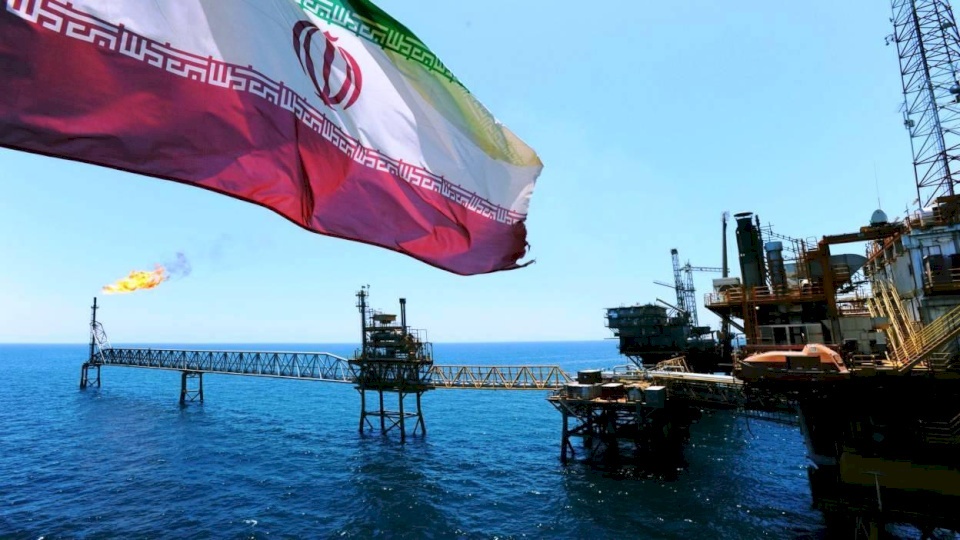
How Will Oil Be Affected If Tensions Between Washington and Tehran Escalate?
SadaNews - The escalating tensions between the United States and Iran have already pushed oil prices to their highest levels in six months. Oil traders are closely monitoring any potential escalation that could disrupt Iran's crude production or push its government to close a vital shipping route used by several major energy exporters in the region.
The United States has deployed a wide array of military forces in the region, and President Donald Trump has stated that he is considering a limited strike against Iran while pressuring its government to quickly reach an agreement that restrains its nuclear program. Any attack or move by Iran to restrict access to the Strait of Hormuz, through which about a quarter of the world's seaborne oil passes, could have implications for global oil markets.
How Important Is the Iranian Oil Industry?
Iran's influence has diminished in recent years due to ongoing sanctions and a decline in foreign investments. In general, the country contributes about 3% of global supplies, producing around 3.3 million barrels per day.
Iran began developing its oil sector in the early 20th century, under the supervision of a British government keen on securing reliable supplies. After decades, the country became a founding member of the "Organization of the Petroleum Exporting Countries" (OPEC) and rose to become the second-largest producer in the organization. At its peak production in the mid-1970s, Iran was among the world's top oil exporters, accounting for over 10% of global crude production.
However, this dominance was undermined after the 1979 revolution, when the new regime expelled foreign companies from the oil sector, reducing outside investments and expertise. Oil production in the country declined and has not returned to peak levels since.
The Islamic Republic of Iran increased its exports after the end of its war with Iraq in the late 1980s as part of efforts to bolster economic growth. Major European and American oil companies subsequently sought to re-enter the sector, but such efforts collapsed in 2018 when the Trump administration withdrew from the Iranian nuclear deal – an international agreement aimed at limiting and monitoring the country's nuclear program in exchange for easing sanctions – and reinstated sanctions.
Today, Iran ranks fourth among oil producers in OPEC, behind Saudi Arabia, Iraq, and the UAE, according to January production data.
Who Buys Iranian Oil?
Amid international sanctions, Iran now relies on the Chinese market to absorb about 90% of its crude exports, which are sold to independent refineries at a significant price discount.
Official customs data indicate that China has not imported Iranian crude since mid-2022, but Iranian oil is shipped through clandestine trade networks and a "shadow fleet" mostly consisting of aging oil tankers. These flows reached about 1.25 million barrels per day in January, compared to 898,000 barrels during the same period a year earlier, according to "Kpler" analytics and ship tracking data.
How Could a New Conflict Affect the Global Oil Market?
A large portion of Iran's production – up to two million barrels per day – goes to Chinese refineries, which would need to seek alternative suppliers in the event of a major disruption in Tehran's production.
However, the biggest risk lies in the potential threat to the Strait of Hormuz, the backbone of global oil supplies, through which a large portion of Saudi Arabia, Iraq, UAE, and Qatar’s exports pass.
Why Is the Strait of Hormuz So Important?
The Strait of Hormuz is the narrow waterway connecting the Arabian Gulf to the Arabian Sea. The Iranian government has previously stated that it has the capability to impose a naval blockade as geopolitical tensions rise, although it has not yet taken any actual steps to close the passage. Disrupting this vital trade route could jeopardize shipments of oil, liquefied natural gas, and propane from Iraq, Kuwait, Saudi Arabia, and the UAE.
Around 16.5 million barrels of oil pass through the strait daily, including most of Iran's exports. Saudi Arabia holds the largest share of this amount, at about five million barrels per day, but it can reroute shipments via a pipeline that stretches 746 miles from the eastern part of the kingdom to its west, reaching a port on the Red Sea where oil can be loaded onto vessels for transport. Similarly, the UAE can bypass this passage by transporting 1.5 million barrels per day through a pipeline that ends at the Gulf of Oman.
Closing the Strait of Hormuz would likely disrupt the flow of oil to Asia from the Middle East. In June, when tensions escalated in the region during a 12-day conflict between Israel and Iran, the cost of chartering a giant tanker to transport two million barrels of crude from the Middle East to China surged.
What Is the Significance of Oil to the Iranian Economy?
Oil exports remain a fundamental pillar of the Iranian economy, despite years of efforts to reduce dependence on crude and diversify into heavy industries, textiles, and mining.
The oil sector contributed about two percentage points to Iran's GDP growth in 2023 (a year in which the economy grew by about 5%), highlighting the extent to which overall growth relies on oil.
Although sanctions have forced Iran to sell its oil at significant discounts compared to global prices to attract buyers, the country achieved revenues estimated at $2.7 billion in November alone, based on Bloomberg calculations using a discounted oil price of $45 per barrel, after accounting for shipping and other costs.
However, Iranian oil revenues may come under further pressure if the "maximum pressure" campaign led by President Trump – which includes a series of U.S. sanctions since he took office – deters Chinese buyers. Revenues will also face additional pressure if the Iranian government lowers prices to compete with heavily discounted Russian crude.
 Follow the latest Sada News via Google News
London Stock Exchange Enters the Era of 24/7 Trading

Shamaran Petroleum: Suspension of Oil Production in Duhok Fields in the Kurdistan Region o...

Dollar Steadies Near One-Week High Amid War Developments

Trump Imposes Tariffs on Canadian Imports... Ottawa Vows to Respond

Oil Prices Drop After Reports of Mediation Efforts Between the U.S. and Iran

Gold Price Rises Supported by Increased Buying Amid Lower Prices

Due to "Hazardous and Counterfeit Products".. Europe Fines "AliExpress" $627 Million
