

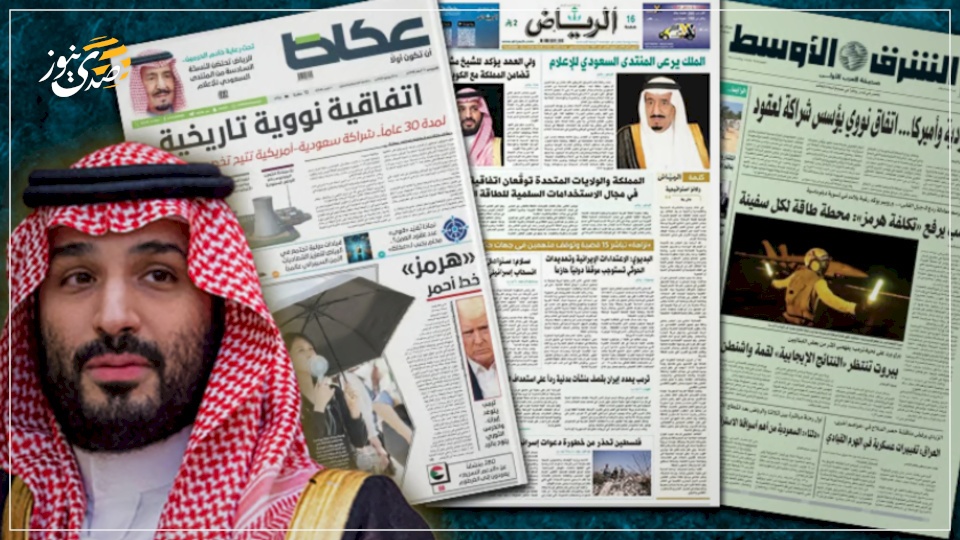
Panic Grips Israel Following Washington-Riyadh Nuclear Deal
Translation and Follow-up by SadaNews: There is a prevailing atmosphere of intense panic and significant concern within Israel's security and political circles following the announcement of a historic agreement for peaceful cooperation in the field of nuclear energy between the United States and Saudi Arabia. The zenith of Israeli fears lies in the clause permitting the establishment of a uranium enrichment facility on Saudi territory, and Washington's complete separation of this nuclear cooperation from any conditions related to normalizing relations with Tel Aviv, which has sparked a wave of anger and widespread warnings within Tel Aviv about the implications of this step on its national security and power balances in the region.
This Israeli fear was reflected in sharp warnings issued by senior former officials within the Israeli defense establishment. According to media reports, including one published by the Hebrew newspaper "Yedioth Ahronoth" quoting the "New York Times", these officials estimated that the deal would lead, in the "best-case scenarios", to undermining the normalization prospects between Tel Aviv and Riyadh, while in the "worst-case scenarios", it would spark an intense nuclear arms race in the Middle East.
According to SadaNews's translation, the Israeli side believes that the absence of strict international monitoring standards in the agreement opens the door for the potential future exploitation of a civilian program to develop military capabilities, especially since the distance between peaceful enrichment and military capability significantly shrinks once control over fuel cycle technology is achieved.
In a detailed analysis of the panic gripping Israeli security circles, Avner Wylan, a former senior official in the defense establishment and a nuclear expert, explained that the agreement represents a dangerous shift in American policy regarding nuclear non-proliferation by abandoning the "gold standard" previously applied with the UAE.
Wylan confirmed that the primary concern does not lie in Saudi Arabia becoming a direct enemy today, but in legitimizing "nuclear capabilities" and providing the infrastructure and expertise that would enable Riyadh to produce military fissile materials in a short time in the future if regimes or alliances change. He also warned that allowing Saudi enrichment would undermine any ability to demand Iran halt its uranium enrichment and push other countries, like Turkey and Egypt, to call for equal treatment.
To mitigate these risks worrying Tel Aviv, Wylan emphasized, as translated by SadaNews, that Israel should insist on full reliance on the International Atomic Energy Agency's additional protocol, continuous inspections of the fuel cycle, and ensuring that operational control and equipment remain under full American management. He noted that despite the current security and operational coordination between Washington, Riyadh, and Tel Aviv against Iran, Israel finds itself compelled to adapt to a significant strategic enhancement by Saudi Arabia without obtaining a political agreement or sufficient leverage over the security mechanisms of the agreement.
On the internal political front, the Israeli fear has transformed into a sharp attack launched by the opposition against Prime Minister Benjamin Netanyahu's government; former Prime Minister Naftali Bennett described the agreement as a grave strategic mistake that threatens national security and creates a serious loss of control. Avigdor Lieberman, head of the "Yisrael Beiteinu" party, asserted that the Saudi civilian nuclear program would inevitably end with nuclear weapons acquisition, calling on the Israeli government to act immediately within the U.S. Congress to halt this step. Meanwhile, Yair Golan, head of the Democratic party, criticized the loss of Israel's ability to influence its fate and the marginalization of its security interests.
This Israeli storm comes at a time when the nuclear agreement is set to last for thirty years with an estimated value of tens of billions of dollars according to the "Wall Street Journal", aiming to give American companies a central role in developing Saudi nuclear infrastructure and sidelining foreign competitors, while allowing for the construction of the enrichment facility following a mutual review between Washington and Riyadh.
The agreement had been under discussion for years, as the Trump administration sought to consolidate the alliance with Riyadh after it was previously conditioned on normalization during Biden's administration before the events of October 7.
In contrast, the deal has been met with widespread celebration in the Saudi press; the newspaper "Okaz" described the event as the "historic nuclear agreement", while the "Middle East" newspaper highlighted its establishment of a decades-long partnership, and the "Riyadh" newspaper emphasized the signing of the peaceful cooperation agreement in the field of nuclear energy.
 Follow the latest Sada News via Google News
The Electoral Committee Announces the Legal Timelines for the 2026 Legislative Elections

Panic Grips Israel Following Washington-Riyadh Nuclear Deal

Officially.. Saudi Arabia and America Announce Reaching Nuclear Cooperation Agreement

More than 900 settlers storm Al-Aqsa Mosque so far

Why Can't Zahran Mamdani Arrest Netanyahu in New York?

The 5,000 Plan: What Are the 'Temple' Groups Planning for Al-Aqsa?

The US Army Completes Latest Round of Strikes on Iran
