

Friedman: 3 Leaders Driven by Hubris into Wars with No Exit
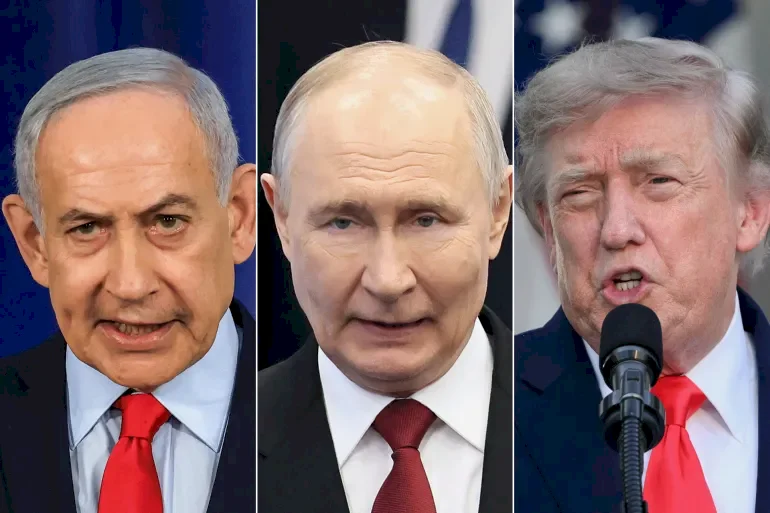
SadaNews - The American writer Thomas Friedman criticized the military options tendency of U.S. President Donald Trump, Israeli Prime Minister Benjamin Netanyahu, and Russian President Vladimir Putin. He stated that the common denominator among these leaders is their belief that they are the smartest, which has led them to make strategic mistakes that have embroiled their countries in complex wars that are difficult to exit.
In an article for the New York Times, Friedman notes that the three leaders surrounded themselves with loyalists who echo what they want to hear, rather than providing realistic assessments, causing them to overestimate their capabilities and underestimate their adversaries. Consequently, they ended up in conflicts with blocked horizons that can only be resolved through negotiation.
Friedman's critique particularly focuses on Netanyahu's calculations in confronting Iran. He argues that Netanyahu made a strategic error by assuming that military strikes alone would be sufficient to overthrow the Iranian regime and that Israel could engineer the post-fall phase and choose new leadership for Tehran.
He points out that the Mossad has carried out complex assassination operations and security infiltrations but does not necessarily possess the capacity to understand the political and social shifts within the targeted countries. He believes that the agency's reliance on opponents of the Iranian regime led it to exaggerate the regime's fragility and the potential for its rapid collapse.
Faulty Assessments
Friedman adds that these faulty assessments also affected Trump, who was convinced of the possibility of changing the Iranian regime through military force, ignoring the warnings from American officials who deemed these scenarios unrealistic.
The writer cites revelations from the New York Times about the Mossad preparing a plan to bring former Iranian President Mahmoud Ahmadinejad back to power after the current regime's fall, considering this idea to reflect a profound misunderstanding of Iranian history, as it would be difficult for Iranians, even among the opposition, to accept a leader viewed as imposed from abroad.
Friedman compares this to what happened in Ukraine, where Putin assumed that Russian troops would be welcomed as "liberators," based on the belief that Russians and Ukrainians are one people and that the Ukrainian government would collapse quickly. He states that the Russian intelligence services made the same mistake by relying on sources that told them what they wanted Moscow to hear, rather than conveying reality as it is.
The writer believes that Netanyahu, despite Israel's military achievements against Hamas, Hezbollah, and Iran, has failed to translate these gains into a new political reality that ensures lasting peace, instead making his primary goal to expand Israeli control over Gaza and the West Bank, which has harmed Israel's relations with its Western allies and weakened the chances for normalization with Saudi Arabia.
Undermining America's Standing
As for Trump, Friedman argues that he has weakened the United States' standing by entering a war against Iran without an international coalition or a political plan for post-military operations, allowing Tehran to utilize low-cost leverage, such as threatening navigation in the Strait of Hormuz and targeting Washington's allies in the Gulf.
Conversely, the writer believes that the Iranian regime bears a significant responsibility for the crisis, having spent decades repressing its opponents and squandering resources on external conflicts instead of investing in development.
Friedman warns that the most dangerous threat facing Iran in the future may not be military but environmental, given the acute water crisis and declining water resources, a crisis that could threaten the country's stability more than any military confrontation.
Friedman concludes that all of these wars will ultimately end through negotiation, as none of the parties involved can continue fighting indefinitely, noting that the question is no longer whether negotiations will come about, but when these leaders will be forced to recognize the failure of their military bets and seek a political exit.
 Follow the latest Sada News via Google News
Report: Houthis Prepare to Resume Targeting Ships Near Bab al-Mandab Strait

The World Heritage Committee Approves Four Decisions Regarding the State of Palestine by C...

The Smallest Island Nation in the World Prepares to Open Its Embassy in Occupied Jerusalem

Friedman: 3 Leaders Driven by Hubris into Wars with No Exit

Occupation Forces Begin Demolition of Two Houses in Nahalin and Za'tara in Bethlehem

Mamdani Acknowledges: New York Does Not Have Authority to Arrest Netanyahu (Video)

Uranium on Saudi Soil: Details of the Nuclear Agreement Between Trump and Riyadh
