

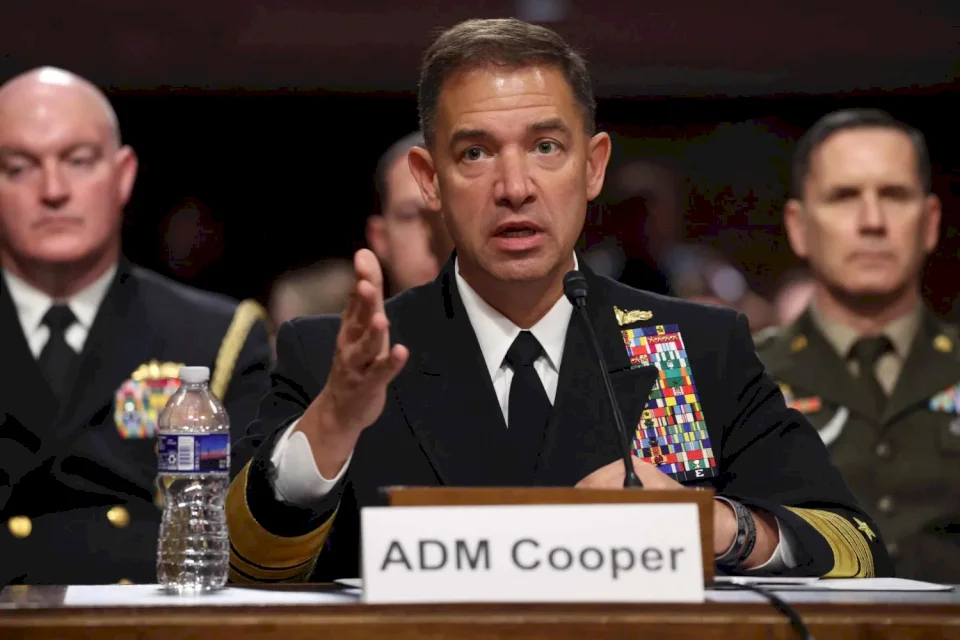
Commander of CENTCOM: U.S. Strikes Have Reduced Iran's Regional Threat
SadaNews - The commander of the U.S. Central Command, Admiral Brad Cooper, stated that Iran's ability to threaten its neighbors and U.S. interests in the region has "significantly decreased."
Cooper confirmed in a briefing before the Senate Armed Services Committee that Tehran is no longer capable of threatening regional partners or the United States as it did in the past "across all domains."
He mentioned that "the Iranian threat has greatly diminished," adding, "Their capabilities have decreased significantly."
He further stated that the U.S. military has a wide range of contingency plans and retains the ability to escort ships through the Strait of Hormuz, but referred policymakers to determine the most appropriate course during this "sensitive negotiation period."
Cooper noted that U.S. forces have ceased using advanced munitions to take down Iranian drones, as the limited stocks of expensive weapon systems, including advanced interceptors, have become a topic of debate during the war with Iran. He added that the U.S. military is currently using cheaper munitions.
He pointed out that Iran has only 10 percent of its drones remaining, despite ongoing skirmishes between Iranian and U.S. forces under a fragile ceasefire that has been in place for a month.
Senators opened the hearing on the status of U.S. forces in the Middle East and Africa, expressing concern about the future of the war with Iran and U.S. presence in Africa.
Senator Jack Reed, the senior Democrat on the Armed Services Committee, stated, "We are on the seventy-fifth day of this war with Iran, and I am concerned that the President does not have a reliable strategy for victory."
Senator Roger Wicker, the Republican chair of the committee, said Africa has become "increasingly a hotspot for global terrorism," emphasizing the necessity for U.S. leadership in Africa to remain a separate combat command.
In the same context, Bloomberg reported from a written version of Cooper's testimony prior to the session that U.S. forces have destroyed more than 90 percent of Iran's stockpile of naval mines, which was estimated at around 8,000 mines. Cooper clarified that over 700 airstrikes eliminated what he described as "previously a massive stockpile" of mines.
He noted that Iran still retains "disruption capabilities," including harassment and limited attacks with drones and missiles, as well as support for some proxies, but it "no longer has the means" to threaten major regional operations or deter U.S. freedom of movement in the air and maritime domains.
Nevertheless, Cooper stated that Tehran is still capable of influencing commercial navigation through rhetoric alone, explaining that "their voice is very loud, and the threats are clearly reaching the commercial navigation and insurance sectors."
 Follow the latest Sada News via Google News
The General Secretariat of the Organization of Islamic Cooperation Affirms the Role of UNR...

Paul's Initiative in Libya: A Real Settlement or a New Division of Influence and Resources...

The Ghost of El Fasher Haunts El Obeid.. A Funding Gap Threatens the Lives of 20 Million H...

Dozens Dead and Injured in Russian Missile and Drone Attack on Kyiv

8 Dead and Injured.. Russia Launches Deadly Attacks on Kyiv

Aoun calls on those opposed to the "framework agreement" to present an alternative

The Organization of Islamic Cooperation Welcomes the UN Report on Occupation Against Child...
