

Behind Neptune.. An Unknown Dwarf Planet Challenges the Laws of Physics with Its 'Impossible' Features
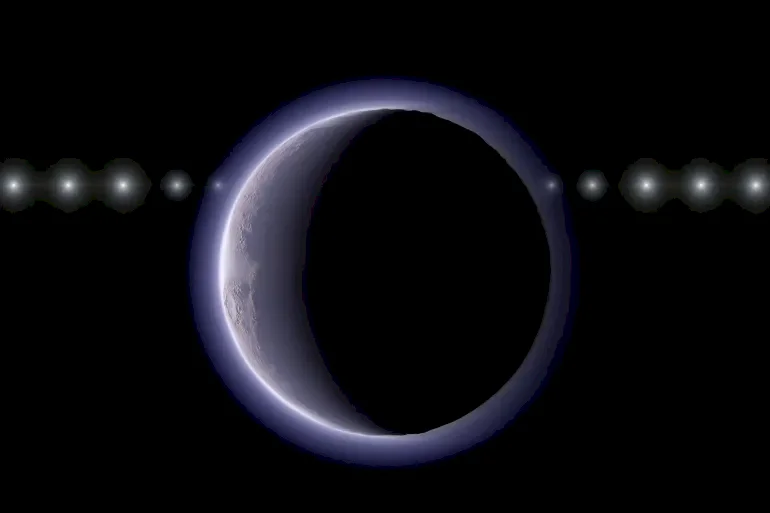
SadaNews - Japanese astronomers have sparked amazement within the scientific community after detecting evidence of an atmosphere surrounding a small icy body located in the Kuiper Belt, the cold and remote area beyond the orbit of the planet Neptune.
The body, technically known as "2002 XV93," has a diameter of about 500 kilometers, making it four times smaller than the planet Pluto.
According to prevailing concepts, this body is supposed to be too small and cold to have enough gravity to retain any gases around it, making this atmosphere a mystery in need of explanation.
This discovery was made using a precise astronomical technique called "occultation," where a team of professional and amateur astronomers in Japan observed the body passing directly in front of a distant star in January 2024. Researchers noted that the star's light did not suddenly cut off as it would when colliding with a solid object, but rather experienced a gradual dimming that lasted about 1.5 seconds.
Professor "Koh Arimatsu" from the National Astronomical Observatory of Japan (NAOJ) interpreted this smooth change as the star's light bending due to an extremely thin atmosphere surrounding the body, estimated to be a million times thinner than Earth's atmosphere.
The Mystery of the Ninth Planet and the Ghosts 'Beyond Neptune'
The discovery of this atmosphere does not come as an isolated event, but instead places us at the heart of the greatest mysteries of our solar system; the realm of "Trans-Neptunian objects."
This distant region, shrouded in mystery, has long piqued scientists' curiosity due to the unusual orbital motions of some of its bodies, which some believe may be due to the gravitational influence of a massive and hidden "Ninth Planet" lurking within.
The object "2002 XV93" is now only the second member of this "family" to be proven to possess an atmosphere, after the dwarf planet Pluto.
Such a discovery will change our perspective on these bodies from being mere inert icy rocks to possibly "active" geological worlds, raising the question: how many of our unknown neighbors in the Kuiper Belt possess such thin atmospheres that we have yet to discover?
The Mystery of Survival.. Cryovolcanoes or Cosmic Collision?
This discovery also raises profound questions about the source of this gas, with the "cryovolcanic activity" hypothesis emerging as a strong candidate; instead of molten lava, the body could be ejecting a mix of water, ammonia, or methane from its interior to maintain its atmosphere.
The other hypothesis is that there has been a recent collision with another icy body. Given that calculations indicate this atmosphere could dissipate over hundreds of years if it resulted from a collision, observing it through the James Webb Telescope will be crucial; if we detect gases like carbon monoxide and the atmosphere persists for a long time, it means that the body is "breathing" from within through cryovolcanoes that remain alive despite the eternal freeze.
Astronomers see this discovery as a poignant reminder that our solar system still hides secrets beyond common conceptions; transforming this small body from a mere silent "snowball" into a world with its own atmosphere compels scientists to reconsider textbooks and academic concepts on how cosmic bodies form and evolve in the far reaches of space.
 Follow the latest Sada News via Google News
You Are No Longer Bound to Your Computer.. OpenClaw Reaches Mobile Phones Amid User Compla...

Senegal and Congo as Examples: Why Do Teams Collapse in the Final Minutes?

Heat Waves: Why Do Some People Die While Others Survive?

How 'The Last Miracles' Was Born from Naguib Mahfouz's Story? The Film Director Reveals th...

Hollywood Enters the 'Microdrama' Race, Betting on Smartphone Audiences

6 Surprises Await You at Samsung's Upcoming Conference.. What Will the Company Reveal?

Combining the Flavor of Coffee with the Calm of Tea.. Can Hojicha Become a New Competitor...
