

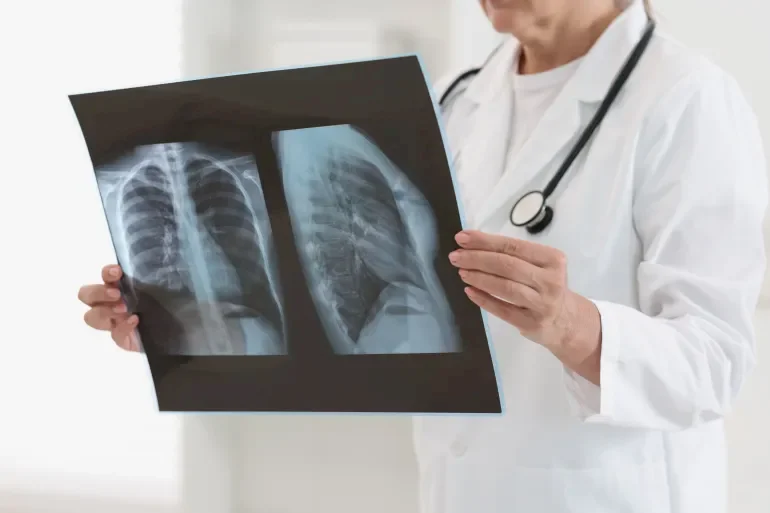
New Device Detects Pneumonia in Minutes
SadaNews - In a remarkable scientific development, researchers from the Massachusetts Institute of Technology (MIT) have successfully created a new experimental sensor that could change the way lung diseases, primarily pneumonia, are diagnosed by analyzing human breath instead of relying on traditional X-rays or laboratory tests.
How does the technology work?
The new test relies on a very small sensor (the size of a chip) that captures synthetic compounds known as "biomarkers," which are initially linked to nanoparticles that can be inhaled.
These biomarkers act as "smart tags," separating from the nanoparticles only in the presence of a specific "key," such as enzymes produced by diseases within the body.
Usage Mechanism:
The patient inhales the nanoparticles (similar to an asthma inhaler).
If the person is healthy, the nanoparticles remain unchanged and exit the body.
If the patient is sick (e.g., with pneumonia), the disease's enzymes cut the biomarkers.
These biomarkers are then exhaled.
The device captures them and confirms the presence of the disease.
The device uses advanced techniques such as spectroscopic analysis and plasmonics, allowing the detection of very tiny amounts of these biomarkers with high accuracy.
The device has shown significant efficiency in laboratory experiments, managing to recognize chemical signals even at extremely low concentrations.
Why is this innovation important?
It enables quick diagnosis within minutes instead of hours or days, is non-invasive, and does not require sample withdrawal. It could potentially be used in clinics or even at home in the future, contributing to early detection and improving treatment opportunities.
What is the current state of research?
So far, the technology is still in its early stages, having only been tested on animals like mice, and human clinical trials have not yet started. However, the results have shown high accuracy in detecting disease-related biomarkers.
Broader Future Prospects
The use of this sensor is not limited to pneumonia; it could later be developed to detect other lung diseases, chemical pollutants in the air, and possibly various diseases that can be tracked via "breath fingerprints."
Although the technology is still under development, it represents a promising step towards a future where disease diagnosis is faster and easier, perhaps simply through a "blow" into a small device.
 Follow the latest Sada News via Google News
After Deschamps' Departure... Zinedine Zidane Tops the Candidates to Lead France

Mbappe Surpasses Messi and Becomes the All-Time Top Scorer in the World Cup

England Defeats France and Achieves Largest World Cup Achievement Since 1966

Messi Refused to Play for Spain and Missed 3 World Cups

Publishers Sue Google for Allegedly Using Books to Train Artificial Intelligence

Google Expands Capabilities of Google Search Console to Support Social Media Accounts

The Mediterranean Table... An Ancient Diet Revealing Its New Secrets for Health and Longev...
