

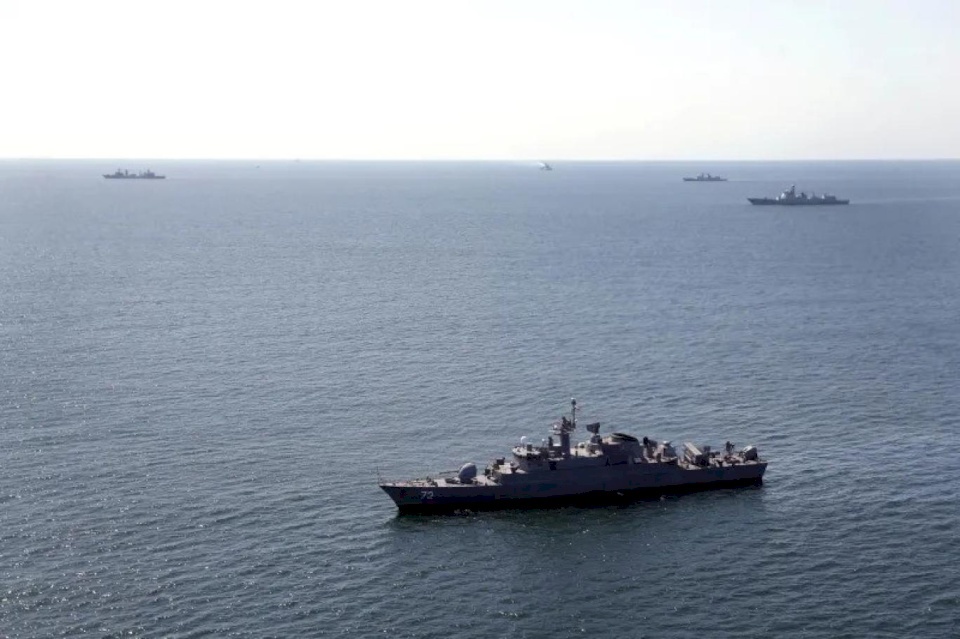
Maritime Siege on Iran: Washington Controls the Gulf of Oman and Arabian Sea and Issues a Warning to Ships
SadaNews - The U.S. Navy notified sailors today, Monday, that the military will impose maritime control in the Gulf of Oman and the Arabian Sea east of the Strait of Hormuz, indicating that this measure will affect all vessels regardless of the flag they fly. The memo stated that the control will come into effect at 5 PM Jerusalem time; and noted that "any ship entering or leaving the besieged area without permission will be subject to interception or rerouting or detention." It added, "The control will not obstruct neutral shipping through the Strait of Hormuz to and from non-Iranian destinations."
Furthermore, the U.S. military announced, as part of a plan described as threatening the fragile ceasefire, that it would start a ban on maritime traffic heading to Iranian ports in the Gulf starting Monday, while allowing ships to pass through the Strait of Hormuz from non-Iranian ports and vice versa.
In the same context, the "Wall Street Journal" reported from officials and informed sources that U.S. President Donald Trump and his advisors are considering resuming limited military strikes against Iran, alongside imposing a maritime blockade on the Strait of Hormuz, with the aim of pressuring to break the deadlock in peace talks.
On the fifth day of the ceasefire agreement between Washington and Tehran, negotiations in Islamabad ended without reaching an agreement, as U.S. Vice President J.D. Vance left the Pakistani capital, considering that the failure of talks is "worse for the Iranians than it is for the Americans."
However, the newspaper reports indicated that a new round of negotiations could be held in the coming days, amid regional efforts to bring both parties back to the dialogue table, alongside attempts to extend the truce announced by Trump for an additional two weeks.
In contrast, U.S. Central Command announced its intention to impose a comprehensive maritime blockade on Iranian ports starting Monday, which includes all ports overlooking the Arabian Gulf and Gulf of Oman, as well as all commercial vessels of various nationalities, whether heading to Iran or departing from there.
In response, the Iranian Revolutionary Guard warned of a "deadly spiral" in the Strait of Hormuz if the United States takes escalation steps, asserting that any misstep would be met with a firm response.
Iranian Parliament Speaker Mohammad Baqer Qalibaf also emphasized that his country will not succumb to threats, asserting that Tehran is ready to confront if war is imposed on it, while it will respond positively if approached with the logic of dialogue.
 Follow the latest Sada News via Google News
High-level sources reveal to SadaNews: Washington seeks to hold a Gaza Reconstruction Conf...

Iraqji Reveals Details of the Attack on the Iranian Supreme Leader's Headquarters

صراع على إرث خامنئي وسط غياب مجتبى.. والمتشددون يتهمون قادة إيران بـ«الانقلاب»

The European Union Reiterates Its Call for Israel to Refrain from Expanding Settlements in...

"Mamdani Berlin".. The German Left Bets on a Politician of Turkish Descent to Lead the Cap...

Hebrew Channel: Kushner Pushing to Enhance Communication Between the United States and the...

SadaNews Report: Israeli Elections with a Settlement Flavor!
