

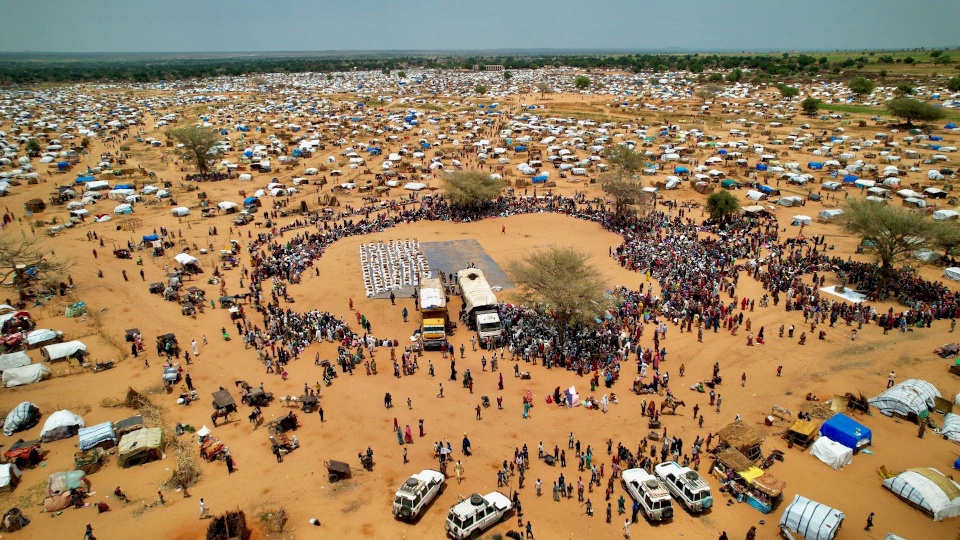
Millions of Sudanese Live on One Meal a Day: "They Eat Tree Leaves and Animal Feed"
SadaNews - A report published today, Monday, by a group of organizations revealed that millions in Sudan live on just one meal a day, as the food crisis in the country worsens and fears of its spread increase.
The ongoing war in Sudan between the army and the "Rapid Support Forces", which enters its third year on Wednesday, has spread hunger and displaced millions, leading to one of the largest humanitarian crises in the world.
The report, issued by the organization "Action Against Hunger" along with the international agency "Care", the International Rescue Committee, "Mercy Corps", and the Norwegian Refugee Council, stated that "in the two regions most affected by conflict, North Darfur and South Kordofan, millions of families consume only one meal a day".
The report added, "Often, they spend entire days without any food", noting that many have resorted to eating tree leaves and animal feed to survive.
The Government Denies Famine Exists
The Sudanese government loyal to the army denies the existence of famine in the country, while the "Rapid Support Forces" deny responsibility for the conditions in the areas under their control.
According to the Humanitarian Needs and Response Plan for 2026, around 61.7% of Sudan's population, equivalent to 28.9 million people, suffer from severe food insecurity.
The United Nations reported extensive atrocities and waves of violence based on ethnicity. In November, a global hunger observatory confirmed for the first time the existence of famine in the city of El Fasher, as well as in Kadugli.
In February, the Integrated Food Security Phase Classification, a global hunger monitoring system supported by the UN, concluded that levels of acute malnutrition exceeded famine thresholds in the Ambro area as well as in Kernei.
The report, based on interviews with farmers, traders, and humanitarian workers inside Sudan, describes how the ongoing war drives the population into starvation due to the disruption of agriculture, as well as the use of starvation as a weapon of war, including the deliberate destruction of farms and markets.
The report mentioned that communal (charity) kitchens have increasingly become unable to meet growing needs, at a time when significant cuts in donor funding hinder the capacity of relief agencies to respond.
The report stated that women and girls are disproportionately affected, as they face a greater risk of being raped and harassed when going to fields, visiting markets, or fetching water. It added that female-headed households are three times more likely to experience food insecurity compared to male-headed households.
 Follow the latest Sada News via Google News
Saudi Arabia condemns the Houthi threats to navigation and pledges to protect its ships

Houthi Movement Announces Ban on Maritime Navigation Against Saudi Arabia

Earthquake of 5.5 Magnitude Hits Western Iran

To Enhance His Support for "Increasing Children"... Vance Announces the Birth of His Fourt...

Death of a Mosque Imam in Armed Attack in Southeastern Iran

Rubio Reveals Circumstances Surrounding the Death of an American Soldier in Iraq

Reliable Threat.. US Embassy in Jordan: Evacuation of International Airport and Port in Aq...
