

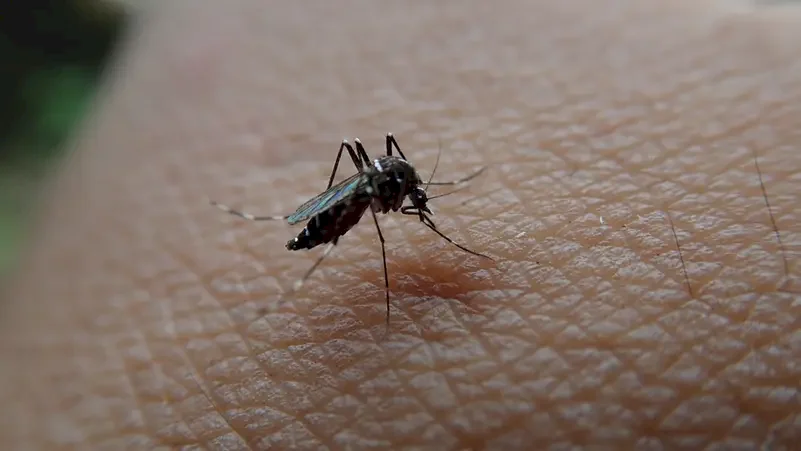
Scientific Research Clarifies.. "This is How Mosquitoes Find You and Attack"
SadaNews - Mosquitoes are well-known for their itchy bites and are found in most parts of the world, with over 3,500 species identified.
In addition to being annoying, mosquitoes transmit serious diseases such as malaria, yellow fever, and Zika, which together cause over 700,000 deaths annually.
In recent studies, researchers from the Georgia Institute of Technology and the Massachusetts Institute of Technology developed a mathematical model predicting how female mosquitoes fly towards humans to feed, following the precise tracking of hundreds of mosquitoes as they hovered around a person and analyzing 20 million data points.
This research presented the first detailed visual representation of mosquito flight behavior and provided measurable data that could improve methods for trapping and controlling them, as reported by Science Daily from the journal Science Advances.
Three-Dimensional Imaging
To understand how mosquitoes navigate, scientists used three-dimensional infrared cameras to observe how the insects moved around objects using visual cues and carbon dioxide. They introduced a person into a confined room, altered the colors of their clothing, and recorded how mosquitoes flew around them.
The study results focused on female Aedes aegypti mosquitoes (also known as yellow fever mosquitoes), a common species in the southeastern United States, California, and many regions around the world.
Mosquitoes Follow Signals
Data indicated that mosquitoes do not cluster because they follow each other; rather, each insect responds independently to environmental stimuli. However, they end up gathering in the same place at the same time.
David Hu, a professor in the George W. Woodruff School of Mechanical Engineering and the College of Biological Sciences at Georgia Tech, explained, "It's like a crowded café," noting that customers don't stay at the café because they follow each other but are drawn by the same stimuli such as drinks, music, and ambiance.
He added that the same applies to mosquitoes; instead of following a leader, the insect follows signals and coincidentally arrives at the same place as other insects. They are identical copies.
Visual Cues and Carbon Dioxide
The researchers conducted three experiments in which they modified visual targets and carbon dioxide levels. In the first experiment, a black ball attracted mosquitoes, but only when they were flying towards it. Once they reached the object, mosquitoes typically did not stay but quickly moved to another location.
When the team replaced the black object with a white one and added carbon dioxide, mosquitoes could identify the source, but only from a close distance. The insects were observed pausing for a moment as if taking a second look before clustering nearby. When both the black object and carbon dioxide were present together, the effect was stronger. Mosquitoes invaded the area, stayed there, and attempted to feed.
Christopher Zou, who conducted the study during his master's program at Georgia Tech, stated, "Previous studies showed that visual cues and carbon dioxide attract mosquitoes. However, it wasn't known how mosquitoes combine these signals to determine their destination. It's like small robots, so the rules needed to be discovered."
Mosquito Targeting Areas
After identifying the importance of static visual signals, Zou tested this behavior on himself. He entered the test room wearing different outfits, including completely black, completely white, and mixed colors. He also stood with his arms outstretched, allowing dozens of mosquitoes to fly around him while cameras recorded their paths.
The data was later analyzed at MIT to identify the most likely rules guiding their movement. It was found that mosquitoes behaved as if Zou were just another object. The largest clusters formed around his head and shoulders, the areas typically targeted by this type of mosquito.
The researchers noted that their findings could lead to more effective pest control strategies.
Zou reported that "one tactic is to use suction traps based on fixed signals, such as continuously releasing carbon dioxide or constant light sources, to attract mosquitoes." He indicated that the study suggests using them intermittently and then activating suction at intervals might be optimal, "because mosquitoes do not tend to stay around their target when both signals are not used simultaneously."
 Follow the latest Sada News via Google News
After Deschamps' Departure... Zinedine Zidane Tops the Candidates to Lead France

Mbappe Surpasses Messi and Becomes the All-Time Top Scorer in the World Cup

England Defeats France and Achieves Largest World Cup Achievement Since 1966

Messi Refused to Play for Spain and Missed 3 World Cups

Publishers Sue Google for Allegedly Using Books to Train Artificial Intelligence

Google Expands Capabilities of Google Search Console to Support Social Media Accounts

The Mediterranean Table... An Ancient Diet Revealing Its New Secrets for Health and Longev...
