

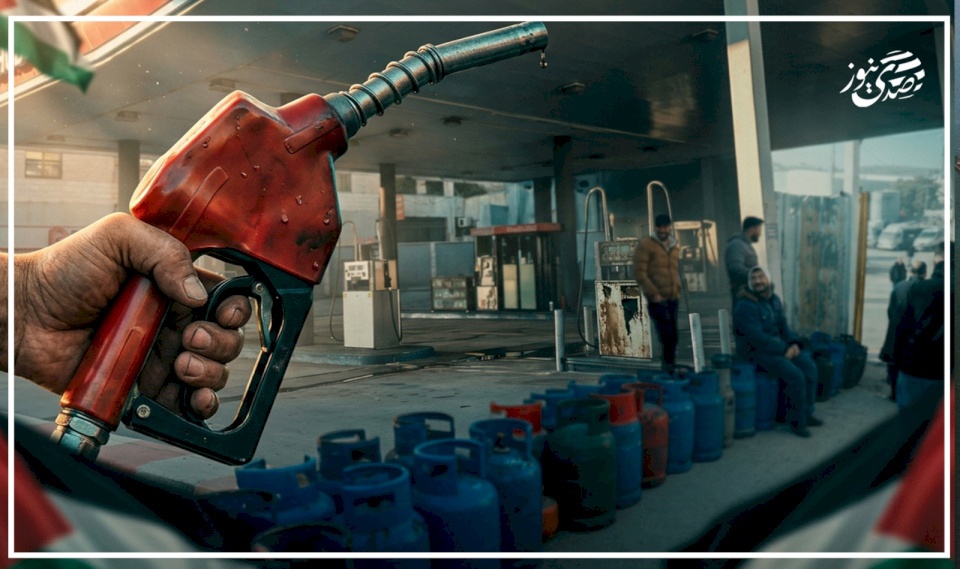
Global Inflation or Poor Planning?! Did the Palestinian Government Reduce Fuel Subsidies?
Exclusive SadaNews: There has been significant public uproar on social media following the announcement by the Public Petroleum Authority about fuel prices for the current month (April 2026), which recorded noticeable increases. The price of a liter of 95-octane gasoline reached 7.90 shekels, the price of a liter of 98-octane gasoline reached 8.86 shekels, while the price of a liter of kerosene reached 8.40 shekels. Additionally, a 12 kg gas cylinder was priced at 95 shekels, and a 48 kg cylinder was priced at 380 shekels. Notably, the increase in the price of diesel, which reached 8.40 shekels per liter, was remarkable.
The percentage increases on fuel types this month are unprecedented, with the increase in petrol liters at 15.33%, diesel at 40.94%, kerosene at 40.94%, small gas cylinders at 25%, and large gas cylinders at 26.67%.
This significant increase is certainly caused by the rise in global oil and gas prices due to the American-Israeli war on Iran. However, why has the price margin between fuel prices in Palestine and Israel decreased? For example, previously, the difference in price per liter ranged between 60-70 agorot due to government support for fuel. However, this month, the difference has not exceeded 15 agorot. Did the government lift fuel subsidies due to its financial crisis? Or did it cut them?
In February and March 2022, the price of a barrel of oil exceeded 100 dollars, as it is currently. However, at that time, the Public Petroleum Authority maintained local fuel prices despite the rise in global prices.
At that time, the price of a liter of 95-octane gasoline, the most popular, was 6.33 shekels, while 98-octane gasoline was 7.20 shekels and diesel was 5.65 shekels per liter. Palestine benefited from government support, which is not based on cash support but rather reducing the tax burden on fuel prices.
Figures released by the Ministry of Finance and Planning show that the government provided fuel subsidies during 2025 amounting to 818 million shekels. In 2024, the support amounted to 845 million shekels, in 2023 it was 644 million shekels, and in 2022 it reached 773 million shekels, totaling approximately 2.280 billion shekels in fuel subsidies over four years, averaging 50-60 million shekels monthly. This was what kept the price margin with Israel lower by around 60-70 agorot most of the time, but this margin has greatly diminished to the point where prices are now very close to equal to those in Israel, with significant differences, most notably that the average wages in Israel range from 13,500 shekels to 14,000 shekels, whereas the average wage in Palestine does not exceed 2,400-2,800 shekels. It should be noted that the prices are similar because both parties live within a customs envelope under the Paris Economic Protocol signed by both sides in 1994, which has governed the economic relationship between the parties to this day.
The Paris Economic Protocol stipulates that the Palestinian Authority has the right to set oil product prices in the Palestinian territories except for gasoline, meaning it is free to set the price of diesel and kerosene. The protocol confirmed that "the difference in the final price of gasoline for Israeli consumers and consumers in the territories should not exceed 15% of the official final consumer price in Israel."
This means that the price of a liter of gasoline sold in the Palestinian market will remain within a circle that is 15% higher or lower than the price in the Israeli market.
It is worth mentioning that the West Bank consumes about 90-100 million liters of fuel annually, with more than two-thirds of this quantity being diesel.
The price of fuel per liter in Palestine is among the highest in the world due to its link to the price in Israel under the Paris Economic Protocol, which set pricing conditions for the Palestinian Authority, which itself benefited from the Israeli "blue" tax to maximize its revenues.
Moreover, oil prices have sharply and rapidly risen since the beginning of the war on Iran in early March 2026, where oil premiums exceeded 40 dollars above baseline prices, with Brent crude breaking the 100-dollar barrier per barrel, recording increases exceeding 55% at certain times. This spike, peaking around 119-120 dollars per barrel, is the highest in months, driven by fears of global supply shortages via the Strait of Hormuz.
Natural gas prices in Asia have surged by as much as 143% since the start of the war on Iran, exceeding 25 dollars per million British thermal units, presenting a sharper supply shock than the Russia-Ukraine war. The closure of the Strait of Hormuz and the halt of Qatari exports disrupted 20% of global supplies. Meanwhile, liquefied natural gas prices in Europe have risen by about 50%.
The price of a liter of fuel in Palestine is among the highest in the world as it is fully imported from Israel, with most of the price being tied to taxes rather than the original price.
The "blue" tax, which is an excise tax on each liter of fuel sold in both Palestinian and Israeli markets, constitutes the largest portion of the final consumer price, reaching 100% of the price plus a value-added tax estimated at 16%.
According to data released by the Ministry of Finance and Planning, the revenue from the petroleum tax in 2025 reached about 3.42 billion shekels out of 10.53 billion shekels total clearance tax, meaning it constitutes 32.5% of total clearance tax, but it was not transferred to the public treasury due to the occupation holding those funds.
In summary, the rise in local fuel prices in this manner is due to the global increase, compounded by the Paris Economic Protocol that tied prices to those in Israel, without finding alternatives, coupled with the weakened financial capacities of the Palestinian Authority to continue meaningful support for the fuel sector. The current reality indicates, according to analysts and experts, that we are heading towards an unprecedented wave of inflation. However, amid poor economic indicators where the Palestinian economy has shrunk by about a quarter after two and a half years of war on Gaza, and where poverty and unemployment rates have risen to unprecedented levels, all of this occurs while individuals' purchasing power continues to erode, especially since nearly 200,000 workers have not returned to their jobs inside the Green Line since the events of October 7, depriving the markets of about (18) billion shekels annually. Additionally, there is a continual government deficit leading to the disbursement of "crumbs" from salaries, which has led about 172,000 public sector employees into poverty and need.
 Follow the latest Sada News via Google News
High-level sources reveal to SadaNews: Washington seeks to hold a Gaza Reconstruction Conf...

Iraqji Reveals Details of the Attack on the Iranian Supreme Leader's Headquarters

صراع على إرث خامنئي وسط غياب مجتبى.. والمتشددون يتهمون قادة إيران بـ«الانقلاب»

The European Union Reiterates Its Call for Israel to Refrain from Expanding Settlements in...

"Mamdani Berlin".. The German Left Bets on a Politician of Turkish Descent to Lead the Cap...

Hebrew Channel: Kushner Pushing to Enhance Communication Between the United States and the...

SadaNews Report: Israeli Elections with a Settlement Flavor!
