

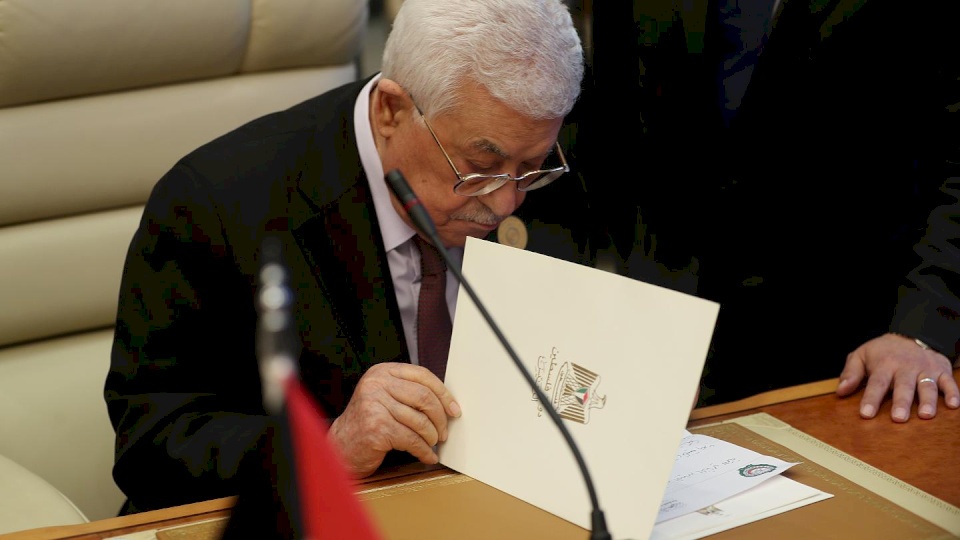
President Abbas Issues a Legislative Decision Regarding the Emergency Budget for the Fiscal Year 2026
SadaNews Economy - Palestinian President Mahmoud Abbas issued a legislative decision today, Tuesday, regarding the emergency budget for the fiscal year 2026, which was referred from the Council of Ministers.
The Cabinet had approved a draft budget for the year 2026 on March 17 of this year.
The emergency budget responds to the complex political, economic, and social reality, with the likelihood of the Israeli government continuing to withhold clearance funds. In light of this, available cash flows will be directed to basic services, foremost among them health, education, security, and social protection, while simultaneously continuing to pay a portion of public sector employees' salaries according to available resources.
The draft budget also takes into account the possibility of continued financial blockade and Israeli measures, which has prompted the government to adopt a strict austerity approach to manage resources and control expenditures since 2025, with efforts to reinforce this during 2026 to ensure control of spending and continuity of basic services provision.
According to the draft budget, total revenues are expected to reach 15.7 billion shekels, including clearance revenues, should they be released, while expected expenses will be around 17.6 billion shekels, a reduction of 5.8% compared to the previous year's budget in 2025. Should the occupation continue to withhold clearance funds, the budget deficit is expected to approach approximately 70%.
In light of preparing a budget responsive to emergency developments, the draft budget includes increasing the emergency and urgent response allocation from about 40 million shekels to 516 million to deal with emergencies.
According to a statement from the Government Communications Office, in light of the increased response to the complexities of the financial situation in the 2026 budget, the Ministry of Finance will intensify measures to enhance local revenues, without affecting low-income groups, in addition to sharply reducing various expenditure items that do not impact basic services. This will coincide with continued government support for services such as water, electricity, fuel, and health insurance, which amounts to approximately 1.3 billion shekels, while conducting a serious review of this government support to ensure it reaches the most in-need groups.
In the same context, and in response to the difficult economic conditions, especially for low-income groups, social protection allocations for 2026 will approach 1.2 billion shekels through various official institutions, in addition to supportive resources being mobilized through donor entities, which aligns with the emergency and public expenditure item included in the draft budget.
Additionally, as part of the government's steps and its reform program, a reduction in the salary bill for 2025 has been achieved, amounting to about 120 million shekels. The government will also complete additional measures for 2026 and stop new appointments entirely. Significant progress has been made in conducting settlements with local authorities and electricity and water companies (known as net lending), which has been reduced by more than half during the past year, and additional reform measures will continue throughout 2026.
In another context, the draft budget includes a trend toward completing essential developmental projects currently being implemented at a cost of 427 million shekels, alongside reinforcing expected external support to reach a total of 880 million shekels across various sectors.
 Follow the latest Sada News via Google News
Soaring Oil Prices Burn the Pockets of the Palestinian Citizen "The Poor"

Millions of Dollars in Losses.. "SadaNews" Reveals Shocking Figures for Traders from Pales...

The Problem of Shekel Overcrowding Worsens.. Fuel Station Owners Threatened with Closure o...

The Palestinian Economy at a Crossroads: 4 Files Awaiting Resolution

Currency Exchange Rates Against the Shekel on Thursday (July 9)

National Economy: Referral of 6 Violators to Prosecution and Seizure of 76 Tons of Violati...

Israel's Foreign Currency Reserves Rise to $238.7 Billion
