

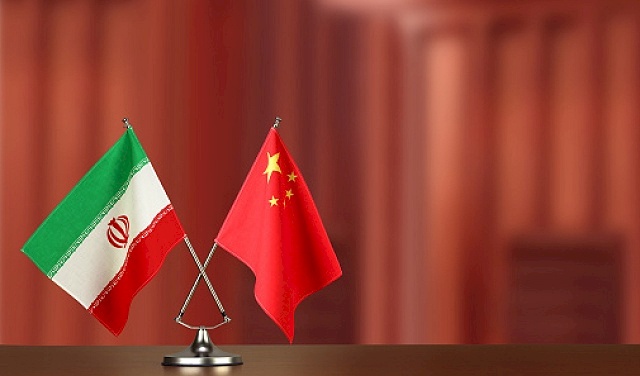
A Partnership Without Commitment: The War Reveals the Limits of Chinese-Iranian Relations
SadaNews - Iran is one of the main sources that China relies on to secure its oil needs, and both countries share a common stance against the United States as a strategic adversary. However, the level of Beijing's support for Tehran is intertwined with a broader network of interests that govern its movements in the region, making this support subject to complex calculations that go beyond the direct bilateral relationship.
Is the relationship between China and Iran balanced?
China is considered a pivotal partner for Iran, having accounted for more than 80% of Iranian oil exports during 2025, making it a key source of Tehran's revenues amid the sanctions imposed on it, according to data from the analytics firm "Kpler".
Conversely, Iran does not hold the same position in Chinese calculations, as Iranian oil constitutes only about 13% of China’s maritime oil imports, according to the same source. The relationship between the two sides is primarily based on interest-driven considerations.
William Figueroa, a specialist in Chinese-Iranian relations at the University of Groningen in the Netherlands, states that "the primary motivation for China's interest in Iran is that it is a source of low-cost oil".
In contrast, Saudi Arabia, Iran's regional rival that has faced strikes during the current war, is one of China's largest oil suppliers, exporting amounts almost equivalent to what Iran exported through maritime routes in 2025, according to "Kpler".
China also relies on oil imports from Iraq, Oman, and the UAE. Figueroa noted that these countries "are generally able to provide what Iran can offer, but within an environment that is more stable and conducive to the United States".
Regarding economic cooperation, China has only executed a limited part of its commitment, announced in 2021, to invest $400 billion in Iran over 25 years.
The volume of trade between the two countries reached $9.96 billion in 2025, a figure significantly lower than the trade volume between China and Saudi Arabia, which reached $108 billion, and is nearly equal to the trade volume with the UAE.
Does China support Iran militarily?
China condemned the American and Israeli strikes on Iran and issued indirect criticisms of the Iranian strikes against regional countries, as well as the closure of the Strait of Hormuz, without showing any clear indication of its willingness to provide military support to Tehran.
John Calabrese, a researcher at the Middle East Institute in Washington, believes that "Beijing has been keen to stay away from any announced military engagement in the war, preferring to adopt a policy of restraint and move through diplomatic channels".
For his part, former French intelligence official Alain Juillet, during his participation in the "Talks on" podcast, suggested that Iran might be relying on the Chinese navigation system "BeiDou" in some of its operations.
Figueroa pointed out that China had previously supplied Iran with drones and dual-use chemicals, "and may have also provided it with intelligence information," according to his estimates.
Conversely, Beijing denied reports that the "Semiconductor Manufacturing International Corporation" sent equipment to Iran.
There is no official military agreement between China and Iran, and Chinese officials avoid direct involvement in the conflict. Beijing also did not respond to U.S. President Donald Trump's invitation to contribute to reopening the Strait of Hormuz.
What is China's ability to influence?
Calabrese sees that China's priorities focus on maintaining stability and continuity of oil flows, alongside protecting its commercial interests and preparing to reposition itself in the balance of power that may form after the war.
This is reflected in its call to cease fighting and diplomatically work to achieve this as soon as possible.
However, the chances of success for this path remain limited. Andrea Ghiselli, an international politics lecturer at the University of Exeter, noted that China finds itself in a "sensitive diplomatic position," as it refrains from directly condemning Iran while simultaneously criticizing any infringement on the sovereignty of Gulf countries.
He added that "Beijing bets on the war ending quickly, perhaps with an American defeat, but one should not overestimate its ability or desire to influence this direction".
China had demonstrated its growing regional influence in 2023 by sponsoring the resumption of relations between Iran and Saudi Arabia, but it does not appear, in 2026, capable of pushing Tehran to cease targeting neighboring countries with which it has partnerships.
What opportunities does Beijing have and what risks does it face?
Although the U.S.'s engagement in a long war may serve China's strategic interests, the continuing conflict poses significant risks for it. Figueroa stated that "this war represents a diplomatic gain for China, as it allows it to observe the erosion of the U.S.'s global image without direct intervention".
However, the economic repercussions of the war, primarily rising oil prices, pose a direct threat to the Chinese economy. Henry Toghendat, a scholar at the Washington Institute for Near East Policy, points out that "one of China's main weaknesses lies in the impact of these developments on its export markets", especially in Europe, explaining that "the Chinese economy still heavily relies on external demand for growth".
Ultimately, China sees Iran as a useful partner and a pressure card against the United States, but it also does not wish for Tehran to possess nuclear weapons and does not view continued instability as a preferred option. Calabrese observes that Beijing "prefers to deal with a familiar regime in Tehran, but has enough political flexibility to adapt to any changes, as it has previously done at various stages in Iran's history".
 Follow the latest Sada News via Google News
Trump: We will make great progress with Beirut.. Aoun: It is time for Lebanon to be stable

The Lebanese Army Deploys in the South and Comes Under Gunfire; Israel Clarifies

Bezhkian: Directives from the Leader to End the State of No War, No Peace

Saudi Arabia condemns the Houthi threats to navigation and pledges to protect its ships

Global Warning to Americans Due to Rising Tensions in the Middle East

Houthi Movement Announces Ban on Maritime Navigation Against Saudi Arabia

Earthquake of 5.5 Magnitude Hits Western Iran
