

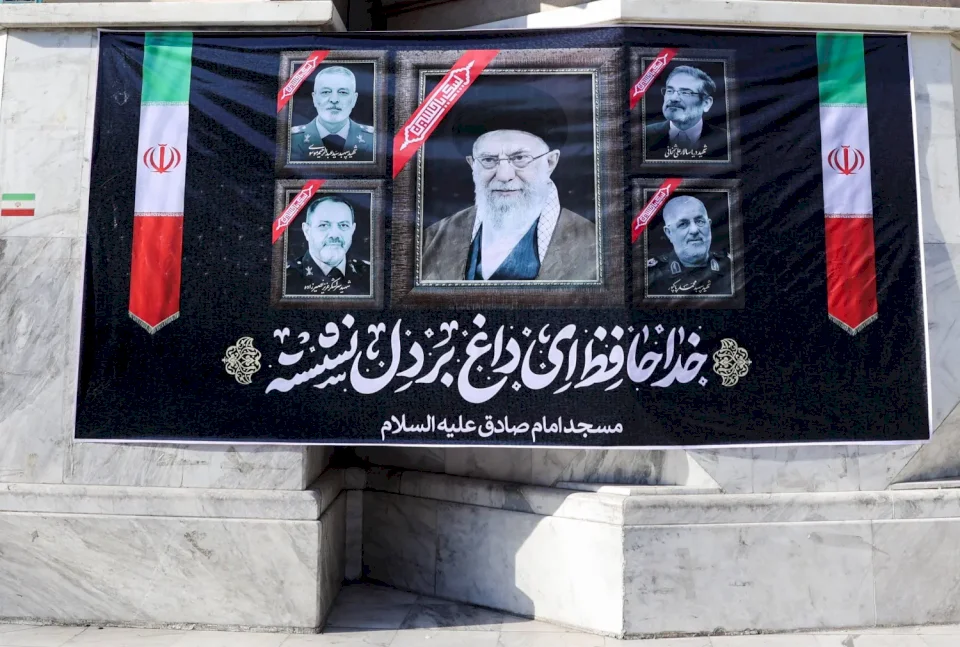
Assassinations Supported by Artificial Intelligence: How Did Israel Target Iranian Leaders?
SadaNews - While American and Israeli military leaders met to devise a war plan against Iran, they discussed how to divide responsibility for a range of targets, including missile batteries, military bases, and nuclear sites.
According to the American newspaper "Washington Post," it is clear that the leaders agreed on Israel taking on the task of pursuing and killing Iranian leaders, which they saw as a "daunting task."
However, it seems that Israel has executed this task efficiently, having killed Iranian Supreme Leader Ali Khamenei in the first strike of the war, as well as more than 250 high-ranking Iranian officials since then, according to Israeli military statistics.
The latest strike occurred on Thursday when Israel announced the killing of Ali Reza Tangsiri, the commander of the Iranian Revolutionary Guard's naval forces.
An AI-Enhanced Assassination System
The Israeli assassination campaign relies on an assassination system that Israel has spent decades building, but it has developed it over the past few years to reach new levels of "lethal efficiency," according to senior Israeli military and intelligence officials.
The system includes surveillance sources and capabilities within Iran, involving elements from within the regime who have been recruited to spy for Israel, as well as electronic infiltrations of thousands of targets, including street cameras and payment platforms, as well as vital internet centers through which the government controls communications and can cut off internet access to its citizens if necessary.
This data and others are analyzed by what Israeli officials describe as a new secret artificial intelligence platform, programmed to extract information about the lives and movements of leaders.
Raz Zmit, the head of Iran research at the National Security Studies Institute, explained to the newspaper that "advances in artificial intelligence have given Israel a way to leverage data that has always been available but was previously impossible to process."
Concerns Over Assassinations Becoming a Continuous Strategy
Security experts are concerned that Israel's growing mastery of targeted assassinations may create an over-reliance on this method and lead to an expansion of the scope of individuals who can be targeted.
Ariel Levite, an Israeli nuclear and security policy expert at the Carnegie Endowment for International Peace, stated: "The threshold has been crossed by turning these assassinations into a permanent strategy rather than an occasional operational necessity."
Levite noted that the distribution of tasks in the current war gives the impression that "the United States relies on Israel to do the dirty work in the war," adding that the U.S. position seems to be "we can't kill them, but we would be very happy if you did."
An American official familiar with the campaign's operations indicated that Israel's responsibility for the assassinations reflects a practical arrangement between the two sides, adding: "We work together, but each side has its own objectives." Officials clarified that this division reflects each side's capabilities rather than any legal impediment, noting that the United States has previously carried out targeted assassinations itself, including the killing of General Qasem Soleimani, the former commander of the Quds Force, in 2020.
For his part, American President Donald Trump described the strikes aimed at Iranian leaders as a joint effort. He told reporters last week, "We killed all their leaders, then they gathered to choose new leaders, and we killed them all." He confirmed that the goal of regime change has been achieved, as "the current leaders are completely different from those we started with."
Israel's Previous Experiences
Israel has leveraged its previous experiences in Gaza, Lebanon, and Iran, using drones, supersonic missiles, and even pre-planted explosives for later detonation.
An Israeli official stated: "For years, everything that could be infiltrated, we tried to infiltrate, from phone calls to traffic cameras to internal security systems."
However, despite the accuracy of the Israeli information, some strikes have not fully achieved their targets. In March, the headquarters of the Iranian Assembly of Experts in Qom was bombed while its members were holding an online meeting, resulting in no injuries.
Experts say that Iran has begun taking more stringent measures to counter the breaches it faces, such as limiting the use of phones by security guards, which poses a temporary challenge to Israeli intelligence.
 Follow the latest Sada News via Google News
High-level sources reveal to SadaNews: Washington seeks to hold a Gaza Reconstruction Conf...

Iraqji Reveals Details of the Attack on the Iranian Supreme Leader's Headquarters

صراع على إرث خامنئي وسط غياب مجتبى.. والمتشددون يتهمون قادة إيران بـ«الانقلاب»

The European Union Reiterates Its Call for Israel to Refrain from Expanding Settlements in...

"Mamdani Berlin".. The German Left Bets on a Politician of Turkish Descent to Lead the Cap...

Hebrew Channel: Kushner Pushing to Enhance Communication Between the United States and the...

SadaNews Report: Israeli Elections with a Settlement Flavor!
