

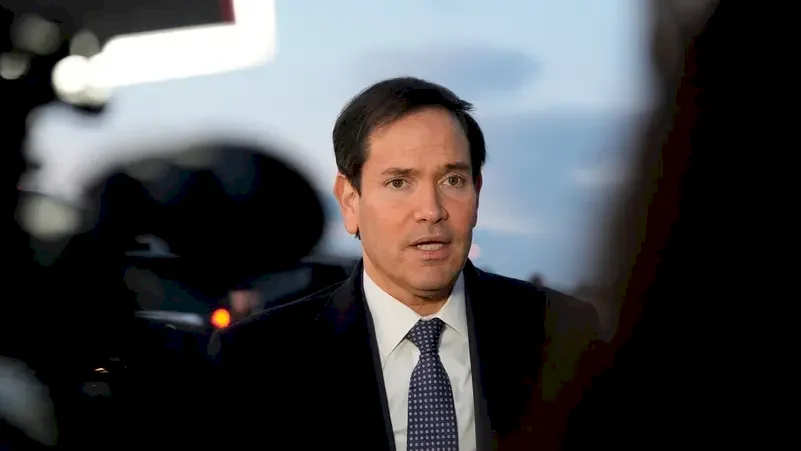
Rubio: We Don't Know Who Rules in Tehran and We Exchange Direct Messages with Iranian Entities
SadaNews Economy - U.S. Secretary of State Marco Rubio confirmed that there are indirect messages and talks between the United States and Iran taking place through intermediaries, noting that President Donald Trump prefers diplomatic solutions and that progress could have been made in this regard earlier.
Rubio explained in remarks to Al Jazeera that Washington welcomes any scenario in which Iran witnesses new leadership with a different vision for the future, emphasizing his country's readiness to seize such an opportunity if it arises.
He also noted that the decision-making process within Iran remains unclear, stating that his country's goals from the beginning were not directly linked to the Iranian political leadership.
He added, "We do not know who rules Iran currently, and no one has seen the new Supreme Leader (Motjaba Khamenei), and the current situation is shrouded in great ambiguity."
The U.S. minister stressed that it is unacceptable for Iran to acquire nuclear weapons and that it must stop supporting armed groups and cease threatening countries in the region.
"Blackmailing the World"
He noted that the short-range missiles launched by Iran target Saudi Arabia, the UAE, Qatar, Kuwait, and Bahrain, considering that the Iranian regime seeks to acquire nuclear capabilities to "blackmail the world," warning of "severe consequences" if this path continues.
Rubio called on Iran to take concrete steps to abandon any nuclear ambitions, halt the manufacture of drones and missiles that have surfaced recently, affirming that Tehran's complete renunciation of arms programs could open a better future for it.
Rubio confirmed his country's close coordination with its allies in defense and the thwarting of most Iranian attacks, emphasizing support for regional countries and rejecting any attempts to control international waterways or disrupt trade flows, warning of further complications if the Houthis in Yemen escalate the situation, "which is a problem that has existed".
NATO and Israel
The U.S. Secretary of State also stated that Israel's focus differs from that of Washington, as Tel Aviv places medium-range missiles at the top of its priorities, while the United States coordinates movements with it to avoid any operational conflicts, according to him.
Rubio described the situation within NATO as "not good," expressing his country's disappointment with the positions of several countries, including Spain, which he said had prevented the use of its airspace and military bases.
He added that the assessment of the alliance's role may undergo a review after the ongoing operations, affirming that President Trump has set a clear mission and that the goals related to Iran will be achieved within weeks, considering that "there is no real NATO without the United States."
Strait of Hormuz
The U.S. minister rejected recognizing any Iranian sovereignty over the Strait of Hormuz, calling it a serious precedent that allows other countries to attempt to control international shipping routes, and confirmed Washington's awareness of the strait's impact on global markets and its allies in the region.
Rubio stated that the Strait of Hormuz will be opened after the military operation in Iran, either with Tehran's approval or through an international coalition involving the United States. He added that Washington's objectives in Iran are clear and will be achieved within "weeks, not months."
The U.S. Secretary of State warned that any Iranian attempt to close the Strait of Hormuz after the military operation will face a strong response and significant consequences.
Trump's Warnings
Today, U.S. President Donald Trump issued a new warning to Iran about the need to open the Strait of Hormuz, or else it "will face American attacks on oil wells and power stations."
He noted that there has been progress in talks between the two sides, but he expected it would be difficult to reach an agreement soon, pointing out that he has suspended attacks on Iranian infrastructure for a limited time. In contrast, Iranian officials accused Washington of sending double messages that combine talk of negotiation with enhancing military presence.
Trump wrote in a social media post: "There has been significant progress, but if an agreement is not reached soon for any reason, which is likely to happen, and if the Strait of Hormuz is not opened immediately, we will end our beautiful stay in Iran by blowing up all power stations and oil wells and the island of Khark, completely erasing them."
Last week, the U.S. President stated that he would suspend attacks on Iranian electricity facilities for ten days, specifically until April 6 according to U.S. time.
Trump mentioned that the United States and Iran are making progress in talks but sent more U.S. troops to the region, while Iranian leaders denied having direct talks with the United States.
 Follow the latest Sada News via Google News
Morocco Hosts Formative Exercise for International Stabilization Force in Gaza

Sheikh Holds Meeting with Security Leaders to Follow Up on Current Developments

Hebrew Channels: The Likelihood of Israel's Participation in the Attack on Iran is Increas...

Netherlands Sets September Deadline for Ban on Settlement Products

12 Martyrs in Gaza Strip since Dawn Today

A Series of Important Decisions Taken.. The Cabinet Discusses Developments in the Deterior...

Organizations of the Temple Prepare for the Largest Raid on Al-Aqsa on What is Called the...
