

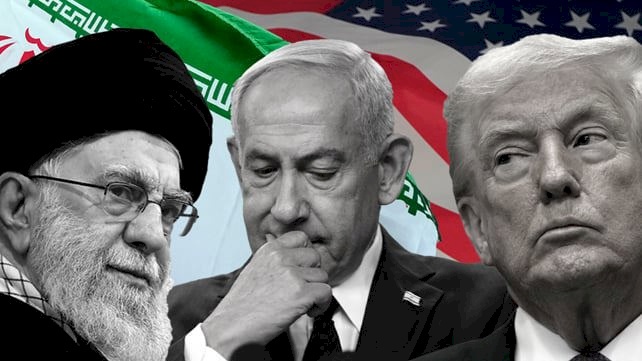
Before the Attack on Iran.. Netanyahu Pressured Trump to Kill Khamenei
SadaNews - Less than 48 hours before the start of the US-Israeli strike on Iran, Israeli Prime Minister Benjamin Netanyahu spoke by phone with President Donald Trump about the justifications for launching a complex and long-range war of the kind Trump had previously campaigned against.
Reuters reported, citing informed sources, that both Trump and Netanyahu were aware from intelligence briefings earlier that week that Supreme Leader Ali Khamenei and his key aides would soon meet at his compound in Tehran, making them vulnerable to a "decapitation strike"; an attack targeting top state leaders, a tactic frequently used by Israelis but less traditionally present in American doctrine.
New intelligence suggested that the meeting was moved to Saturday morning instead of Saturday evening, according to three individuals who were informed about the call. This call had never been disclosed before.
They stated that Netanyahu, who was determined to proceed with a process he had been advocating for decades, argued that there might not be a better opportunity to kill Khamenei and avenge previous Iranian attempts to assassinate Trump. Those attempts included a hit job reportedly orchestrated by Iran in 2024, when Trump was a candidate.
The Department of Justice had charged a Pakistani man with attempting to recruit people within the United States to participate in the plot, which was said to be in retaliation for the US killing of Quds Force commander Qassem Soleimani.
The sources, who spoke on condition of anonymity to discuss sensitive internal deliberations, indicated that by the time of that call, Trump had already agreed to the idea of the US conducting a military operation against Iran, but had not yet decided when or under what circumstances the US would engage.
The US military had bolstered its presence in the region for weeks, leading many within the administration to conclude that it was no longer a question of whether the president would move forward, but when he would do so. One potential date, a few days earlier, had been scrapped due to poor weather.
Reuters could not ascertain the extent to which Netanyahu's arguments influenced Trump as he considered ordering the strike, but the call represented Netanyahu's closing argument to his American counterpart.
The three sources familiar with the call believed that this conversation - alongside intelligence showing that the window to kill the Iranian leader was closing - served as a motivating factor in Trump’s final decision on February 27 to issue orders for the military to proceed with Operation "Epic Fury".
Netanyahu argued that Trump could make history by helping eliminate Iranian leadership that had long been opposed by the West and many Iranians as well.
He added that Iranians might even take to the streets, overthrowing the theocratic regime that has ruled the country since 1979, which he believed had been a major source of global terrorism and instability ever since.
The first bombs fell on Saturday morning, February 28. Trump announced that evening that Khamenei had been killed.
In response to a request for comment, White House spokeswoman Anna Kelly did not directly address the call between Trump and Netanyahu, but told Reuters that the military operation was designed to "destroy the Iranian regime's capability to produce and operate ballistic missiles, dismantle the regime’s navy, end its ability to arm proxies, and ensure that Iran can never acquire a nuclear weapon."
Neither Netanyahu's office nor Iran's UN representative responded to requests for comments.
Netanyahu had dismissed, in a press conference on Thursday, as "fake news" the claims that Israel "somehow pressured the United States into entering a conflict with Iran," adding, "Does anyone really think that anyone can dictate to President Trump what he should do? Come on!".
Trump had publicly stated that the decision to launch the strike was his alone.
Reuters' account, based on officials and others close to the leaders who spoke on condition of anonymity due to the sensitivity of internal deliberations, does not suggest that Netanyahu forced Trump into war.
However, it shows that Netanyahu was an effective advocate for this option, and that the manner in which he presented the decision - including the opportunity to kill an Iranian leader who was alleged to have overseen attempts to kill Trump - was persuasive to the American president.
Defense Secretary Pete Hegseth hinted in early March that revenge was, at least, one of the motivations behind the operation, when he told reporters, "Iran attempted to kill President Trump, and President Trump had the last laugh."
June Attack Targeted Nuclear and Missile Sites
Trump campaigned for the 2024 election on the basis of a foreign policy of "America First" that his first administration pursued, and he publicly stated that he wanted to avoid war with Iran, preferring to deal with Tehran diplomatically.
However, with discussions over the Iranian nuclear program failing to yield an agreement the previous spring, Trump began contemplating a strike, according to three individuals familiar with White House deliberations.
The first attack came in June, when Israel bombed Iranian nuclear facilities and missile sites, killing several Iranian leaders. US forces then joined the attack, and when that joint operation ended after 12 days, Trump publicly boasted about the success, stating that the US had "completely destroyed" Iranian nuclear facilities.
However, discussions resumed months later between the US and Israel about launching a second airstrike aimed at hitting additional missile sites and preventing Iran from gaining the capability to build a nuclear weapon.
Israelis also wanted to kill Khamenei, the old and sworn geographic rival who had repeatedly launched missiles at Israel and supported armed proxy forces surrounding the state. This included the Hamas movement that carried out the surprise attack on October 7, 2023, from Gaza, and Hezbollah in Lebanon.
Israeli Defense Minister Israel Katz told Channel "12" in Israel on March 5 that the Israelis had begun planning their attack on Iran based on the assumption that they would act alone. However, during a visit Netanyahu made to Trump's Mar-a-Lago resort in Florida in December, Netanyahu informed Trump that he was not entirely satisfied with the results of the joint operation in June, according to two individuals familiar with the relationship between the two leaders who spoke on condition of anonymity.
The two added that Trump showed openness to a new bombing campaign but also wanted to try a new round of diplomatic talks.
Several US and Israeli officials and diplomats said that two events pushed Trump toward attacking Iran again.
The US operation on January 3 to capture Venezuelan President Nicolas Maduro in Caracas - which resulted in no Americans being killed and ousted an old enemy of the US - demonstrated that ambitious military operations could have limited side effects on US forces.
Later that same month, massive anti-government protests broke out in Iran, which were met with extreme violence from the IRGC, leading to thousands of deaths. Trump promised to help the protesters but did nothing publicly right away.
Meanwhile, cooperation, secretly, intensified between the Israeli military and the US Central Command in the Middle East (CENTCOM), with plans for joint military operations being drawn up during secret meetings, according to two Israeli officials who spoke on condition of anonymity.
Soon thereafter, during a visit Netanyahu made to Washington in February, the Israeli leader briefed Trump on the growing Iranian ballistic missile program, pointing out specific sites of concern. He also outlined the risks of this program, including the danger that Iran could eventually have the capability to strike US territory, according to three individuals familiar with those private discussions.
The White House did not respond to questions regarding Trump’s meetings with Netanyahu in December and February.
Trump's Opportunity to Make History
By late February, many US officials and regional diplomats considered a US attack on Iran to be very likely, although details remained unclear, according to other US officials, one Israeli official, and additional sources familiar with the matter.
Trump received briefings from Pentagon and intelligence officials about the potential gains from a successful strike, including inflicting severe damage on the Iranian missile program, according to two individuals familiar with those briefings.
Before the call between Netanyahu and Trump, Secretary of State Marco Rubio informed a small group of senior congressional leaders on February 24 that Israel would likely attack Iran, regardless of whether the US participated or not, and that Iran would likely respond by targeting US interests, according to three individuals informed of that meeting.
Rubio's warning was based on an assessment from US intelligence officials concluding that an attack of this nature would indeed provoke Iranian counterstrikes against US military facilities and against Washington's Gulf allies, according to three sources familiar with US intelligence reports.
This prediction proved accurate. The strikes led to Iranian counterattacks on US military assets, over 2,300 Iranian civilian deaths, and at least 13 American military fatalities, as well as attacks on Washington's Gulf allies, and the closure of one of the world's most important shipping routes, leading to a historic spike in oil prices that consumers began to feel in the US and abroad.
Trump had also been informed that there was a possibility, albeit slim, that killing senior Iranian leaders could bring about a government in Tehran more willing to negotiate with Washington, according to two other individuals familiar with Rubio’s briefing.
The individuals knowledgeable about the call said that the prospect of regime change was one of Netanyahu's arguments during the call that occurred just before Trump issued his final orders to attack Iran.
However, the CIA did not share this view; it had assessed in previous weeks that Khamenei would likely be replaced by an internal hardliner if he were killed, as Reuters previously reported. There was no response from the CIA.
Trump repeatedly called for an uprising after Khamenei's death. As the war entered its fourth week and the region sank into conflict, the IRGC was still patrolling the streets of the country. Millions of Iranians remained confined to their homes.
Mohsen Khamenei, the son of Khamenei, who is considered more hardline and antagonistic to America than his father, was named the new Supreme Leader of Iran.
 Follow the latest Sada News via Google News
High-level sources reveal to SadaNews: Washington seeks to hold a Gaza Reconstruction Conf...

Iraqji Reveals Details of the Attack on the Iranian Supreme Leader's Headquarters

صراع على إرث خامنئي وسط غياب مجتبى.. والمتشددون يتهمون قادة إيران بـ«الانقلاب»

The European Union Reiterates Its Call for Israel to Refrain from Expanding Settlements in...

"Mamdani Berlin".. The German Left Bets on a Politician of Turkish Descent to Lead the Cap...

Hebrew Channel: Kushner Pushing to Enhance Communication Between the United States and the...

SadaNews Report: Israeli Elections with a Settlement Flavor!
