

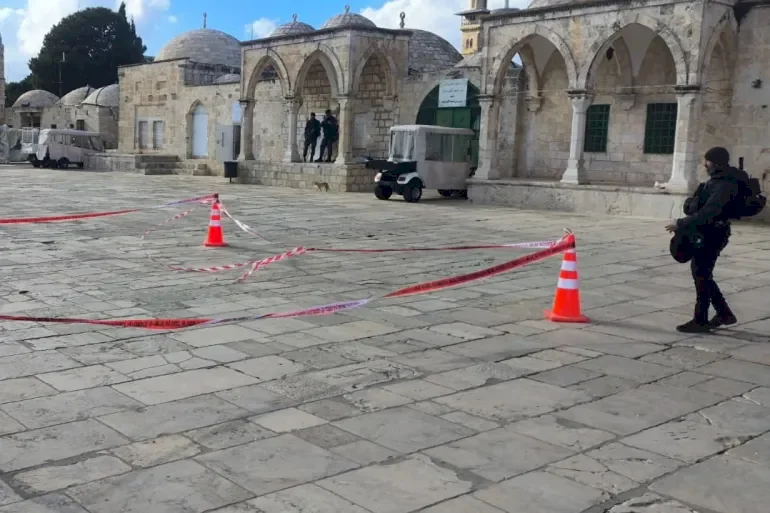
For the First Time in 59 Years.. Al-Aqsa Mosque Without Eid Al-Fitr Prayer
SadaNews - For the first time in 59 years, the sound of Takbeer is absent from Al-Aqsa Mosque, and Eid Al-Fitr prayers are banned for worshippers within its grounds, leaving its courtyards empty and filled with a heavy silence that embraces its corridors, which have always been a vibrant heart of worshippers and defenders, witnessing their prayers, tears, and stories of endless patience.
This year, the Eid Al-Fitr prayer was not permitted at Al-Aqsa after a prolonged closure that included the last Friday of Ramadan, the Night of Decree, and the last ten days, casting an atmosphere of sorrow and pain over the hearts of Palestinians, deprived of performing their rituals in the vicinity of the first Qibla for Muslims.
On February 28, the occupation authorities closed the mosque and the Old City of Jerusalem under the pretext of declaring a state of emergency coinciding with the American-Israeli joint attack on Iran.
Despite this, Palestinians continued to hold on to their prayers, as videos circulated in recent days showed worshippers performing Taraweeh prayers near the Gate of the Tribes in occupied Jerusalem, reflecting their steadfastness and determination to continue their rituals despite the restrictions of occupation and being prevented from entering the mosque's courtyards.
However, the occupation forces attempted to disperse the worshippers, as dozens of Palestinians prayed the Isha and Taraweeh prayers around Al-Aqsa Mosque, while the occupation forces removed one of its guards from the area, in a step that reflects a new escalation against the defenders.
With the continued closure and prohibition of Eid prayers inside Al-Aqsa, the mosque's preacher, Sheikh Ikrima Sabri, launched a sacred call to head towards the mosque, emphasizing that prayer is obligatory at "the nearest possible point" from the Al-Aqsa sanctuary.
He called on the people of Jerusalem, the occupied interior, and the West Bank to go in large numbers towards the vicinity of the mosque to perform prayers at its doors and thresholds and in the streets leading to it, considering this a religious and national duty to break the siege imposed on the first two qiblas.
In the same context, social media platforms have not calmed down since the announcement of the closure of Al-Aqsa Mosque, and with the prohibition of Eid Al-Fitr prayers, anger erupted among Palestinian and Arab activists, considering the decision a dangerous escalation targeting the sanctities and touching the religious and spiritual rights of Palestinians and Muslims on their holiday.
The defenders described the closure of Al-Aqsa Mosque during Ramadan and the arrival of Eid Al-Fitr as "the toughest Ramadan and Eid we have experienced," affirming that the silence of its courtyards and their emptiness from worshippers left a deep emotional and spiritual void in their souls, adding that this step increased their feelings of alienation and deprivation from the first Qibla of Muslims.
Blogger expressed astonishment at the passage of 20 days since the closure of Al-Aqsa Mosque and the prevention of worshippers from praying there, without anyone taking action or issuing any practical official response, restricting themselves to issuing only statements.
They added that this alarming international and societal silence increases Palestinians' feelings of bitterness and frustration, leaving the door open for more violations.
Others praised the Palestinian steadfastness while warning that the occupation is gradually testing Muslims' patience toward its ongoing crimes against Al-Aqsa, confirming that "today it closes its doors while you ignore it, and tomorrow it may be demolished before your eyes, and only statements of condemnation would come from you without action."
Blogger clarified that the continued closure of Al-Aqsa Mosque during Ramadan and Eid Al-Fitr under the pretext of security conditions constitutes a direct provocation, linked to religious knowledge and freedom of religions, pointing out that there may be other invisible motives that carry a greater danger than mere security considerations.
Others perceived that the occupation might continue the closure beyond Eid Al-Fitr, in light of the absence of any official defense or practical steps to prevent the Talmudic schemes it aims for according to its beliefs, which include the demolition of Al-Aqsa Mosque and the construction of the alleged temple.
Overall, bloggers considered the occupation's closure of Al-Aqsa a planned and deliberate act aimed at imposing fateful changes in its administration, continuing to remove guards and preventing others from entering the mosque, in a step that represents part of a comprehensive strategic war, amid ongoing questions about the role of the international community in protecting the sanctities and preserving the religious rights of Palestinians.
Source: Social media + Al Jazeera Net
 Follow the latest Sada News via Google News
Exchange Rates of Currencies Against the Shekel on Tuesday (July 7)

Weather: Hot Conditions and Decrease in Temperatures

Netanyahu Pressures to Prevent Turkey from Getting "F-35" and Engines for Its Local Fighte...

Report: Israel Refuses to Renew Water Agreement with Jordan

Hamas: The Resignation of the Government Work Committee Came in Response to National Inter...

Trump: Either Reach an Agreement with Iran or "America Will End the Mission"

In Israel's First Reaction.. Sa'ar: Hamas is Maneuvering and We Insist on Implementing Tru...
