

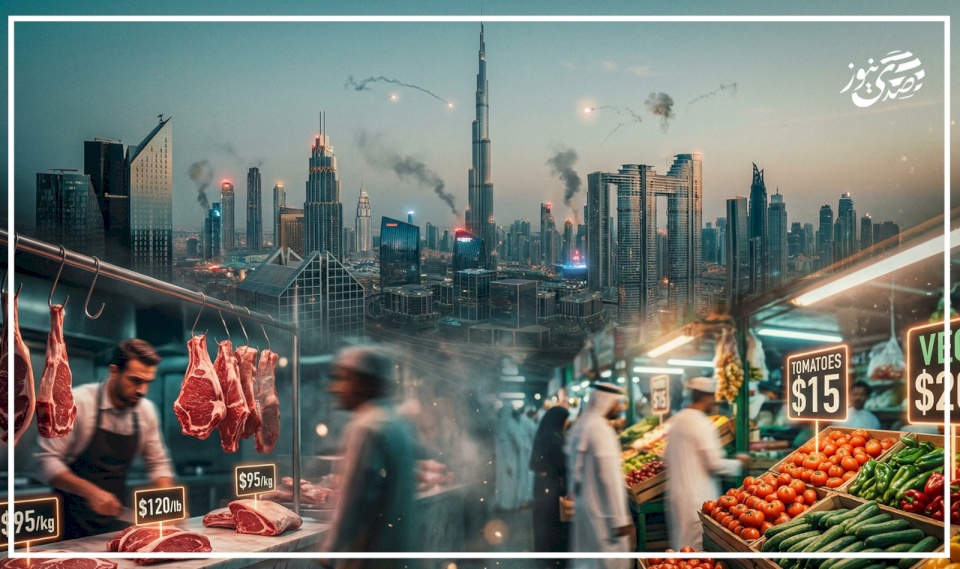
Closure of Hormuz causes rise in food prices in the Gulf and disrupts supplies
SadaNews - In one of Bahrain's major stores, the shelves seem stocked with goods despite the war that has disrupted main supply routes, yet this disruption is clearly reflected in the prices of some food products "which have risen significantly" in recent days, according to Mahmoud Ali who points out that meat prices "have nearly doubled".
Like most neighboring Gulf countries, Bahrain relies heavily on imports, particularly for its food products.
Economic expert, Frederic Schneider, from the "Middle East Council on Global Affairs," noted that "most ports in the UAE, Qatar, Kuwait, and Bahrain have suspended or significantly reduced their activities".
He added that air transport, which is another logistical pillar for these countries, is operating at low capacity due to daily Iranian missile and drone attacks.
As operations are disrupted through the main Gulf gateways, such as Jebel Ali Port in Dubai, Abu Dhabi Port, and Dammam Port in Eastern Saudi Arabia, ships have redirected their routes to ports south of the strait in Oman and the UAE.
In a conversation with SadaNews, an engineer working in Abu Dhabi about the economic operations in the UAE, said: "We are suffering a significant shortage in construction supplies for buildings, roads, and more... We have begun to clearly notice this shortage especially as the UAE is primarily an importing country and had no stockpiles of these materials since it relied on an open maritime trade line before the war."
The engineer, who preferred to remain anonymous in his conversation with SadaNews, stated that shipping costs have increased significantly, rising from $3,000 to $12,000 for a single container during the war.
He adds, "The crisis is not just in construction materials; it is much larger than that. Nowadays, there is no fresh meat available as fresh meat was consistently arriving from East Asian countries and others in shipping containers. What is available now is only frozen meat in stores. If the war continues longer, we will also suffer from a shortage of frozen meat."
Alternatives
On its part, Saudi Arabia has solidified its position as a primary supply center in the heart of the Gulf region, especially since its airspace remains open, while maritime traffic continues to its ports located on the Red Sea.
To address the disruption of traffic through Gulf Coast ports, the Kingdom has launched an initiative aimed at enhancing its transportation networks, particularly by designating key hubs for logistics services, intended to accommodate containers and goods being redirected from the country’s eastern ports, according to transportation sector officials.
During a recent trip to the border with Qatar, reporters from the "Associated Press" witnessed a flow of freight trucks crossing the border.
Alongside this, alternative routes have been adopted that link the Mediterranean through Syria or Jordan.
However, Schneider explained that these crowded routes are more expensive and are insufficient to compensate for the paralysis across traditional routes.
Fresh products, which are largely imported from Asia and cannot be stored for long periods, were the first commodities affected by the consequences of the war that erupted on February 28, following the American-Israeli strikes on Iran.
"A Real Danger"
Despite attempts to seek alternatives, not all Gulf countries have equal opportunities to cope with the current situation.
Saudi Arabia has direct access to the Red Sea, while the UAE claims it has stocks that are sufficient for a period ranging from 4 to 6 months. Qatar had invested heavily in its strategic reserves after the three-year blockade imposed by its neighbors in 2017.
However, the situation differs for Bahrain and Kuwait, where the consequences of suffering are beginning to show on consumers.
In the wake of residents rushing to stores in the early days of the war in anticipation of shortages or price increases, Kuwaiti authorities froze the prices of some essential commodities and supported meat imports.
A source in the Kuwaiti Ministry of Commerce told the "Associated Press" on the condition of anonymity, "In general, prices have remained stable."
However, he acknowledged that "there has been an increase of more than 30% in meat and fish prices," affected by the suspension of fishing in the Gulf and the halt of imports from Iran, India, and Pakistan.
The private sector is also trying to mitigate the effects of the war. The LuLu supermarket chain, which has 280 stores in the region, reported that it is maintaining a stock of non-perishable goods sufficient for a period of 4 to 6 months and has chartered special flights to transport fruits, vegetables, meat, seafood, and poultry.
V. Nandakumar, the company’s media officer, stated that 6,000 tons of products have been imported so far through 37 flights, confirming "not to pass the additional costs to consumers at this time."
However, maintaining this equation for a long period may be difficult.
Frederic Schneider mentioned that there is a "level of preparedness," pointing out that "prices, despite rising, are still under control." However, he noted the "real risk of rising prices for imported products, especially food items," taking into consideration the likelihood of "the war not ending soon."
 Follow the latest Sada News via Google News
High-level sources reveal to SadaNews: Washington seeks to hold a Gaza Reconstruction Conf...

Iraqji Reveals Details of the Attack on the Iranian Supreme Leader's Headquarters

صراع على إرث خامنئي وسط غياب مجتبى.. والمتشددون يتهمون قادة إيران بـ«الانقلاب»

The European Union Reiterates Its Call for Israel to Refrain from Expanding Settlements in...

"Mamdani Berlin".. The German Left Bets on a Politician of Turkish Descent to Lead the Cap...

Hebrew Channel: Kushner Pushing to Enhance Communication Between the United States and the...

SadaNews Report: Israeli Elections with a Settlement Flavor!
