

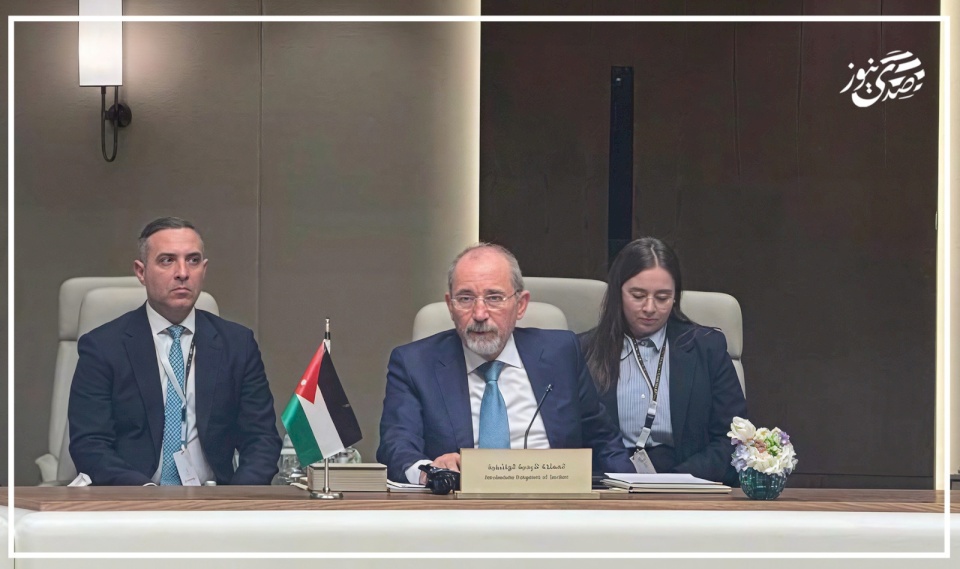
Jordanian Foreign Minister Participates in Consultative Meeting of 12 Countries in Saudi Arabia
SadaNews - The Jordanian Deputy Prime Minister and Minister of Foreign Affairs and Expatriates, Ayman Safadi, participated last night in a consultative ministerial meeting hosted by the Kingdom of Saudi Arabia to discuss "Iranian aggressions" against several countries in the region.
The meeting, convened at the invitation of the Saudi Minister of Foreign Affairs, Prince Faisal bin Farhan, included the foreign ministers of the Republic of Azerbaijan, the Islamic Republic of Pakistan, the Kingdom of Bahrain, the Republic of Turkey, the Syrian Arab Republic, the State of Qatar, the State of Kuwait, the Republic of Lebanon, the Arab Republic of Egypt, and the Minister of State for Foreign Affairs of the United Arab Emirates.
During the meeting, Safadi reiterated Jordan's "complete solidarity with the Gulf Cooperation Council countries and the Islamic nations that are facing Iranian aggressions, which Jordan deems as unprovoked and represents a flagrant violation of international law and the sovereignty of nations. Safadi affirmed Jordan's support for all measures taken by these countries to protect their security, stability, sovereignty, and the safety of their citizens".
Safadi valued the "solidarity of the brothers with Jordan in facing Iranian aggressions".
The following statement was issued at the meeting:
The foreign ministers of (the Hashemite Kingdom of Jordan, the Republic of Azerbaijan, the Kingdom of Bahrain, the Arab Republic of Egypt, the State of Kuwait, the Republic of Lebanon, the Islamic Republic of Pakistan, the State of Qatar, the Kingdom of Saudi Arabia, the Syrian Arab Republic, the Republic of Turkey, and the United Arab Emirates) held a consultative ministerial meeting on Wednesday, 29 Ramadan 1447 AH, corresponding to March 18, 2026, in the city of Riyadh, concerning the Iranian aggressions.
The attendees discussed the Iranian aggressions against the GCC countries, the Hashemite Kingdom of Jordan, the Republic of Azerbaijan, and the Republic of Turkey, and they condemned and denounced these deliberate Iranian aggressions using ballistic missiles and drones, which targeted residential areas, civilian infrastructure including oil facilities, water desalination plants, airports, residential properties, and diplomatic missions.
The participants affirmed that these aggressions cannot be justified under any pretext and in any form.
They also confirmed the right of states to defend themselves according to Article (51) of the United Nations Charter.
The participants called on Iran to immediately stop its aggressions, respect international law and international humanitarian law, and abide by the principles of good neighborliness as a first step towards de-escalation, ensuring security and stability in the region, and activating diplomacy as a means to resolve crises.
They stressed that the future of relations with Iran depends on respecting the sovereignty of states, refraining from interfering in their internal affairs, and not violating their sovereignty and territories in any form, as well as not using and developing military capabilities to threaten countries in the region.
The participants emphasized the necessity for Iran to comply with United Nations Security Council Resolution No. 2817 (2026), to immediately cease all attacks, and refrain from any provocative actions or threats directed at neighboring countries, and to stop supporting, financing, and arming its militias in Arab states which serve its purposes against the interests of these countries, and to avoid any actions or threats aimed at closing or obstructing international navigation in the Strait of Hormuz or threatening maritime safety in Bab el-Mandeb.
The participants reaffirmed their support for the security, stability, and territorial integrity of Lebanon, the activation of the sovereignty of the Lebanese state over its entire territory, and support for the Lebanese government's decision to restrict arms to the state. They also condemned Israel's aggression against Lebanon and its expansionist policies in the region.
The participants renewed their commitment to continue intensive consultation and coordination in this regard, to monitor developments and assess changes in a way that ensures the crystallization of common positions and the implementation of necessary legal measures and actions to protect their security, stability, and sovereignty, and to stop the wrongful Iranian aggressions against their territories.
Safadi conducted bilateral discussions with his counterparts participating in the meeting.
 Follow the latest Sada News via Google News
Trump: We will make great progress with Beirut.. Aoun: It is time for Lebanon to be stable

The Lebanese Army Deploys in the South and Comes Under Gunfire; Israel Clarifies

Bezhkian: Directives from the Leader to End the State of No War, No Peace

Saudi Arabia condemns the Houthi threats to navigation and pledges to protect its ships

Global Warning to Americans Due to Rising Tensions in the Middle East

Houthi Movement Announces Ban on Maritime Navigation Against Saudi Arabia

Earthquake of 5.5 Magnitude Hits Western Iran
