

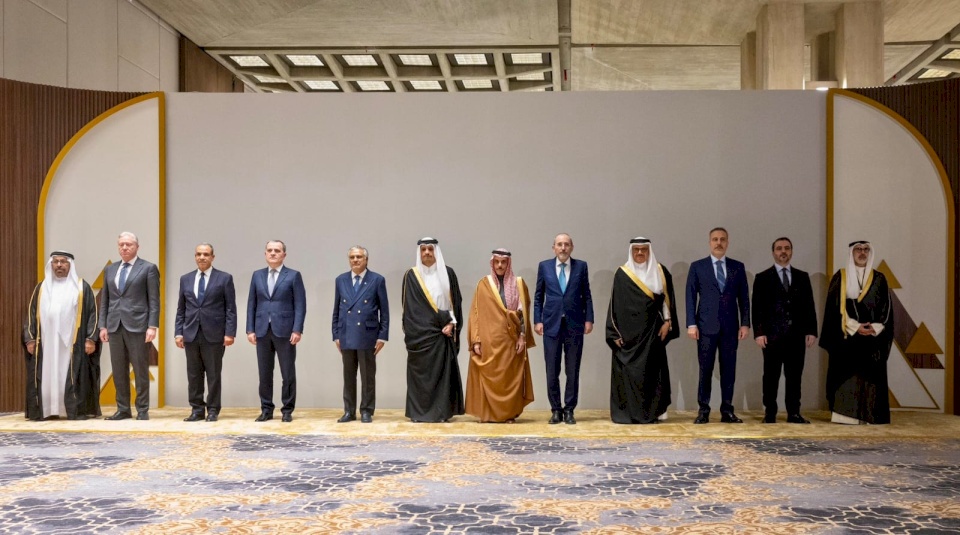
Joint Statement from 12 Arab and Islamic Countries: Iran Must Immediately Stop Its Aggressions
SadaNews - The foreign ministers of the Republic of Azerbaijan, the Kingdom of Bahrain, the Arab Republic of Egypt, the Hashemite Kingdom of Jordan, the State of Kuwait, the Lebanese Republic, the Islamic Republic of Pakistan, the State of Qatar, the Kingdom of Saudi Arabia, the Syrian Arab Republic, the Republic of Turkey, and the United Arab Emirates held a consultative ministerial meeting yesterday, Wednesday, in Riyadh, regarding "Iranian Aggressions".
The attendees discussed the Iranian aggressions against the Gulf Cooperation Council countries, the Hashemite Kingdom of Jordan, the Republic of Azerbaijan, and the Republic of Turkey. They condemned and denounced these deliberate Iranian aggressions using ballistic missiles and drones, which have targeted residential areas, civil infrastructure including oil facilities, water desalination plants, airports, residential compounds, and diplomatic premises.
The attendees emphasized that these Iranian aggressions cannot be justified in any form and violate the sovereignty of the states, jeopardizing their security and stability. They contradict international law and humanitarian law.
The attendees called on Iran to immediately halt its aggressions, respect the principles of good neighborliness, refrain from interference in the internal affairs of states, and not use its territory or that of others to launch aggression against neighboring countries. They further demanded that Iran cease supporting, funding, or arming militias that carry out hostile actions against Arab states.
The attendees stressed the need for Iran to respect United Nations Security Council Resolution 2817 (2026), which condemns these aggressions and calls for their immediate cessation, and to refrain from any provocative actions or threats directed at neighboring states.
They asserted that the future of relations with Iran depends on respecting the sovereignty of states and not interfering in their internal affairs, as well as not using its territory or that of others to launch aggression against neighboring states.
The attendees reiterated their support for the sovereignty, independence, and territorial unity of Arab states, and the necessity of resolving disputes peacefully in accordance with the principles of international law.
They renewed their commitment to enhancing cooperation and coordination among themselves to face these challenges and to protect the security and stability of the region.
 Follow the latest Sada News via Google News
Macron: France Requested EU Assistance to Deal with Fires

Ukrainian Drones Target St. Petersburg Area in Russia

Man Stabs Two People in New York While Shouting 'Allahu Akbar'

Tehran Responds: Trump Threatens to Use Iranian Funds to Compensate Damaged Ships

American Escalation Using B-1 Bomber Against Targets of the Iranian Revolutionary Guard

Iranian Revolutionary Guard Targets Al-Adairi Camp and Ali Al-Salem Air Base in Kuwait

Massive Fire in Spain Forces Residents of 34 Villages to Evacuate
