

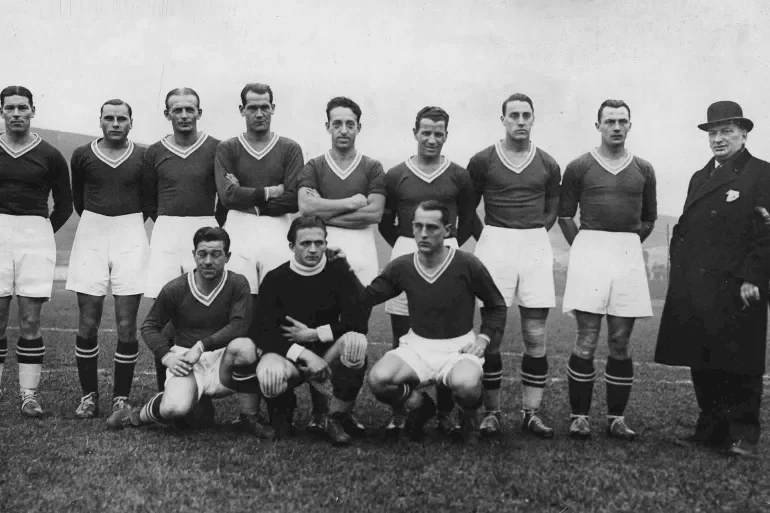
How Did the Tactics of Modern Football Begin in the Heart of Cafés in Vienna and Budapest?
SadaNews - While modern European football boasts complex possession systems, the true roots of this revolution trace back to the 1930s, specifically from within the "cafés of Vienna and Budapest". There, amidst discussions among intellectuals and cigarette smoke, the "Danubian School" was born, which was not just a style of play but a comprehensive engineering of the game's features.
This school succeeded in transforming football from the strong physical struggles relied upon by the traditional English school into "tactical symphonies" based on the work of the mind and perfect short passing.
Jonathan Wilson, a top reference in the history of football tactics, asserts in his analyses: "Modern football was not born in the 1970s with 'total football' in the Netherlands, but was born in the cafés of Vienna. Coach Hugo Meisl and his Austrian team proved that football is fundamentally a mental game; without these geniuses, the game would have remained primitive for a long time."
Austrian 'False Striker' (The Model of Sindelar and Messi)
Hugo Meisl is considered the mastermind behind Austria's "Wunderteam" that dominated European football in the early 1930s.
He was also one of the early coaches who laid the foundations of modern football; he collaborated with his English friend Jimmy Hogan to develop a playing style based on technical skill rather than merely physical strength.
Meisl led the Austrian national team to present a revolutionary football characterized by rapid passing and intelligent movements, as the team did not suffer any defeats in 14 consecutive matches between 1931 and 1932, breaking the monotony of traditional tactics.
This team was the first to play "tiki-taka" or "total football" decades before Rinus Michels, Johan Cruyff, and Pep Guardiola.
The first signs of tactical deception emerged through the legendary forward Matthias Sindelar, nicknamed "Mozart".
With his slender body and pale features, the Austrian Matthias Sindelar, dubbed "the paper man", was not just a striker; he was a tactical revolution walking on the grass of the pitches.
At a time when the center-forward was merely a "stake" waiting for crosses, Sindelar decided to rebel; he would retreat to the midfield, dragging along the toughest defenders, leaving behind a deadly gap and confusion previously unknown to defenders.
In 1932, Sindelar faced England as a "ghost" that could not be caught, applying the first concept of the "false striker" that dismantled traditional English defenses.
Nearly 80 years later, Pep Guardiola summoned the "spirit" of Sindelar and placed it in the body of Lionel Messi. What Messi did on that historic night (6-2) in "El Clasico" was not a momentary innovation, but a meticulous execution of the original "scheme" drawn by the paper man.
By withdrawing from the penalty area, Messi forced Real Madrid defenders - Cannavaro and Metzelder - to choose between leaving space behind them or chasing him to the midfield; a "trap" Sindelar had set decades earlier.
The End of a Legacy
Within five years, both the mastermind of the team, Meisl, and his pupil, Sindelar, passed away, marking the end of the dream of Austrian football dominance.
Meisl died in 1937 at the age of 55, of a sudden heart attack. His death was a major shock to the global sports community as it came while he was at the peak of his career, preparing his team for the 1938 World Cup.
It was not just the departure of a coach but a "dramatic end" that paved the way for the loss of the legacy of the great Austrian team before World War II.
On January 23, 1939, the "paper man" was found dead in his apartment in Vienna, marking the darkest chapter in football history, an ending that transformed the "Danubian School" from just a tactical school into a genuinely tragic epic.
Wembley Earthquake and the Code Explosion
But this "engineering" did not stop at Austria; it crossed the Danube River to settle in Budapest. There, the Hungarians developed the "code" to become even deadlier.
In 1953, the Hungarian national team entered Wembley Stadium, the stronghold of the English who believed they were the masters of the game forever.
In just ninety minutes, the old football empire fell with a score of 3-6, with Puskás and his companions moving like ghosts, exchanging positions with unprecedented fluidity.
It was not just a match, but a "tactical explosion" that proved that the mind defeats muscles. This system, later known as "total football", was not a purely Dutch invention, but a resonance of Hungarian cries of joy on that sad London evening.
In his memoirs and statements about the evolution of the game, legendary Manchester United coach Alex Ferguson spoke of the moment that changed his concepts: "The match between Hungary and England in 1953 was the moment everyone realized that the world had changed. The Hungarians made us look like we were from the prehistoric age. They gave us a lesson in moving without the ball and exchanging positions, a lesson we are still trying to master today."
The Great Escape... Seeds of Latin Magic
But the real drama began with the sounds of the defender; after the Hungarian Revolution of 1956, these geniuses fled as refugees, carrying their tactical secrets in small bags. Thus, the "spirit" moved from Europe to Latin America.
Bella Guttmann, the rebellious Hungarian godfather, arrived in Brazil, where he found incredible innate talent, but lacking in "system".
With his Hungarian rigor, Guttmann instilled a (4-2-4) plan, giving Brazil the structure that allowed young Pelé to dance over the grass.
Simultaneously, his compatriot Emeric Hirschel was laying the groundwork for River Plate’s "machine" in Argentina. The Hungarian immigration was the "spark" that transformed innate Latin magic into organized global dominance.
The historical example: the title "La Máquina" (The Machine) given to the River Plate team in the 1940s was not coincidental. Hirschel introduced them to the concept of "team play" and high pressing, making them the most feared team on the continent.
The modern connection: Argentina's philosophy of possession and short balls (La Nuestra) is a blend of local skill and the organization of the Budapest school.
Ghosts Haunting the Pitches
Behind the brilliance of high pressing applied by coach Jürgen Klopp, and the suffocating possession imposed by Manchester City under Guardiola, there lie not entirely new innovations, but "ghosts" of the coaches of the Danubian School who shaped the features of modern football a century ago and then passed away in exile.
This story is not merely about football plans, but it is a journey that began with a scheme drawn on a wooden table in one of Vienna’s bustling cafés full of intellectuals, where the game transformed from mere physical running into "engineering".
These revolutionary ideas soon caused tactical earthquakes in London, before finding their way to reshape the identity of football in South America, settling in the feet of samba and tango geniuses.
In numerous tactical analyses that have addressed Guardiola's philosophy, his roots are always referenced, and the Spaniard states: "I am not inventing anything new; I am retrieving ideas that have always existed. When we look at Matthias Sindelar in the thirties, we realize that the idea of the false striker was an ancient genius. Those coaches in Central Europe are the true teachers of everyone who came after them, including Cruyff and myself."
 Follow the latest Sada News via Google News
After Deschamps' Departure... Zinedine Zidane Tops the Candidates to Lead France

Mbappe Surpasses Messi and Becomes the All-Time Top Scorer in the World Cup

England Defeats France and Achieves Largest World Cup Achievement Since 1966

Messi Refused to Play for Spain and Missed 3 World Cups

Publishers Sue Google for Allegedly Using Books to Train Artificial Intelligence

Google Expands Capabilities of Google Search Console to Support Social Media Accounts

The Mediterranean Table... An Ancient Diet Revealing Its New Secrets for Health and Longev...
