

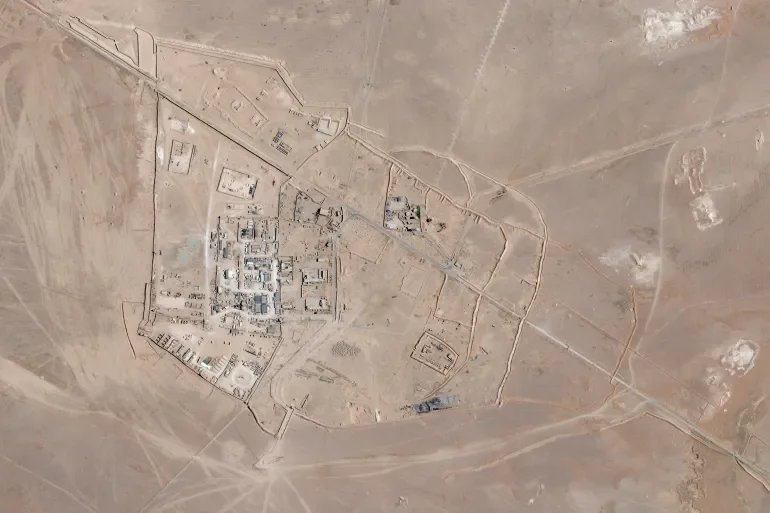
Shift in the Balance: Implications of the American Withdrawal from the Tanf Base in Syria
SadaNews - The American withdrawal from the Tanf base is not read as an isolated military move, but rather as a link in a broader trend to rearranging Washington's priorities in Syria and the region.
This base, which has represented a geopolitical knot at the intersection of the Syrian-Iraqi-Jordanian borders for years, was more than just a military deployment point; it served as a tool of political and security pressure that enabled the United States to influence the balances in southeastern Syria and control cross-border movements.
This withdrawal closes a chapter of military deployment that began in 2016 as part of the war on the Islamic State organization, and it is also part of a wider repositioning of American forces in Syria, which included the evacuation of 6 bases within a year, raising questions about its potential implications on security and strategic balances in southern Syria.
A Junction of Vital Roads
The Tanf base derived its importance from its sensitive geographical location, overseeing several vital routes linking Damascus to Baghdad, and extending its oversight over vast areas of the Syrian desert. During its years of operation, the base performed three main functions: monitoring the borders, cutting off cross-border supply lines, and supporting a local faction responsible for security tasks in its surroundings, which was later integrated into a security structure under the Syrian state.
With the completion of the American withdrawal, units from the Syrian army have spread in the area, coinciding with the transfer of thousands of Islamic State detainees to Iraq, reflecting the full transfer of security responsibility in this border sector to Damascus.
Withdrawal Calculations
Major Muhammad Khalid of the Syrian army stated in a talk with Al Jazeera Net, that the withdrawal came after the completion of transferring Islamic State fighters to Iraq and the finalization of security understandings between the Syrian Democratic Forces (SDF) and the Syrian government.
He explained that an agreement was reached between American leadership and the Syrian government regarding the withdrawal of American forces following progress in security arrangements in the eastern country, with Syrian forces set to fill the gap.
Khalid added that Washington was no longer willing to lose more soldiers in the complex desert environment, especially with a battlefield partner represented by the Syrian army, capable of confronting Islamic State cells with aerial support from the international coalition.
He noted that this move came months after the merger of the "Free Syria Army" (previously known as the Revolutionary Commando Army), stationed in Tanf, within the umbrella of "Desert Security" under the Syrian Ministry of Interior.
Defining the American Role
For his part, political advisor and member of the Syrian American lobby, Dr. Samer Al-Safadi, believes that the withdrawal reflects Washington's transition from a pattern of direct military presence to what he describes as distant deterrence. He clarifies that the United States no longer views the Tanf base as necessary for maintaining a field balance, relying increasingly on aerial surveillance tools and local partnerships in counter-terrorism efforts.
Al-Safadi considers this step to carry a political significance that goes beyond its military aspect, suggesting an American readiness to acknowledge the Syrian government's ability to control its southeastern borders. In his opinion, this could open the door to less confrontational approaches between Washington and Damascus, though it may not reach the level of a radical transformation in American policies.
The American Department of Defense announced in April 2025 its intention to integrate its forces in Syria and reduce their number from about two thousand to half, while maintaining a limited presence at specific sites.
Balances in the South
Militarily, Colonel Mustafa Al-Farahat describes the withdrawal as an ending of direct foreign presence in a strategic point that has remained outside governmental control for years. He notes that the state's restoration of this border triangle enhances the unity of military geography in the southeastern region and grants the Syrian leadership a wider margin to manage desert security.
However, Al-Farahat emphasizes that this development does not mean the emergence of an entirely new balance of power, as the southwest has been subject to relatively stable regional understandings for years. The real challenge lies in the ability of the newly deployed forces to secure vast desert areas that have long been an active environment for Islamic State cells.
In this context, the Syrian Ministry of Defense announced today that the Syrian army has taken over the Al-Shaddadi military base in Al-Hasakah province, northeastern Syria, after coordination with the American side. The ministry confirmed in statements to the Syrian news agency that the base is among the most prominent strategic points in the Syrian Jazira region due to its location linking Al-Hasakah and Deir Ezzor provinces.
Two Bases for the Coalition
For his part, political researcher specialized in eastern Syria, Anas Shawakh, stated in a report to Al Jazeera Net that two American bases remain operational in the region: the first in Rumailan, which includes a command for the international coalition and a helicopter landing site, while the second is at the Qasrk base near Tal Tamr on the Al-Hasakah-Tal Tamr road.
Shawakh pointed out that both bases are located within areas controlled by the SDF, within what is known as the triangle, which continues to maintain its military presence in SDF regions.
For his part, researcher Abdullah Al-Khair believes that the American withdrawal from Tanf reflects a change in Washington's priorities more than it signifies a radical shift in the structure of the conflict in southern Syria.
He estimates that the true strategic impact will be determined by three interrelated factors:
The level of security coordination between Damascus, Amman, and Baghdad.
The Syrian state's ability to control the desert and prevent the return of cross-border activity.
The nature of Iranian presence in the upcoming stage.
He adds that the balance of power in the south will not flip completely, as most contact lines have stabilized for years, but the withdrawal removes from Washington a pressure tool that allowed it to disrupt or slow some arrangements. In this sense, what is happening is a "shift in the mechanisms of managing the balance" rather than a change in its essence.
Al-Khair concludes that the Tanf base formed a geopolitical knot more than an open combat front, and with the withdrawal of American forces from it, the management of this knot is entirely transferred to the Syrian state. If Damascus succeeds in establishing security and preventing any military void, the southern Syria may head towards a greater degree of relative stability; however, if this control falters, the area may return to a circle of regional tug-of-war, albeit in different forms than before.
Source: Al Jazeera
 Follow the latest Sada News via Google News
Bezhkian: Directives from the Leader to End the State of No War, No Peace

Saudi Arabia condemns the Houthi threats to navigation and pledges to protect its ships

Global Warning to Americans Due to Rising Tensions in the Middle East

Houthi Movement Announces Ban on Maritime Navigation Against Saudi Arabia

Earthquake of 5.5 Magnitude Hits Western Iran

To Enhance His Support for "Increasing Children"... Vance Announces the Birth of His Fourt...

Death of a Mosque Imam in Armed Attack in Southeastern Iran
