

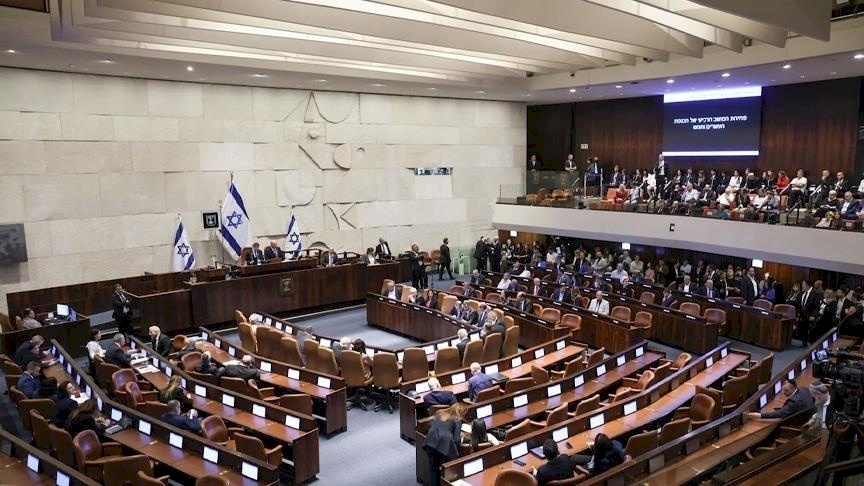
Israel: 60 Seats for the Opposition and 50 for Netanyahu's Bloc in Case of Early Elections
SadaNews - A poll conducted on Friday showed a strengthening of the opposition's power in Israel compared to the bloc supporting Israeli Prime Minister Benjamin Netanyahu, theoretically increasing the chances of the former to form the next government.
The Israeli newspaper "Maariv" reported that in the event of early elections, opposition parties would gain 60 seats in the Knesset (parliament) composed of 120 seats, compared to 50 for Netanyahu's supporting bloc and 10 seats for the Arab parties.
According to the poll results, the increase in the opposition's strength is attributed to the rising popularity of the "Yashar" party, led by former Chief of Staff Gadi Eisenkot, which is projected to gain 12 seats, compared to 9 seats in last week’s poll.
According to Israeli laws, forming a government requires the confidence of 61 members of the Knesset or more.
Unless early elections are held, the current Knesset’s term will end next October.
The distribution of seats in Netanyahu's camp is as follows: "Likud" 25 seats, "Jewish Power" led by Itamar Ben Gvir 10 seats, "Shas" 8 seats, and "Yahadut HaTorah" 7 seats.
On the other hand, the opposition parties are: "Bennett 2026" 21 seats, "Yashar" 12 seats, and "Democrats" led by Yair Golan 9 seats, "Yisrael Beiteinu" led by Avigdor Lieberman 9 seats, and "There is a Future" led by Yair Lapid 9 seats.
The Democratic Front and the Arab Change List alliance receives 5 seats, while the United Arab List led by Mansour Abbas also gets 5 seats.
Both the "Religious Zionism" party led by Bezalel Smotrich and the "Blue and White" party led by Benny Gantz do not exceed the electoral threshold according to the poll.
In terms of preferences for the presidency of the government, the poll indicated that 41% of respondents prefer Netanyahu as prime minister, compared to 40% favoring former prime minister Naftali Bennett, while 20% said they have no answer.
In a direct competition between Netanyahu and Eisenkot, Netanyahu receives 42% compared to 38% for Eisenkot.
If facing off against Lapid, Netanyahu receives 47% compared to 30% for Lapid.
The poll also shows that 47% of Israelis do not believe Netanyahu's account regarding the events that led to the October 7, 2023 attack, while 28% do, and 25% said they do not know.
The newspaper noted that the poll was conducted by the "Lazar Institute" (private) and included a random sample of 593 Israelis, with a margin of error of 4.4 percent.
On October 7, 2023, "Hamas" and Palestinian factions launched "Al-Aqsa Flood," attacking 11 military bases and 22 settlements, aiming to "end the unjust blockade on Gaza, which had lasted for 18 years (at that time) and thwart Israel's plans to eliminate the Palestinian cause and impose its sovereignty over Al-Aqsa Mosque."
The next day, Israel initiated a genocide in Gaza that lasted two years, causing over 72,000 Palestinian deaths and more than 171,000 injuries, along with massive destruction affecting 90% of the infrastructure, with an estimated reconstruction cost of about 70 billion dollars.
 Follow the latest Sada News via Google News
High-level sources reveal to SadaNews: Washington seeks to hold a Gaza Reconstruction Conf...

Iraqji Reveals Details of the Attack on the Iranian Supreme Leader's Headquarters

صراع على إرث خامنئي وسط غياب مجتبى.. والمتشددون يتهمون قادة إيران بـ«الانقلاب»

The European Union Reiterates Its Call for Israel to Refrain from Expanding Settlements in...

"Mamdani Berlin".. The German Left Bets on a Politician of Turkish Descent to Lead the Cap...

Hebrew Channel: Kushner Pushing to Enhance Communication Between the United States and the...

SadaNews Report: Israeli Elections with a Settlement Flavor!
