

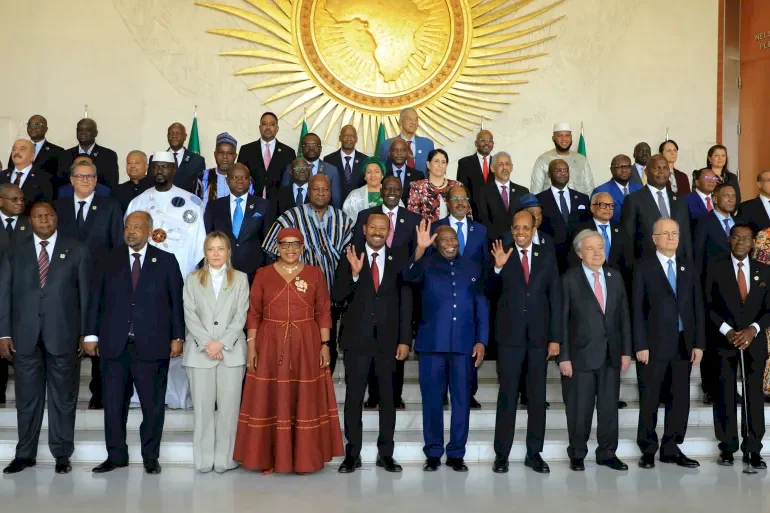
African Leaders Discuss the Future of Their Continent and Seek Solutions to Its Crises in Addis Ababa
SadaNews - The 39th African Summit in the Ethiopian capital, Addis Ababa, concluded its first day of work, with wide participation from leaders of countries and governments.
The opening sessions on Saturday were dominated by warnings about the expansion of conflict hotspots and the increasing fragility of continental institutions, alongside discussions on key issues led by the situations in Sudan, disturbances in the Sahel countries, debt issues, water sovereignty, and the free trade area.
Warnings of Conflicts
Moussa Faki Mahamat, Chairperson of the African Union Commission, addressed the ongoing conflicts in the African continent in his opening speech, stating: "From Sudan to the Sahel, and from the eastern Democratic Republic of Congo to Somalia and beyond, our peoples are still paying a heavy price for instability."
He continued, "We find it difficult to silence the guns. Political and institutional fragility in many of our countries is worrisome. Conflicts, both open and latent, become chronic."
United Nations Priorities
For his part, United Nations Secretary-General Antonio Guterres emphasized that the African continent will remain "the top priority" for the international organization, stressing the need for its permanent representation on the UN Security Council.
While addressing the ongoing conflicts, Guterres announced the UN's full commitment to press for an "immediate ceasefire" in Sudan.
He stressed the need to address external parties supplying arms to the warring sides, indicating the organization's engagement with the African Union, the Arab League, and the Quartet to create pressured conditions to end the conflict ongoing since April 2023.
The Secretary-General also addressed tensions in the Horn of Africa, expressing hope for reconciliation between Ethiopia and Eritrea to contribute to the stability of the continent, especially following the tensions that followed the Tigray conflict, noting that the two countries share a "long history of joint struggle."
Comprehensive Security Approach
For his part, Egyptian Foreign Minister Badr Abdel Atti called for adopting a "comprehensive approach" to enhance security in Africa, dealing with the challenges of terrorism and external interventions affecting the sovereignty of states.
Abdel Atti conveyed Egypt's commitment - as the chair of the African Peace and Security Council this month - to support efforts to "silence the guns" by 2030, and reach a comprehensive political settlement that preserves Sudan's unity and territorial integrity.
Regarding the Palestinian issue, Palestinian Prime Minister Mohammed Mustafa called for a decisive international response to Israeli settlement expansion to protect the two-state solution.
Mustafa, who was invited to the summit, emphasized that Israel continues to violate the ceasefire agreement and threatens its second phase, stressing to African leaders that "the Gaza Strip is an integral part of the State of Palestine."
For his part, the Chairperson of the African Union Commission called for a "stop to the extermination" of Palestinians, describing the suffering of the population there as requiring a firm international stance.
Earlier on Saturday, the 39th African Union Summit commenced in Addis Ababa, with the attendance of the UN Secretary-General, to discuss the future of the continent and attempts to halt internal conflicts in its countries.
On the agenda of the summit are issues of water security, sanitation, the free trade area, debts burdening the continent, in addition to security disturbances in the Sahel and Horn of Africa countries.
Among the key issues, the war in Sudan seeks to outline a roadmap for resolving this crisis.
Source: Al Jazeera + Agencies
 Follow the latest Sada News via Google News
Trump: We will make great progress with Beirut.. Aoun: It is time for Lebanon to be stable

The Lebanese Army Deploys in the South and Comes Under Gunfire; Israel Clarifies

Bezhkian: Directives from the Leader to End the State of No War, No Peace

Saudi Arabia condemns the Houthi threats to navigation and pledges to protect its ships

Global Warning to Americans Due to Rising Tensions in the Middle East

Houthi Movement Announces Ban on Maritime Navigation Against Saudi Arabia

Earthquake of 5.5 Magnitude Hits Western Iran
