

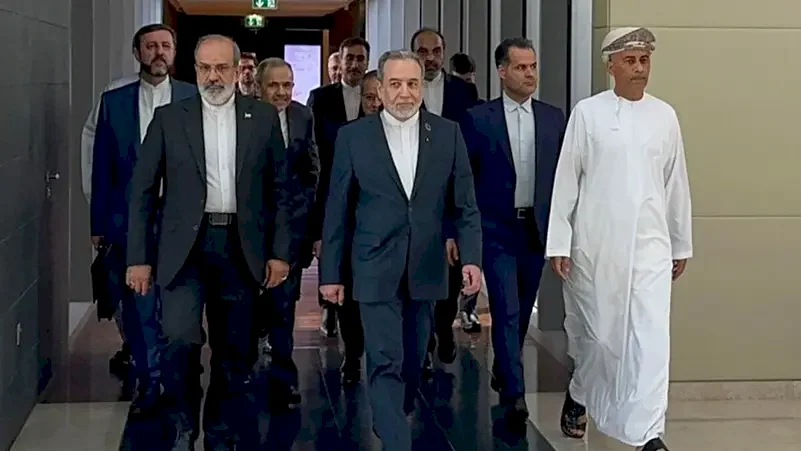
An Iranian Delegation Led by Araqchi Heads to Geneva to Resume Negotiations with the U.S.
SadaNews - Iranian Foreign Minister Abbas Araqchi departed Tehran for Geneva on Sunday evening to conduct the second round of nuclear negotiations, along with some diplomatic consultations.
According to the Mehr News Agency, Abbas Araqchi, the Foreign Minister of the Islamic Republic of Iran, left Tehran heading to Geneva on Sunday evening at the head of a specialized diplomatic delegation, to conduct the second round of nuclear talks and some diplomatic consultations.
The indirect nuclear negotiations between Iran and the United States will take place on Tuesday, mediated by the Sultanate of Oman.
During this visit, the Foreign Minister will also meet with the Swiss Foreign Minister, the Omani Foreign Minister, the Director-General of the International Atomic Energy Agency, and several international officials residing in Switzerland, to hold discussions with them.
Swiss authorities announced on Saturday that a new round of negotiations between the United States and Iran will be held in Geneva next week, hosted by Oman, which previously hosted the first round in Muscat this month.
A spokesperson for the Foreign Ministry stated that 'Switzerland is ready at any time to make efforts to facilitate dialogue between the United States and Iran.'
He also added that 'Oman will host the talks between the United States and Iran in Geneva next week,' without specifying a date, affirming that 'Switzerland welcomes and supports these talks,' according to AFP.
Continuing the Talks
The indirect negotiations between the United States and Iran, which took place in the Omani capital Muscat, concluded last Friday evening.
Iranian television reported that the Foreign Ministry spokesperson Ismail Baqaei said the talks ended 'for now,' and that both delegations are expected to return to their countries.
In a post published later on the American 'X' platform, Baqaei said that the talks that took place in Muscat concluded with both sides reaching a consensus on continuing the discussions.
Baqaei indicated that the Iranian and American sides presented their views and demands during the negotiations today in Muscat.
Negotiations began on Friday morning in Muscat between Washington and Tehran, in a negotiating track that was interrupted last year following American and Israeli airstrikes and attacks on Iran.
The negotiations between the two countries took place at a time when tensions are rising between them, amidst a US military buildup in the region against Tehran.
The talks between the American and Iranian sides were hosted by Omani Foreign Minister Badr al-Busaidi.
Iranian Foreign Minister Abbas Araqchi headed the Iranian delegation in the negotiations, while the United States was represented by Special Envoy for Middle East Affairs under President Donald Trump, Steve Whitkoff.
Also participating in the talks were Majid Takht-Ravanchi, Iran's Deputy Foreign Minister for Political Affairs, Hamid Ghanbari, Deputy Foreign Minister for Economic Affairs, and Foreign Ministry spokesperson Ismail Baqaei.
On the American side, Whitkoff was accompanied by Jared Kushner, President Trump's son-in-law and advisor.
The Muscat negotiations resume a track that was planned for June 2025, before being thwarted by Washington and Israel launching airstrikes on Iran targeting nuclear, military, and security facilities, resulting in the deaths and injuries of hundreds, including leaders.
The current round of talks is being held amidst a US military buildup in the Middle East and Israeli threats to strike Iran, pushing it to end its nuclear and missile programs and abandon its 'agents in the region.'
Tehran asserts that the US administration and Israel fabricate pretexts for military intervention and regime change, vowing to respond to any military attack, even if limited, and insisting on lifting the Western economic sanctions imposed on it in exchange for restricting its nuclear program.
The enrichment of uranium and the removal of highly enriched uranium from Iran are major points of contention between the two sides.
Iran demands the lifting of sanctions in exchange for its commitment to restricting its nuclear program to prevent the production of a nuclear bomb.
In contrast, the United States demands that Iran completely cease its uranium enrichment activities and remove highly enriched uranium from its territory abroad.
The US administration also sought to place Iran's missile program and its support for armed groups in the region on the negotiation table.
However, Iran has repeatedly confirmed that it will not negotiate on any issues other than its nuclear program.
 Follow the latest Sada News via Google News
Smotrich: Israel Has No Interest in Joining the War Against Iran

Occupation Issues Military Order to Seize 5 Dunams of Land in Jaba'

Axios: Proposal for a 10-day Ceasefire Between Washington and Tehran and Two Options for M...

In a Rapid Pace.. The Occupation Builds a Huge Earth Barrier Inside Gaza

Meeting Between Aoun and Trump Expected Alongside 'Experimental Areas'

Gaza Health Warns of Collapse of Oncology Services Due to Depletion of Treatments and Susp...

The Occupation Demolishes a House in the Town of Sa'ir near Hebron
