

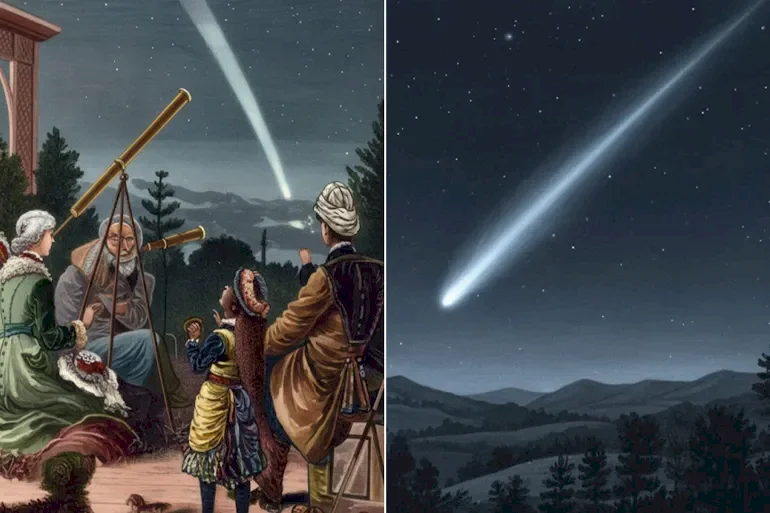
A New Comet Ignites Astronomers' Enthusiasm as They Await Its Survival from the Sun's Flames
SadaNews - Astronomers around the world are eagerly awaiting developments regarding the new comet "MAPS-C 2026" (C/2026 A1 MAPS), which is currently hurtling towards the sun on a perilous path, amidst hopes that it will transform into a striking celestial spectacle in the spring of 2026, and may even be visible to the naked eye if it survives.
The comet, discovered in January 2026 by the "Atacama Sky Monitoring System with Astronomical Cameras" (AMACS1) in the Atacama Desert in Chile, belongs to the famous Kreutz Sungrazing Comets family, a rare group known for producing some of the brightest comets in history, but it is also known that most of its members disintegrate when they approach the sun very closely.
The Survival Test Near the Sun
The comet is expected to reach its "solar perihelion" on the morning of April 4, 2026, passing at a distance of no more than 160,000 kilometers above the sun's surface, a distance considered extremely close by astronomical standards. At this point, it will face immense temperatures and tidal forces that could completely tear it apart, making its survival a matter of debate among scientists.
Some experts believe that its current dimness may signal that it will not survive after perihelion, while others think that the comet may be of medium size, which gives it a chance to pass through this critical phase, as a few Kreutz comets have done in the past.
If the comet survives its dangerous approach, it will begin to move away from the sun visibly, moving quickly across the sky, passing through March and April in areas close to the zodiac's orbit, and then later moving to higher constellations. This rapid movement will cause its position to change from night to night, adding a special allure for observers.
Will it be Visible to the Naked Eye?
The possibility exists, although it is not guaranteed. If the comet maintains its nucleus and increases in brightness after perihelion, it may appear low on the western horizon after sunset in the second week of April, and might be seen with the naked eye in a dark sky, or at least with simple binoculars.
It is worth noting that this comet carries the initials of its four discoverers: "Maury - Attard - Parrott - Signoret".
The question remains open: Will "MAPS-C 2026" become a dazzling celestial visitor, or will it silently vanish into the sun's flames? The answer will become clear in the coming weeks as it approaches the most dangerous point in its journey.
Source: Online sources
 Follow the latest Sada News via Google News
After Deschamps' Departure... Zinedine Zidane Tops the Candidates to Lead France

Mbappe Surpasses Messi and Becomes the All-Time Top Scorer in the World Cup

England Defeats France and Achieves Largest World Cup Achievement Since 1966

Messi Refused to Play for Spain and Missed 3 World Cups

Publishers Sue Google for Allegedly Using Books to Train Artificial Intelligence

Google Expands Capabilities of Google Search Console to Support Social Media Accounts

The Mediterranean Table... An Ancient Diet Revealing Its New Secrets for Health and Longev...
