

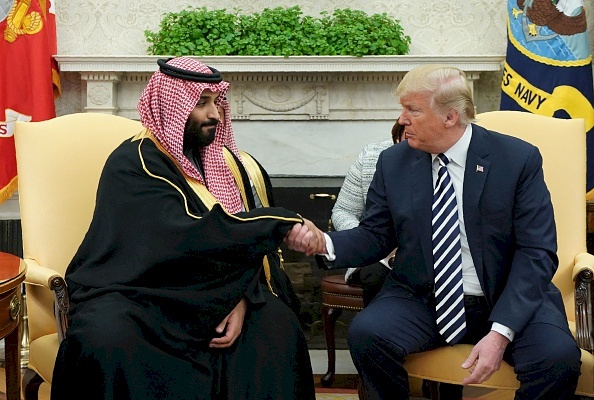
Uranium on Saudi Soil: Details of the Nuclear Agreement Between Trump and Riyadh
SadaNews: The Wall Street Journal has reported that U.S. officials say President Donald Trump has officially approved a historic civilian nuclear agreement with Saudi Arabia that spans 30 years.
In this context, two sources told Reuters that the Trump administration intends to refer a treaty to Congress in the coming days to exchange nuclear energy technology with Saudi Arabia, in a move that lacks the guarantees the U.S. claims would prevent the use of nuclear materials in weapon programs.
The two sources explained that the administration will present a document known as "Agreement 123," signed by U.S. Secretary of Energy Chris Wright and his Saudi counterpart Prince Abdulaziz bin Salman, noting that both parties had signed a preliminary agreement in Riyadh last year. So far, there has been no comment from the White House or the U.S. Department of Energy in response to requests for comment.
This agreement is based on Section 123 of the U.S. Atomic Energy Act enacted in 1954, allowing U.S. government and companies to collaborate with Saudi entities to develop a civilian nuclear industry worth billions of dollars. According to sources familiar with the agreement, it does not include the "gold standard" that would prevent the Kingdom from enriching uranium and reprocessing spent nuclear fuel, both of which could lead to the production of nuclear weapons. Additionally, the agreement does not include, according to sources who requested anonymity due to the sensitivity of the topic, the "additional protocol" that grants the United Nations International Atomic Energy Agency broader oversight powers over nuclear activities, including conducting surprise inspections at undeclared sites.
Regarding the timing of the referral, one source stated that the administration will submit the agreement to Congress today, while another source suggested it could be presented in about a week. A third source, who did not clarify whether the agreement lacks those guarantees, merely indicated that it would be referred to Congress soon. Energy Secretary Chris Wright had previously stated that the preliminary agreement does not address uranium enrichment and includes all non-proliferation standards stipulated in the U.S. Atomic Energy Act, which are among the strictest in the world. One source explained that the agreement opens a legal pathway for cooperation in the nuclear fuel cycle, including uranium enrichment, but it does not obligate the U.S. to transfer any capabilities or technologies related to it to Saudi Arabia.
As SadaNews translated, the United States expects that engaging American companies in establishing the Saudi nuclear program will allow Washington to oversee and ensure that the program does not progress toward developing military nuclear capabilities. According to the agreement, American companies will supply Saudi Arabia with new nuclear reactors and other nuclear technologies, while some foreign suppliers affiliated with these companies may play a secondary role.
Alongside the advancement of reactor projects, U.S. and Saudi officials will conduct a two-year study to assess the feasibility of uranium enrichment inside Saudi Arabia, including whether local enrichment would be economically viable compared to reliance on imported nuclear fuel. If the study concludes that local enrichment is justified, the U.S. will construct the enrichment facility under a secret arrangement known as the "Black Box," a system aimed at preventing the transfer of sensitive uranium enrichment technologies to Riyadh.
According to senior officials in the Trump administration, as translated by SadaNews, U.S. participation will prevent enriched uranium from being diverted for military purposes, as well as ensure that the reprocessing of spent nuclear fuel in reactors for use in building a nuclear bomb is not possible.
If the United States opposes proceeding with the uranium enrichment program after the study concludes, Saudi Arabia will not be allowed to carry out enrichment itself or collaborate with any other foreign partner for a period of ten years.
 Follow the latest Sada News via Google News
Friedman: 3 Leaders Driven by Hubris into Wars with No Exit

Occupation Forces Begin Demolition of Two Houses in Nahalin and Za'tara in Bethlehem

Mamdani Acknowledges: New York Does Not Have Authority to Arrest Netanyahu (Video)

Uranium on Saudi Soil: Details of the Nuclear Agreement Between Trump and Riyadh

US Army Announces Completion of the 11th Night of Strikes on Iran

Weather: Hot conditions with a slight increase in temperatures

Morocco Hosts Formative Exercise for International Stabilization Force in Gaza
