

What is the Dutch secret behind Nvidia's AI boom?
SadaNews - Nvidia has succeeded in rising to the top of global companies in terms of market value, driven by the enormous demand for its advanced chips that power the artificial intelligence revolution.
However, this remarkable success would not have seen the light of day without a lesser-known European company that is highly significant in the semiconductor industry, the Dutch "ASML".
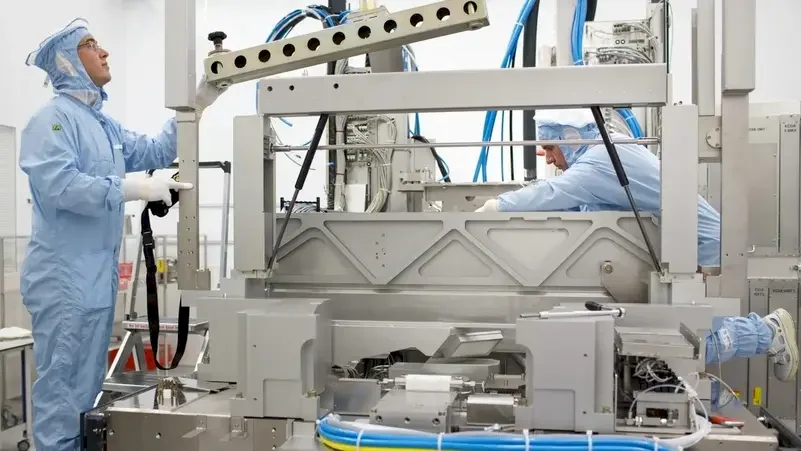
"ASML" is considered one of the most valuable technology companies in Europe, specializing in manufacturing photolithography machines used to engrave the most intricate patterns on silicon wafers, a crucial step in producing advanced electronic chips.
The Dutch company stands out as the only entity in the world that manufactures printing machines using extreme ultraviolet (EUV) technology, which is essential for producing the most advanced chips.
"ASML" dominates approximately 90% of the global photolithography market, according to a report published by CNBC, which was reviewed by Al Arabiya Business.
Market analysts believe that "ASML's" dominance is set to expand.
Didier Skima, an analyst at Bank of America, predicted that the company would become a de facto monopoly in the next generation of EUV technologies, confirming that this technology will support major technological transformations over this decade.
These expectations followed the announcement of ASML's financial results, which showed that new orders in the fourth quarter of 2025 exceeded double analysts' expectations.
Catch up with "ASML" is nearly impossible
On his part, Javier Corriñero, an equity analyst at Morningstar, stated that photolithography is the fundamental building block of any electronic chip, noting that "ASML" machines participated in manufacturing about 99% of semiconductors worldwide.
He added that EUV technologies specifically are the cornerstone of building the current and future AI architecture.
“ASML” produces two types of these machines:
Low Numerical Aperture (NA) EUV, used in manufacturing the current generation of AI chips, such as Nvidia's Blackwell chips.
High Numerical Aperture (NA) EUV, which is more advanced and is currently used in research and development laboratories to produce the next generation of chips.
These systems rely on firing powerful laser beams at drops of molten tin inside a vacuum, generating plasma that emits EUV light, which is directed through ultra-precise mirrors to engrave chip designs onto silicon wafers.
These machines are sold to chip manufacturing companies like Taiwanese "TSMC", which in turn works with chip design firms, led by "Nvidia".
Corriñero explained that competitors such as Japan's "Nikon" and "Canon" are still far from this level of development, stating that the investment and technological gap built by "ASML" over three decades makes catching up almost impossible.
Growth prospects
The company's data showed that EUV systems accounted for the largest share of the value of new orders, contributing approximately 7.4 billion euros of a total of 13.2 billion euros in the fourth quarter of 2025.
Over the year, "ASML" sold about 48 EUV systems, generating revenue of 11.6 billion euros.
Although the company does not officially disclose its machine prices, analysts estimated the price of the advanced High NA EUV system to range between 320 and 400 million euros, while the price of the Low NA EUV system is about 220 million euros.
Currently, companies like "TSMC", "Intel", and "Samsung" are experimenting with High NA EUV systems in laboratories, with expectations of entering commercial production on a large scale between 2027 and 2028, with "Intel" likely being the first adopter.
 Follow the latest Sada News via Google News
After Deschamps' Departure... Zinedine Zidane Tops the Candidates to Lead France

Mbappe Surpasses Messi and Becomes the All-Time Top Scorer in the World Cup

England Defeats France and Achieves Largest World Cup Achievement Since 1966

Messi Refused to Play for Spain and Missed 3 World Cups

Publishers Sue Google for Allegedly Using Books to Train Artificial Intelligence

Google Expands Capabilities of Google Search Console to Support Social Media Accounts

The Mediterranean Table... An Ancient Diet Revealing Its New Secrets for Health and Longev...
