

Report: Israel Acknowledges Link Between Washington's Aid and Trump’s Tariff Relief
SadaNews - The Israeli newspaper Globes reported that recent statements from the Israeli government reveal a clear acknowledgment of a direct political and commercial link between U.S. military aid and the reduction of tariffs imposed by U.S. President Donald Trump's administration, in a development that highlights the fragile negotiating position of Tel Aviv and its structural dependence on foreign support.
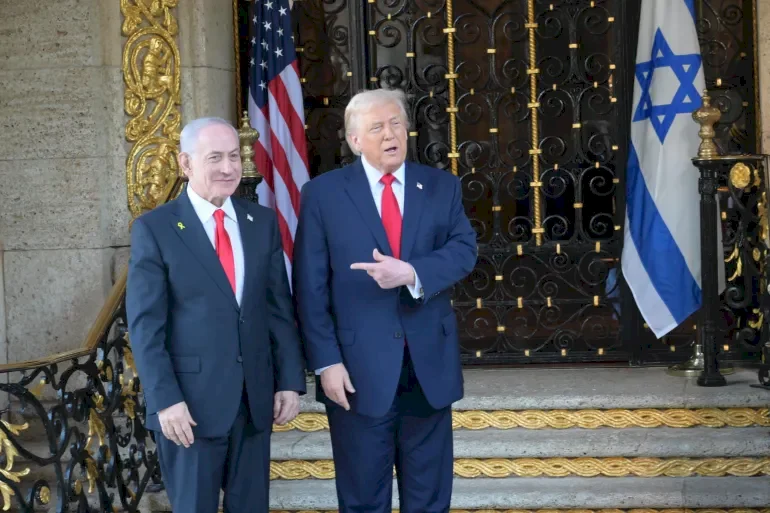
The newspaper recalls the scene that marked the turning point when Prime Minister Benjamin Netanyahu sat next to Trump at the White House last April, awaiting a response regarding tariff relief, to which the U.S. response was brief and decisively significant: "Don't forget that we give Israel billions of dollars every year." According to Globes, this was not just a passing comment, but a clear message of political and economic pressure.
From American Hint to Declared Israeli Policy
After nine months, Israel practically acknowledges what Trump hinted at, as Netanyahu announced in an interview with The Economist his desire to end U.S. military aid within a decade, a step that Globes describes as a pre-emptive attempt to ease U.S. pressure in tariff negotiations.
The newspaper quotes government sources stating that the connection between the two issues has become clear within decision-making corridors, where the U.S. side repeatedly asks one question: "What do you want, when you receive billions every year?"
That same source admits that reducing dependence on U.S. aid is used as a leverage to improve Israel's negotiating position, rather than as an independent sovereign option.
Political Discourse Hiding a Financial Gap
Globes sees that the announcement of abandoning aid primarily serves Trump’s political narrative, who seeks to minimize foreign aid, and benefits from presenting Israel as a model for an ally "willingly relinquishing billions of dollars," which strengthens the "America First" discourse without having to bear the political cost arising from reducing support.
However, the newspaper points out that this discourse fundamentally contradicts the Israeli financial reality, as discussion about abandoning approximately 120 billion shekels (around 38.15 billion dollars) in U.S. aid over a decade coincides with a government plan to inject an additional 250 billion shekels (around 79.48 billion dollars) into the defense budget during the same period.
"The Citizen Will Pay the Price"
Globes transmits explicit warnings from the Israeli Ministry of Finance, which believes that the gap resulting from losing aid cannot be bridged without imposing a direct cost on society. According to ministry estimates, an annual deficit of about 12 billion shekels (approximately 3.82 billion dollars) will be split between the military and the public budget, which means either increasing taxes or cutting civilian spending.
A source in the ministry indicates that covering just half of this deficit is equivalent to raising the value-added tax by 1%, at a time when no serious preparations have been made within the Ministry of Finance before Netanyahu's announcement, and the newspaper hints that even the finance minister may not have been previously aware of the step.
Globes confirms that the timing of Netanyahu's announcement is not isolated but comes at the height of negotiations with Washington after imposing a 15% tariff on Israeli exports, amid efforts to obtain sectoral exemptions. The newspaper points out that these negotiations go beyond trade to include broader geopolitical issues, from Iran to Gaza, with official recognition of the interconnection of these issues.
Historical Dependence
The newspaper reviews the historical background of U.S. aid, which has changed since 1985 into a fixed grant of 3 billion dollars annually, before a 2016 agreement with Barack Obama's administration solidified assistance at 3.3 billion dollars annually for armament, in addition to 500 million dollars for missile defense until 2028.
Globes concludes that the talk of abandoning aid does not reflect economic strength or strategic independence, but rather reveals increasing U.S. pressures, deep internal contradictions, and a negotiation path in which Israel is pushed to make long-term financial concessions in exchange for immediate relief in tariff costs.
 Follow the latest Sada News via Google News
Dollar Steadies Near One-Week High Amid War Developments

Trump Imposes Tariffs on Canadian Imports... Ottawa Vows to Respond

Oil Prices Drop After Reports of Mediation Efforts Between the U.S. and Iran

Gold Price Rises Supported by Increased Buying Amid Lower Prices

Due to "Hazardous and Counterfeit Products".. Europe Fines "AliExpress" $627 Million

Gasoline Prices Exceed $4 Again in America Amid Resumed War

What was the financial reward for Spain after winning the World Cup?
