

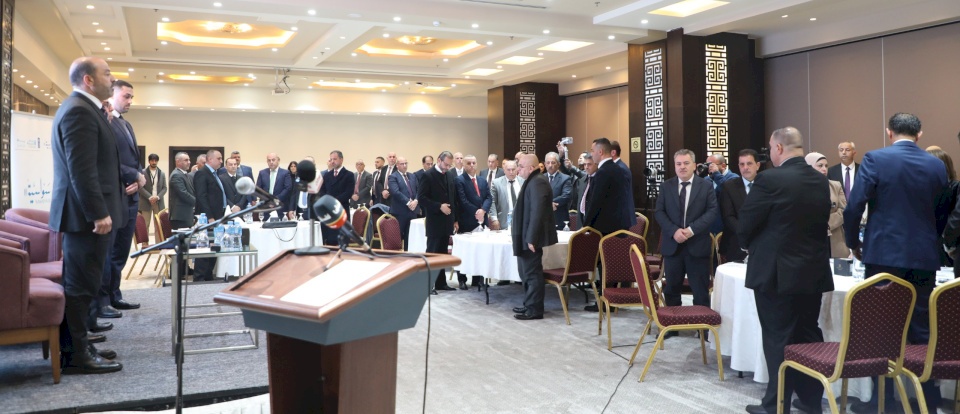
Launch of the Conference on the Integration of Judiciary and Public Prosecution in Addressing Judicial Accumulation
SadaNews - The works of the Conference on the Integration of Judiciary and Public Prosecution kicked off this morning, Saturday, in the city of Ramallah, and will continue over two days, with wide participation from judges, public prosecution members, several partner institutions, and support from the Siyas program.
The opening was attended by General Director of Police, Major General Alaa Al-Saqa, Bar Association President Fadi Abbas, General Director of the Independent Commission for Human Rights Dr. Ammar Dweik, and several representatives of international partner and supporting institutions in the justice sector.
The conference is held as part of national efforts aimed at diagnosing the reality of judicial accumulation faced by the regular courts and the public prosecution, and enhancing coordination and integration between these two institutions to contribute to improving performance efficiency and expediting case resolutions amid the exceptional political and security circumstances faced by the State of Palestine.
The conference began with a speech by His Excellency the President of the Supreme Judiciary Council, Honorable Judge Mohammed Abdul Ghani Al-Awawy, who emphasized that the continuity of judicial facilities' work over the past years is the result of integration and institutional cooperation between the judiciary and the public prosecution. He stressed that the protection of justice and the safeguarding of citizens' rights is a shared national responsibility that cannot be fragmented, and that this conference represents an important station to discuss practical challenges and develop judicial work mechanisms in a way that enhances public trust in the justice system.
In this context, he reviewed the judicial performance indicators for this year, noting that the number of criminal cases pending before the courts reached 47,743 cases, while a total of 59,384 cases were registered during the year 2025, reflecting a 23.3% increase compared to 2024.
Conversely, the courts resolved 57,020 cases during the same year, achieving an improvement rate of approximately 32% compared to the previous year, which reflects an increase in judicial resolution efficiency despite the notable rise in the number of incoming cases.
For his part, the Public Prosecutor, Counselor Akram Al-Khatib, delivered a speech addressing the reality of judicial accumulation as a direct reflection of occupation challenges, jurisdiction restrictions, and fragmented geography. He emphasized that these challenges require the unification of vision, regulation of procedures, and expedited case resolution, based on the principle that the judge and public prosecutor share joint responsibility in managing lawsuits and achieving timely justice, committed to the same standards of accuracy, discipline, and neutrality.
The Public Prosecutor also highlighted the importance of digital transformation as a mandatory tool for case management, in addition to the need for institutional readiness to manage justice in emergencies to ensure the continuity of rights and unify procedures.
The opening session included a speech by Omar Al-Asouli, Deputy Executive Director of the Siyas Program, who affirmed the program's continued support for the justice sector and strengthening partnerships with judicial institutions to contribute to building a more efficient and resilient justice system, despite the challenges that increase year after year, and that the program will continue to support the plans of the Supreme Judiciary Council and the plans of the public prosecution.
Following the opening, the first day's sessions commenced, focusing on presenting the reality of judicial accumulation in regular courts and the public prosecution, and discussing procedural challenges through joint working groups including judges and prosecution members from various governorates. The conference will continue on its second day with discussions on digital transformation themes in the work of judicial inspection departments, building judicial capacities, juvenile justice, human rights, violence against women, and managing justice in emergencies, leading to the formulation of practical and actionable outputs and recommendations.
 Follow the latest Sada News via Google News
Al-Sharqawi from Geneva: Protecting the special status of Jerusalem requires greater coord...

Lt. General Al-Natsha Undergoes Lengthy Interrogation at Moskobiya Regarding His Represent...

The Occupation Demolishes a House in the Town of Sa'ir near Hebron

Sheikh Offers Condolences for the Martyrdom of Citizens in Deir Jareer

Ministry of Labor Calls for Registration in Licensed Private Vocational Training Centers a...

Occupation Forces Storm the Home of Major General Bilal Al-Natsheh in Jerusalem

The Working Group on Palestine of the Permanent Independent Human Rights Commission Issues...
