

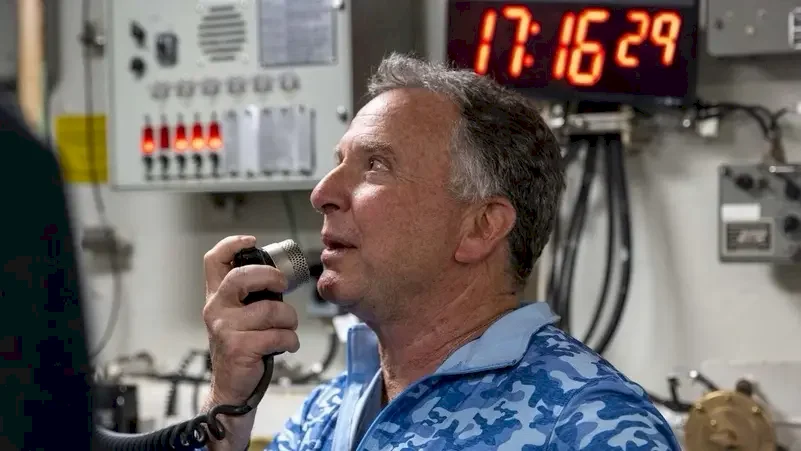
Whitckoff from the USS Lincoln: We Support Peace Through Strength
SadaNews - American envoys Steve Whitckoff and Jared Kushner visited the USS Abraham Lincoln aircraft carrier stationed in the Arabian Sea near Iran.
Whitckoff stated that everyone supports Trump’s message advocating for peace through strength, noting that he listened to the soldier who shot down an Iranian drone.
Whitckoff stressed that America defends its interests, deters its adversaries, and demonstrates to the world America’s readiness and determination, always on high alert.
Meanwhile, Iranian Foreign Minister Abbas Araghchi expressed hope for a swift resumption of negotiations with the United States on Saturday, while warning that his country is prepared to strike American bases in the region if it comes under attack.
Indirect negotiations took place Friday between Washington and Tehran in Muscat, marking the first such talks since the United States launched strikes on key nuclear sites during a 12-day war initiated by Israel against Iran in June.
After the round of negotiations, President Donald Trump praised the talks as "very good," while Araghchi spoke of a "very positive atmosphere."
Trump announced on Friday that both parties would meet again "early next week."
Araghchi led his country’s delegation, while the American delegation was headed by Steve Whitckoff, Trump’s envoy to the Middle East, along with the President’s son-in-law Jared Kushner.
"Handshake"
Araghchi confirmed that the talks were "indirect," while also pointing out that "an opportunity arose for handshakes with the American delegation."
Axios reported on Friday, citing two sources, that direct discussions occurred between Araghchi and Whitckoff and Kushner.
The Iranian foreign minister felt that "the road is still long to build trust," adding that "the Iranian nuclear issue can only be resolved through negotiations."
He stated, "We are ready for an agreement that provides reassurance regarding uranium enrichment by lowering its rate."
Western countries and Israel accuse Iran of seeking to acquire nuclear weapons, a claim Tehran denies while asserting its right to possess civilian nuclear technology.
Before the war with Israel, Iran was enriching uranium at a rate of 60%, according to the International Atomic Energy Agency, which is close to the threshold needed for making nuclear weapons.
Trump has repeatedly called for a complete ban on uranium enrichment, but Araghchi reiterated that "enrichment is an inalienable right that must continue."
He also said that Tehran "opposes transferring uranium abroad," a option raised multiple times in previous talks.
The Muscat talks came in the wake of U.S. threats to carry out a military strike against Iran, initiated against the backdrop of the crackdown on widespread protests in the country that resulted in thousands of deaths.
While the United States deployed the USS Abraham Lincoln and its strike group to the region, Araghchi renewed the warning that his country would target U.S. bases if an attack were made on Iranian territory.
"Doctrine of Hegemony"
Additionally, the Iranian foreign minister reiterated that his country refuses to discuss its ballistic missile program, saying, "This is purely a defensive matter for us, and it cannot be negotiated at all."
He noted on Friday that "the discussions are focused exclusively on the nuclear file," while Washington insists that it must also address ballistic missiles and Iran’s support for armed groups in the region.
Reports indicated that Israel pressured to include these two items on the negotiation agenda.
In a speech to the Al Jazeera Forum in Qatar on Saturday, the Iranian foreign minister attacked Israel, condemning the "doctrine of hegemony" that allows it, according to him, to expand its military arsenal while pressuring other countries in the region to disarm.
He stated, "Israel’s expansionist project requires weakening neighboring countries, militarily, technologically, economically, and socially."
On June 13, Israel launched an unprecedented war against Iran, targeting nuclear and military sites, as well as civilian locations, resulting in the deaths of more than a thousand people, including nuclear scientists and military leaders.
The United States participated by striking nuclear facilities. Trump stated at the time that these strikes "destroyed" Iran’s nuclear capabilities, but the extent of the damage remains unknown.
As part of the "maximum pressure campaign" being waged by the United States against Tehran, the U.S. State Department announced shortly after the conclusion of the negotiations on Friday new sanctions on Iran’s oil sector, affecting 15 entities, two individuals, and 14 vessels.
At the same time, Trump signed an executive order that took effect on Saturday, imposing additional tariffs on countries that continue to trade with Iran.
These tariffs will affect trade with several countries, including Russia, Germany, Turkey, and the United Arab Emirates.
According to data from the World Trade Organization, more than a quarter of Iran’s trade activity in 2024 was with China.
 Follow the latest Sada News via Google News
12 Martyrs in Gaza Strip since Dawn Today

A Series of Important Decisions Taken.. The Cabinet Discusses Developments in the Deterior...

Organizations of the Temple Prepare for the Largest Raid on Al-Aqsa on What is Called the...

Smotrich: Israel Has No Interest in Joining the War Against Iran

Occupation Issues Military Order to Seize 5 Dunams of Land in Jaba'

Axios: Proposal for a 10-day Ceasefire Between Washington and Tehran and Two Options for M...

In a Rapid Pace.. The Occupation Builds a Huge Earth Barrier Inside Gaza
